Showing posts with label Learn. Show all posts

Wednesday, 7 May 2025

Inquiry focus for 2025

 Core Learning Area: Literacy

Focus Group: The group of students I am focussing on this year are Year 5-8 students who have been assessed as being strong academically in their year group, however who are behind their expected level in reading and/or writing.

Evidence:


You can see from this data that there are a high proportion of these students working below their expected year level in Reading or Writing in Year 5, 6 7 and 8.

Observations and Initial Questions:

From this group of students, there are some students who are extremely capable with using their reading and writing capabilities to access the curriculum and share their learning. There are also students in both classes who find the learning more challenging, either because they find it difficult to ‘read to learn’ or they find it difficult to share their learning or express their thoughts through writing.

For every child in this group that has a lower than expected reading age, their PAT Reading and/or Vocabulary levels were a lot stronger. Why is this? Is the issue with how these students are testing?

Does lack of ability to complete their work and manage their time have a correlation to reading or writing level?

Does reading and/or writing level have a correlation with language acquisition or oral language capabilities?

How I might verify this defined problem:

  • Performance in most current testing
  • Observations of classroom behaviours
  • Language Acquisition
Draft Inquiry Focus:

How can I support students in Year 5 to 8 who have been tracked as being strong academically compared to their year-level peers, however who are working ‘below’ expectations for literacy levels (reading &/or writing).

Possible Research/ Resources:

Sheena Cameron Reading and Writing books
Literacy Learning Progressions
Revised English Curriculum Progressions
Research looking into the correlation of input (reading/listening) and output (writing/ speaking)

Possible Strategies:

  • Think-Peer-Share. Pairing children up so they are working with a peer who is stronger in that area.
  • Converstaion Starters/ Sentence Starter prompts
  • Shorter activities which really focus in on building individual student needs (e.g. challenged more with input or output)
Next Steps:

  • Provocations
  • Integrated projects
  • 1:1 readings or writing with individuals who need more support (including extra activities targeted at individual needs)
  • Strong focus on reading and writing in extension classes.

Friday, 5 May 2023

Formulating a Hypothesis


This week in our Kāhui Ako meeting, we discussed formulation of hypotheses. I have chosen to summarise my hunches, as well as research that has supported these hunches and feedback from my Kāhui Ako colleagues. I believe that my hunches are still too broad and more work needs to be done to narrow down my focus to something which is going to be measurable. 

Friday, 3 March 2023

Creating surveys to start painting a picture of the challenge school-wide

 While Clarelle and Danni have been gathering data from the students in their classrooms, I started creating some surveys to be sent out to Senior management, Teachers and Students from across our school. The three of us then sat down to add some more questions, make a few tweaks, simplify the surveys and then send them off. Our focus was to find out what our colleagues own views are around challenges in maths for their own students as well as their own teaching. 

Here are the surveys that we created.

Student Survey:


Teacher survey:


Senior Management Survey:

Thursday, 12 January 2023

Where to for next year?

 In 2022, I inquired into developing confidence using videography roles within the Pt England Network News programme. There were some great things I learned through this inquiry, particularly the value roles like videographers can provide to develop confidence in some children. Going forward into 2023, I want to continue to utilise roles within the Pt England Network News programme to develop confidence in children. I will continue to think about what the role of videographers may look like and add in more opportunities for children to do movie editing. I will work through challenges. One of the big things that played on my mind during 2022 was that I was very conscious not to have the same children out of class too often to video at sports tournaments as, even though there is huge value in leadership, creativity, problem solving and making decisions when out as videographers, I didn't want their role as videographers to hinder their progress in classroom subjects.

Next year, as I continue as a within school Kāhui Ako teacher, I want to look into a very different challenge. I want to use learning opportunities provided in the creative space to look at developing persistence and success in children who find focus and success a regular challenge in their schooling. How this looks, I will spend some time developing over the first term of 2023, so watch this space!

Tuesday, 22 November 2022

Thinking ahead to my possible inquiry for 2023

Below are some thoughts about where my inquiry may go next year.

What achievement challenge are you considering as an area of focus in 2023 and why? Include in your WHY both evidence and your own passion/expertise

Improve the achievement of students with additional needs in the learning areas of English/key competency using language symbols and texts


I am in a unique role where I get to see children from right across the school. I want to put more energy into creating some progressions and variations to the Creative Space programme to account for children with additional needs so they can all achieve in some way.


This is something which I have observed by giving variation in tasks throughout the year, however what do I do when there is a child who refuses to take part?


  • Survey to find out why they aren’t taking part.

  • Ask what they want to be doing?

  • What could I do to help them achieve?

  • What would an engaging task look like for them?


What learnings from the 2017 - 2022 CoL teacher inquiries have informed or inspired your thinking.


This year there were many CoL inquiries into engagement and enjoyment: Robyn Anderson and Kelsey Parrant looked at this for reading. Christine Tupou-Fonua looked into student and teacher wellbeing and how that influenced achievement, enjoyment and engagement.


I want the children to come to my space and feel that excitement, enjoyment and as a result, achievement - but how do I achieve this for the children who find it more difficult to focus?


How would your work support Manaiakalani pedagogy and kaupapa?


Learn-Create-Share

Transferrable Creative tasks which can also be done in the classroom - ubiquitous

Engagement of children through the create

Transferrable skills

Making strong and replicable progressions for different learning experiences where teachers can challenge children, pull back if it’s too much or look at alternatives if it’s not engaging some children.


Which elements of the extensive Manaiakalani research findings inform or challenge you as you think about this?


2017 research into the main teaching activity observed: conference, instructional, learning model, behaviour/management, q&a or roving.


Developing in Digital Worlds: 3 21st century skills in a digital environment - cognitive, interpersonal, intrapersonal. The benefits of a digital environment in teaching key comps for children. 

I could rate children on key comps at the start of the year compared to the end of the year.


How would you like to be supported in 2023 as you undertake this inquiry?


Regular release so I have guaranteed, regular time to work on my inquiry. This is really important as I don’t have the children constantly in front of me as classroom teachers do.

Collaboration between myself and classroom teachers to support the target group of children.


How would you plan to support your colleagues in your school with THEIR inquiries and/or teaching in the area you are exploring?


Creative activities which can be used in the classroom to support the children with additional needs.

Support of children in the key competencies to lead to the feeling of success for these children.


Monday, 19 September 2022

What does Enthusiasm tell us?

 Over the last couple of weeks, I have had two videographers from my target group of students who have shown interest in being the videographer at in-school events. In these situations, they have been the ones who have suggested being the videographers. This sign of enthusiasm tells me a lot about the mindset of these students, how they feel valued and confident in themselves and that being a videographer is something they are good at and can lead in.

This anecdotal evidence is hugely valuable to see the success in using videography as a way of developing confidence in some children.


In an article on the Western Weekender, an opinion piece (Confidence and enthusiasm) talks about the importance of enthusiasm and confidence in a business environment. I think the same can be said in education. In the article, it states that "being enthusiastic in what you do breeds confidence." This article also makes an interesting point about confidence. It explains how people feel reassured by people who are confident which in turn leads to greater trust. I would add an extra element to this which is that this could be seen as a never ending cycle as feeling trusted by others can also help your confidence to grow. 

Monday, 13 June 2022

Stopping, Reflecting and Refocussing my Inquiry

 Today I continued looking into research but realised I was still uncertain about what I was actually trying to achieve. I stopped and reflected on who my target group are. The target group are children who showed low confidence in terms of speaking, presenting and sharing ideas. Understandably, I have gone down the path of oral language and what makes a good 'speaker' however when considering the big picture, I don't believe I am going to get good results if this is my focus with this group of target learners. I first need to support development of their confidence before I even consider supporting them to become better speakers. 

During a Kāhui Ako meeting at the beginning of this term, Across School Teacher Amy Tofa, suggested using Tuaka Teina to develop children's confidence. I am in a unique position where I have children ranging from year 5 up to year 8 who are all experienced and skilled in Presenting, Videography and Video Editing. I also have children who could benefit from being paired up with a supportive, patient and experienced student who can support my target learners in developing  their confidence through various roles in the production of our school news.

This week, I plan to introduce these Tuakana-Teina partnerships.

How this will look: 

1. Presenters. Any children who have been paired to develop a potential presenter will attend our news filming at 8am on Monday through to Thursday. They can being by practising the same script as the Tuakana and as buddies, will decide when the Teina is ready to present. They can use tools such as quicktime to develop the confidence of the Teina, even if they don't yet have the confidence to present in the actual news. 

2. Videographers. Each Tuakana will support a Teina by taking them along to sporting events and other school events to film together.

3. Video Editing. Each Teina will work with Tuakana to edit footage from sporting events, student movies from around the school that have been filmed by Videographers. This could be the same children who were the videographers.

Assessing speech

 To assess children's speech, I need to create a rubric. I researched ways that people have previously used rubrics to measure speech.

Fountas & Pinnell's (2010) Six Dimensions Fluency Rubric

This rubric can be used to measure:

  • Pausing
  • Phrasing
  • Stress
  • Intonation
  • Rate/pace
  • Integration
This article clearly explains these six dimensions.

Fluency Rubric. This includes:
  • Expression & Volume
  • Phrasing (also in Fountas & Pinnell's rubric)
  • Smoothness
  • Pace (also in Fountas & Pinnell's rubric)
Morrison & Wilcox (2020). Assessing Expressive Oral Reading Fluency.
  • Rubric with same focus points as the fluency rubric above.
  • Expressive oral language has been seen as important for a long time. In American education, many children read from the bible and there was an expectation that they read fluently.
  • Early 1900s: a push for silent reading over oral reading, with valid justification for this, oral reading became less expressive.
  • Report of the National Reading Panel (2000): 3 aspects of fluent oral reading: rate, accuracy, expression. 
  • Prosody: How one reads with expression (not just the superficial features of consonant and vowel sounds).
  • Prosody <---> Comprehension (Schwanenflugel and Kuhn)
  • Automated measuring tool: Praat (2001) by Paul Boersma and David Weenink
  • Multidimensional fluency scale (MDFS). Zutell and Rasinski - Found to create reliable and valid scores.
  • This article recommends that human scored assessment tools are more effective than computerised tools as more is picked up via observation in terms of oral reading aspects. It is important for the human assessment tool that the rater/scorer is consistent otherwise reliability and validity reduces. 
From this, I put together a rubric which combines categories from all the above. I will share this in my next blog post.

Monday, 9 May 2022

Preliminary Data

 I have begun gathering some preliminary data for my target group of children. These children were selected due to being at the 'reading to learn' phase of their reading development. I have selected children whose reading ages are at 9 years and above as these children will be required to read from a script which changes on a daily basis.

Using my knowledge of these children as well as asking for teacher recommendations, I have selected a group of children who are noted as lacking some confidence or oral language capabilities, despite their confidence in reading and writing. These children are also children who show potential in developing their confidence. This information was found through anecdotal notes from previous teachers, conversations with teachers as well as my own knowledge of these children.

I asked these children to fill in a questionnaire about their own confidence and communication abilities.

I colour coordinated responses from this survey to create a picture of self confidence.

Example 1:


Response 1 = Red
Response 2 = Red
Response 3 = Orange
Response 4 = Green
Response 5 = Green

Example 2:

Response 1 = Green
Response 2 = Green
Response 3 = Orange
Response 4 = Red
Response 5 = Red

From this survey, I have created a target group of students. Students in the target group are children who scored orange and red across a number of their responses.

Their responses sat alongside the responses of a group of children who demonstrate strong confidence, oral language and communication. These children will not be in my target group as they always have strong self confidence. This will be some of my baseline data which will be compared at the end of the year.

Once I have found all children in my target group, I will use a standardised self efficacy test to which will be used to compare the responses of individuals in this target from the beginning to the end of the year.

Monday, 21 March 2022

Te Ahu o te Reo Māori with Takatū

I am SO excited to be participating in Te Ahu o te Reo Māori this year! I had the introductory zoom session on Sunday morning and was buzzing about the course at the end of it.


The course with Takatū is broken up into 7 levels. I am going to be entering into the course at the Tumu level. I really liked this illustration which explains the levels and the philosophy behind the course. 


Example of using movie as a medium to create meaningful learning experiences for children

At the beginning of the year, I sent an email out to our teachers at Pt England School. A large element of the Pt England Network News is sharing learning from across the school. During lockdown last year, it was challenging to expect each teacher in the school to do this. I would sift through the children's blogs to find great learning examples and share these daily on the news. Now we are back at school, it is important that I place that responsibility back onto the teachers so that each class and the tauira in that class have their learning showcased in some way. 

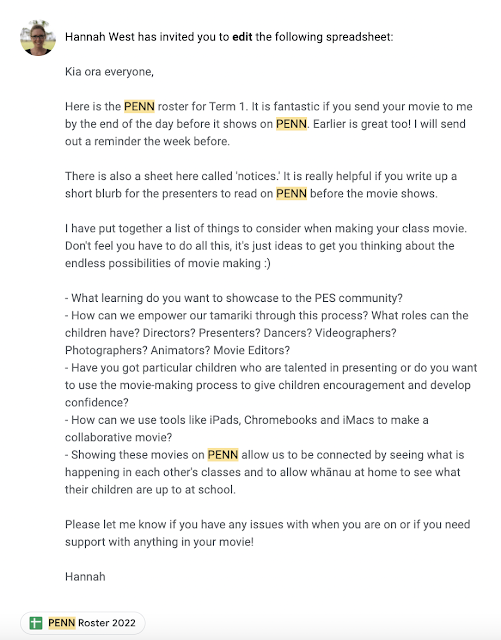
Here is the email I sent out to the teachers to encourage this:


In the email, I created a list of suggestions to teachers to support them in making movies which are meaningful for our tauira. 

Last week, I came across a wonderful example of a teacher who used these suggestions to make an awesome movie! Heidi Davis is a third year teacher who teaches year 2 and 3 children. Heidi looked over the list I had sent and wanted to use her term 1 PENN movie to create a meaningful learning experience which would challenge and excite her learners.

In her movie, she had one of her year 3 children read the script. You can hear the confidence, fluency and clarity as he reads. What a fantastic, engaging, REAL learning experience for this child! Other children showcased their learning through the term. Heidi included her children and they were highly aware of the purpose as they created the movie together. Heidi said that the children were so excited to see the finished product! The anticipation of waiting now until it shows on PENN is engaging and will create a fantastic intrinsic reward for the children too! 

Here is Heidi's movie:


This is such a great example of what I hope to see more of through my inquiry this year. I want to see more movie making happening across the school which engages children, creates real learning experiences and gives children a purpose in their learning. I want to be able to watch movies like Heidi's class movie and be able to see the learning that the children have had through the experience of making the movies.

Having taught in the classroom, I do understand and appreciate the time that is required to do this well. Therefore, part of my role will be to support teachers in making this happen. 

Monday, 7 March 2022

Developing confidence, communication & oral language through film

Producing the Pt England Network News (PENN) for the school has started off with a bang this year! We have got some fantastic new equipment to improve the quality of the product we create at school. I have also already started seeing the potential that using film at school has on learning for the children, particularly confidence, communication and oral language.

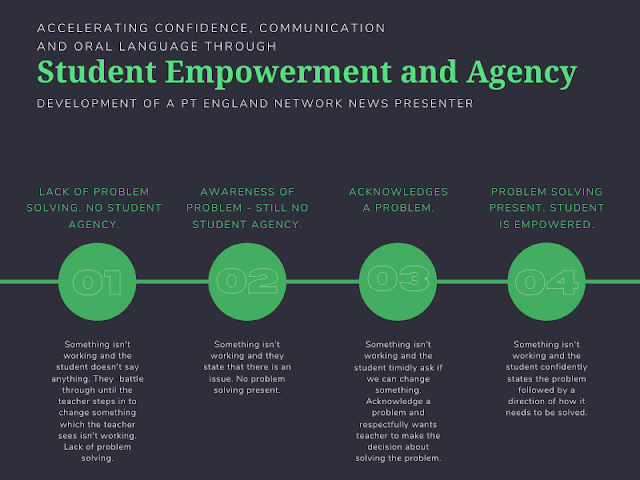
There is an understanding amongst my PENN crew that we are a team. I am at the same level as them in the team. This is the first step I use to create confidence amongst the children and it sometimes takes some time for the children to get to the point where they realise they can tell me what to do, rather than ask. An example of this is if the sun is in their eyes when filming. Rather than ask to move, the understanding is that the children can tell me that we need to move. When the script is scrolling too fast, the understanding is that the children tell me that it needs to be slowed down, rather than ask for it to be slowed down. 

The pattern I often see with new children is this:

On Thursday last week, one of my presenters said that they wanted to develop the weather section of the news to provide more important information. In particular, adding in UV levels and fire risk. We decided that having a UV level included was important for the audience to know about.

On Saturday, I received this email:

Yes, emailing you on the weekends is probably the wrong time but I want to add the UV level part. It's to tell whether you need to stay protected from the sun, or if it's ok and you won't get a sunburn.

Thanks if you want to add it.

Here is some of the email thread we had. My emails are in red, where the student's are in blue.

Hi _________,

I have taken the fire danger level out but thought we could include the tide times and water temperature at Pt England Beach. What do you think? Keeping the UV level in is great!

Miss West

YAY to UV level! I thought I was going to add that but I think that it was too much information. So that means that:

Tomorrow's weather, UV level, tide times (maybe for after school so they can play at the beach after school) and water tempo is going to be added for weather. And inquiry is the easiest one. For now...

That's it. Let's see what we think and decide if we want to remove anything this morning.

Ok, let's do more detail person to person in like 10 minutes

I was so impressed when this student re-voiced our conversation in writing, creating a great summary of what we had discussed (see above in blue). This is a great example of me working alongside a child at their level, encouraging them to solve the problems with confidence.

Here is the finished product of the weather segment this morning after the email stream (go to 6m36s).

Monday, 28 February 2022

How can we provide opportunities for the PENN crew outside of 'normal school'

Providing real life, authentic learning experiences has long been seen as valuable for children. It provides a strong purpose for the children. PENN has always had this but has become more so as it is shared on an online platform which whānau and the wider community can view. This has become even more important over the last few years, with children learning from home. 

A quote from one teacher, describing the importance of PENN during lockdown in 2021: "A constant presence on the daily to help us keep some of the normal going."

Our first opportunity for members of the PENN crew to create a purpose beyond the walls of school will happen this week. We are going to be filming a virtual visit to our school as part of a collaboration with the Digital Council for Aotearoa. This experience will provide opportunities for several videographers as well as several presenters who will provide the voice overs, commentary, lead an interview and will 'host' the virtual visitors.

The finished product will be able to be used by the digital council as well as by us for visitors to our website.

Going forward, I will need to consider how we can provide more of these opportunities to our children, particularly since one of our major external opportunities - sporting events - is not happening much at the moment.

Some opportunities which will lend itself to this:

- Te Oro - Baby Whale Tale on display
- Blake NZ-VR experience - could we get our children to organise a 'documentary style' short film which they could then utilise?
- Some community-focussed documentary style short films to learn about the amazing things happening in our community - Kereru Kidney Centre, Te Oro, Rocket Lab, Kai Collective Project, Ruapotaka Marae, Tāmaki Regeneration.
- Meet some heroes in our community - interview of local doctors, nurses, police, supermarket workers, Marsic Bros etc.

These could be fully created by the children - from videography through to post production.

Now, I know this is ambitious especially with the fact we can't even take children out into the community at the moment, but I strongly believe this would be the next step in developing the Pt England Network News to the next level. I am sure with a team behind me, we can make this happen!

Good inquiry happens in teams

At our Kāhui Ako meeting, we discussed the importance about inquiry happening in teams to make them effective and successful. I thought it would be useful to think about who my team will be.

So far, I am thinking about inquiring into my role as leading the PENN (Pt England Network News) programme and how this programme can be used to support confidence in children's oral language capabilities. 

So...who would be in my 'team' ?

Russell's inquiry into having "present, happy, healthy, engaged tauira who are learning in the goldilocks zone" definitely fits nicely with my inquiry. There are many opportunities for children to get excited about through the PENN programme. These include presenting, being a videographer or photographer and movie editor. 

The teachers of Team 4 and 5 are very much important in my 'team' as they are the ones who teach these children on a day-to-day basis. In the environment of living in a pandemic, having these teachers on my team is important to ensure the day-to-day running of the news, even if the children or myself have to be isolating at home. It will be important to consider how we will continue to have the news running if and/or when these scenarios arise. Regular conversations with these teachers will be important to decide on these children who would benefit greatly from the opportunities of the news as well as seeing progress of these children in their confidence and oral language.

In this inquiry, it is going to be important to have an 'innovation team' as well. This could begin through my 'Team 6' colleagues as well as the enablers group. These people will be important to bring new ideas to fruition to change up the news and provide more opportunities to develop confidence and oral language.

My Kāhui Ako teachers will also be extremely valuable. Through looking at my colleague's blogs I will find those teachers whose inquiries match with mine and which could benefit from each others findings.

Wednesday, 23 February 2022

Kāhui Ako: First meeting of the year

Last Thursday we had our first Kāhui Ako meeting of the year. Russell and Chris challenged us to rethink our inquiries for the year, pondering what is realistic and important in the world we are currently living in. Russell gave a personal example with his own inquiry, "How do we reliably get a 'threefer' - three core subjects accelerating simultaneously, 3 years in a row?" Realising this was no longer a realistic expectation with so much disruption to school, he has considered changing his inquiry to, "How do I have present, happy, healthy, engaged tauira who are learning in the goldilocks zone." Russell then discussed the fine balance between social connection/ building relationships and risk mitigation/ public health goals. These two things are so important at the moment however class terribly in terms of giving them both 100%! So how do we do it?

Russell's korero got me thinking about what I can be doing for our tauira to ensure they are coming to school engaged and happy, and to continue to build their confidence - something my programme lends itself beautifully to. 

My role is divided between teaching in the Creative Space, teaching the Extension classes and teaching children through the daily production of the Pt England Network News (PENN). All of these programmes are things that already engage and excite our children. So how can I develop these programmes deeper, to better develop the confidence and key competencies of our children?

Going through lockdown last year made me realise that the children I connect with the most on a daily basis whether I am at school or at home, and therefore can have the largest impact on in this world where we have to be so flexible and resilient, is my PENN crew. During the long 2021 lockdown, I was in daily email contact with these children to ensure the news was created and online each day. This real experience in itself created a huge amount of motivation for the children involved.

Since we have returned to school, a group of keen presenters come to school early to film for the day's news. The motivation is there. So what can I do to further benefit children in our school? In particular, which children would benefit the most from participating?

Since I know I already run creative-based programmes which provide a high level of motivation for the children involved, I now need to consider how I can support children who need to develop confidence through presenting, videography and photography, and editing. 

Thursday, 18 November 2021

Bursts in Bubbles 2021

During the Manaiakalani Kāhui Ako Bursts and in Bubbles event this afternoon, I took summary notes about the inquiries I felt I could utilise in my own current practice and incorporate with my own findings in my inquiry.


Anita Unka (Y1-2): How can I use feedback and feedforward in writing to build relationships with whānau, enabling greater shifts in student achievement for our tāmariki?

Gaps in oral language, limited vocabulary --> limited ideas when writing.
Writing flexi-connects - whānau on other end in a meet while teacher and child at school.
Through lockdown, the flexi-connects changed where the child was with their parent and Anita was on the other end of the call.

Poto Faalili (Y7&8): How will being culturally responsive in my teaching and an integrated approach to teaching and learning accelerate student achievement?

Engaging boys, particularly those that turn up to school late.
Student voice via talanoa.
Priority to see this group every morning at 8:30am. Changed to lunch with lunches. Well-being was important in this as well as talanoa about learning.

Amy Tofa (Y7&8): Will building self efficacy in students enable them to be more independent in Project Based Learning and accelerate their progress in Reading? 

Lack of self efficacy for completing project-based learning.
Lack of confidence.
Frank Paris to build self efficacy.
High anxiety impacts self efficacy.

Christine Tupou-Fonua (Y7&8): Can we make accelerated shifts in literacy through teaching identity & cultural competencies?

Coconut Model Work (see her blog)

Clarelle Carruthers (Y4): How will using a variety of high interest texts and providing open tasks impact students critical thinking?

Critical thinking and vocabulary.
Frustration by children was a big issue.
Whole class theme for reading each week to encourage more collaboration and vocabulary development.
For true critical learning to happen, the children need to be doing the work - remove the scaffolds.

Kelsey Parrant (Y5): Will a focus on vocabulary and interest specific texts have an impact on reading achievement for my learners reading below 8 years? 

Lack of understanding or strategies to understand meaning of vocabulary when reading.

Robyn Anderson (Y7&8): Will a focus on oral language in maths accelerate student confidence and capability to use spoken and written maths vocabulary and language?

Oral language and maths
Stepping in with scaffolds too early as the teacher wasn't helpful.
Robyn also developed some speaking prompts to support the children in learning to talk.
Giving children time to talk was essential.

Aimee Litchfield (Y1&2): How can I develop the use of oral language and use a wider range of vocabulary to see acceleration across all curriculum areas?

Unable to express themselves with more than one word.
Daily picture prompts.
Increase in vocabulary.
Next steps - to develop fluency.
Strongly implement learning in oral language through to writing.

Wednesday, 29 September 2021

Lockdown: August - September 2021

We have spent most of this last term in lockdown due to Covid-19. During my time working from home, I have been responsible for the continuation of PENN, our Pt England Network News. I have been really fortunate to have an amazing team of children working with me to make this happen. Daily email correspondence with the children has been essential. Rather than me selecting which children are going to present each day, I have made it the responsibility of the children to commit by putting their name down to present each day. This has been really successful and there have only been a few occasions when I've had to follow up on children who have forgotten or find replacements when I can't get hold of someone.

Here is an example of the finished product:

You can see that another big part of my job from home has been to put together examples of learning that have been happening at home during lockdown. It has been great to share so much on PENN each day and to document this time in our lives! As well as looking through many children's blogs myself, I have received regular emails from some teachers with children's work they want me to share but I have also received emails from children who are proud of something they have done and want some of their learning shared. Celebration of this has been a huge part of what I have been working on from home. 

In addition to producing the news each day, I have taken my year 5 & 6 and year 7 & 8 extension classes weekly and have run Creative Space meets each week for Team 4 (year 5 & 6) and for Team 3 (year 3 & 4). On Fridays, I have run an elective class for Team 5 (year 7 & 8).

Year 7 & 8 Controversial Topic Brainstorm: Which country should some Olympic athletes compete for? Click on the link to see the children's work for one of our google meets.


I have developed a number of lessons to support children to be Creative in their learning at home:


This activity was designed for year 3 & 4 children working on Scratch. Here are some examples of children who completed the challenges from this lesson:

Hunter

Jackson

For Māori Language week, I ran a Scratch session on creating a digital pepeha/mihi. I ran this with both Team 3 and Team 4. This was a model I provided to the children for this activity:


The week after this, with the Team 3 children, I introduced the extensions that came on Scratch. Some of the children who had been doing lots of Scratch from home were really interested in this. Here is a project which Jaxon made to show how he can make his sprites draw in Scratch.

With Team 2 (year 2 children), I took google meets for each of the classes where I taught them how to do Stop Motion Animation. 


I created this 'How to' Video to support the children (and teachers) in a rewindable way:


Here are some of the fantastic finished products by children in year 2 and 3:


Tomorrow I will run this session with Team 1 (year 1 children). I will also run it with Team 3 (year 3s and 4s) and will include support to children on chrome books to teach them how they can do Stop Motion in google slides.

Thursday, 5 August 2021

Restating my Inquiry Question and Chain of Events

We are now half way through the year. In this post, I am going to restate my inquiry question to ensure I am still on track with my inquiry focus this year.

Inquiry Question: How can I change my teaching to support oral language progression towards the level of language which children can comprehend when reading?

Inquiry Goals: To improve oral language.

To reduce the disparity between the level of oral language and vocabulary used and the level of language and vocabulary they can read and recognise in written texts. To increase confidence when speaking and presenting.

Challenge: There is a disparity between the level of oral language and vocabulary which the year 5-6 extension children use and the level of language and vocabulary they can read and recognise in written texts.

Hypothesis: Giving children many opportunities to speak in front of each other (through sharing and presenting their ideas and learning within a small and a larger group), with the support of prompts and scaffolds will improve their confidence to speak and therefore improve their use of oral language.


Thursday, 3 June 2021

Plan for Baseline Line vs End of Year Data Comparison

I have collected baseline data from a number of sources which I will be able to compare with data which I will collect at the end of the year. I have and will continue to use this data to build a profile of student learning in terms of oral language and vocabulary. This diagram plans out how these comparisons will be made:

Thursday, 13 May 2021

Collaborative Inquiry Group

Today at staff meeting we met in three groups:

- Those with a focus group of children who learning to read.
- Those with a focus group of children who are reading to learn.
- Those with an inquiry focus on maths.

I went along to the group of people who were focussed on those children who are reading to learn, as this covers my focus group of children. Our group was led by our Principal, Russell Burt. Others in the collaborative group were:

Gabriel Hughes - Year 5/6
Kelsey Parrant - Year 5
Latini Ilaoa - Year 7/8
Sally Va'afusuaga - Sport
Jenni Clarke - Reading Support
Migi Siō - Year 4/5
Adina Iordache - Year 4

Through discussions around my inquiry, we came to identify that my focus group have an output mileage problem. That is, the children are not being given enough opportunities to practice 'output' through speaking and presenting.

Through discussions around other people's inquiries, I identified areas that could be useful to explore such as teaching understanding around lexical chunks rather than individual words as well us looking into pragmatics of oral language, being the way we interact socially with one another. More can be read about pragmatics here.

I found this collaborative inquiry session really valuable in terms of supporting one another, making links between different groups of children at different levels and sharing knowledge.