Showing posts with label Oral language. Show all posts

Monday, 13 June 2022

Stopping, Reflecting and Refocussing my Inquiry

 Today I continued looking into research but realised I was still uncertain about what I was actually trying to achieve. I stopped and reflected on who my target group are. The target group are children who showed low confidence in terms of speaking, presenting and sharing ideas. Understandably, I have gone down the path of oral language and what makes a good 'speaker' however when considering the big picture, I don't believe I am going to get good results if this is my focus with this group of target learners. I first need to support development of their confidence before I even consider supporting them to become better speakers. 

During a Kāhui Ako meeting at the beginning of this term, Across School Teacher Amy Tofa, suggested using Tuaka Teina to develop children's confidence. I am in a unique position where I have children ranging from year 5 up to year 8 who are all experienced and skilled in Presenting, Videography and Video Editing. I also have children who could benefit from being paired up with a supportive, patient and experienced student who can support my target learners in developing  their confidence through various roles in the production of our school news.

This week, I plan to introduce these Tuakana-Teina partnerships.

How this will look: 

1. Presenters. Any children who have been paired to develop a potential presenter will attend our news filming at 8am on Monday through to Thursday. They can being by practising the same script as the Tuakana and as buddies, will decide when the Teina is ready to present. They can use tools such as quicktime to develop the confidence of the Teina, even if they don't yet have the confidence to present in the actual news. 

2. Videographers. Each Tuakana will support a Teina by taking them along to sporting events and other school events to film together.

3. Video Editing. Each Teina will work with Tuakana to edit footage from sporting events, student movies from around the school that have been filmed by Videographers. This could be the same children who were the videographers.

Monday, 30 May 2022

Researching the topic

 Through researching the topic, I found an article which discussed the process of using public speaking and oral presentations in the classroom.

Boyce, Alber-Morgan, Riley (20067). Fearless Public Speaking: Oral Presentation Activities for the Elementary Classroom. 

Through communications with Naomi Rosedale from the Research team at Manaiakalani, I was reassured that Public Speaking was the correct avenue to be looking down for my inquiry however, I needed a bit more direction as this is still quite a vast topic.

Naomi also suggested I look into read aloud - in particular vocal modulation and prosody. She also suggested I look into 'journalism.'

With a focus on confidence, Naomi suggested I need some baseline data of speaking (by getting the children reading aloud or speaking) as well as confidence (self-efficacy). I have already had children fill out a questionnaire/survey for confidence/self-efficacy however I haven't yet got any baseline data of speaking. This is therefore my next step. I will need to formulate a rubric for speaking which includes such things as delivery, content and audience awareness.

Something I should be aware of (which my attention was drawn to during communicaitons with Naomi) is whether my focus is on scripted or un-scripted oral language. These are quite different things. In terms of the children I am focussing on, I think my focus for this year will be on scripted oral-language as I want my focus to be on developing confidence for these children. The children who I would like to work with are not my general news crew, but a group of children with which we want to develop confidence.


Monday, 23 May 2022

Graphing the data

 I have begun to graph data on children's self confidence. 

Feeling Listened To:


There was a slight increase in number of children who responded positively (4 or 5 - green) when asked about their friends listening to them compared to their classmates. This suggests that there are some children who are more confident with those they have a closer relationship with. Interestingly, this trend was even stronger when asked about their teachers listening to them. So more children felt more listened to by their teachers than their friends. 

The last graph is an interesting one. 5/14 children were quite low in confidence when it came to feeling listened to by others. This could have a major impact on these children and their confidence in speaking if they are not feeling listened to. How can I use the various jobs within the school news to act on this finding?

Talking about Learning


The same trend of a group of children lacking in confidence continues into this section but only with a small number of children. There is however, quite a large group of children who are "sitting on the fence" suggesting they aren't confidence but aren't totally overwhelmed by the idea of speaking out. This is a great finding for my inquiry as children sitting at the orange zone would be a great group to target for increasing confidence by presenting on the news. 

Speaking & Presenting


When responding to standing up and talking in front of others, the number of children in the "red zone" increases.

Speaking my Thinking


On the whole, these children don't have a problem with vocabulary - most children feel quite confident that they have the words they need to be able to explain themselves.

Listening to others


All children in this group feel confident that they are good at listening to others. This is a really clear find which confirms that these children don't have an input challenge but an output challenge, with speaking and presenting.

Monday, 9 May 2022

Preliminary Data

 I have begun gathering some preliminary data for my target group of children. These children were selected due to being at the 'reading to learn' phase of their reading development. I have selected children whose reading ages are at 9 years and above as these children will be required to read from a script which changes on a daily basis.

Using my knowledge of these children as well as asking for teacher recommendations, I have selected a group of children who are noted as lacking some confidence or oral language capabilities, despite their confidence in reading and writing. These children are also children who show potential in developing their confidence. This information was found through anecdotal notes from previous teachers, conversations with teachers as well as my own knowledge of these children.

I asked these children to fill in a questionnaire about their own confidence and communication abilities.

I colour coordinated responses from this survey to create a picture of self confidence.

Example 1:


Response 1 = Red
Response 2 = Red
Response 3 = Orange
Response 4 = Green
Response 5 = Green

Example 2:

Response 1 = Green
Response 2 = Green
Response 3 = Orange
Response 4 = Red
Response 5 = Red

From this survey, I have created a target group of students. Students in the target group are children who scored orange and red across a number of their responses.

Their responses sat alongside the responses of a group of children who demonstrate strong confidence, oral language and communication. These children will not be in my target group as they always have strong self confidence. This will be some of my baseline data which will be compared at the end of the year.

Once I have found all children in my target group, I will use a standardised self efficacy test to which will be used to compare the responses of individuals in this target from the beginning to the end of the year.

Monday, 4 April 2022

Creating a self assessment tool

Today I have begun creating a self assessment tool to gather evidence from the perspective of my target group of children. I have broken the assessment tool into confidence, communication and oral language. I will assess the children on this this term and will then reassess them at the end of the year.

Monday, 21 March 2022

Data Collection

As I have mentioned in previous posts, my data collection will be focussed on confidence, communication and oral language. So how will I assess these three elements to create a profile of learners?

PAT Vocabulary Test: This will give me an idea of the children who need support in developing their vocabulary knowledge. 

Observation: I have emailed the team 4 teachers to ask them to observe and recommend children who could benefit from being a videographer, photographer, presenter or editor for the news to support development of confidence, communication or oral language.

Reading Age: The idea is that the children who are presenters for the news should be reading at 10 years or above. This is because the news requires children to read from a script fluently.

Student Voice: Asking the child about their confidence, communication and oral language and about the their speaking and confidence at home.

Whanau input: Gathering data through conversations with parents about their child and their confidence, communiation and oral language at home.

PENN episodes: Comparison of children in term 1 compared to term 4, presenting on the news. How have they improved? This could be measured using a rubric.


Examples of children creating the content to develop confidence, communication and oral language.

Over the last couple of weeks, we have had some awesome examples where children have used film/videography as a medium for their learning.

These first two examples were learning experiences led by our Sport Coordinator, Sally Va'afusuaga. Sally worked with our 2022 House Captains to create these movies for the school. These are clear examples of film being used for the teaching and developing of confidence, communication and oral language. 

The first movie was also edited by Finau and Jade, two Year 8 House Captains.

This next example was created when our year 5s & 6s had their fun day in place of the usual year 5&6 camp. I had some time where I took two keen year 4 children out to try out the video cameras. This is an example of developing confidence but also communication as the children had to ask questions to learn more about using the cameras.

These are just three examples where tauira are being given opportunities to use film as a medium for learning, developing confidence, communication and oral language. 

How can I develop more confidence through PENN and how can I encourage more of this sort of learning to be happening through the classroom?2

Monday, 28 February 2022

How can we provide opportunities for the PENN crew outside of 'normal school'

Providing real life, authentic learning experiences has long been seen as valuable for children. It provides a strong purpose for the children. PENN has always had this but has become more so as it is shared on an online platform which whānau and the wider community can view. This has become even more important over the last few years, with children learning from home. 

A quote from one teacher, describing the importance of PENN during lockdown in 2021: "A constant presence on the daily to help us keep some of the normal going."

Our first opportunity for members of the PENN crew to create a purpose beyond the walls of school will happen this week. We are going to be filming a virtual visit to our school as part of a collaboration with the Digital Council for Aotearoa. This experience will provide opportunities for several videographers as well as several presenters who will provide the voice overs, commentary, lead an interview and will 'host' the virtual visitors.

The finished product will be able to be used by the digital council as well as by us for visitors to our website.

Going forward, I will need to consider how we can provide more of these opportunities to our children, particularly since one of our major external opportunities - sporting events - is not happening much at the moment.

Some opportunities which will lend itself to this:

- Te Oro - Baby Whale Tale on display
- Blake NZ-VR experience - could we get our children to organise a 'documentary style' short film which they could then utilise?
- Some community-focussed documentary style short films to learn about the amazing things happening in our community - Kereru Kidney Centre, Te Oro, Rocket Lab, Kai Collective Project, Ruapotaka Marae, Tāmaki Regeneration.
- Meet some heroes in our community - interview of local doctors, nurses, police, supermarket workers, Marsic Bros etc.

These could be fully created by the children - from videography through to post production.

Now, I know this is ambitious especially with the fact we can't even take children out into the community at the moment, but I strongly believe this would be the next step in developing the Pt England Network News to the next level. I am sure with a team behind me, we can make this happen!

Good inquiry happens in teams

At our Kāhui Ako meeting, we discussed the importance about inquiry happening in teams to make them effective and successful. I thought it would be useful to think about who my team will be.

So far, I am thinking about inquiring into my role as leading the PENN (Pt England Network News) programme and how this programme can be used to support confidence in children's oral language capabilities. 

So...who would be in my 'team' ?

Russell's inquiry into having "present, happy, healthy, engaged tauira who are learning in the goldilocks zone" definitely fits nicely with my inquiry. There are many opportunities for children to get excited about through the PENN programme. These include presenting, being a videographer or photographer and movie editor. 

The teachers of Team 4 and 5 are very much important in my 'team' as they are the ones who teach these children on a day-to-day basis. In the environment of living in a pandemic, having these teachers on my team is important to ensure the day-to-day running of the news, even if the children or myself have to be isolating at home. It will be important to consider how we will continue to have the news running if and/or when these scenarios arise. Regular conversations with these teachers will be important to decide on these children who would benefit greatly from the opportunities of the news as well as seeing progress of these children in their confidence and oral language.

In this inquiry, it is going to be important to have an 'innovation team' as well. This could begin through my 'Team 6' colleagues as well as the enablers group. These people will be important to bring new ideas to fruition to change up the news and provide more opportunities to develop confidence and oral language.

My Kāhui Ako teachers will also be extremely valuable. Through looking at my colleague's blogs I will find those teachers whose inquiries match with mine and which could benefit from each others findings.

Friday, 17 December 2021

End of Year Analysis: CoL Inquiry 2021

We are at the end of 2021 and what a year it has been! Since coming back to school, I have been unable to teach my Extension classes due to Covid-19 restrictions. As a result, I have formed a final data analysis to show what potential the implementation of my 'tool' could have had, had we had more time in the classroom this year.

I hypothesised that providing speaking prompts and increasing speaking mileage would close the gap between reading and vocabulary level when it comes to speaking and presenting. This was decided after I found that my target group were all great readers (above their chronological age) yet they did not demonstrate the same vocabulary understanding, use and knowledge when it came to speaking and presenting.

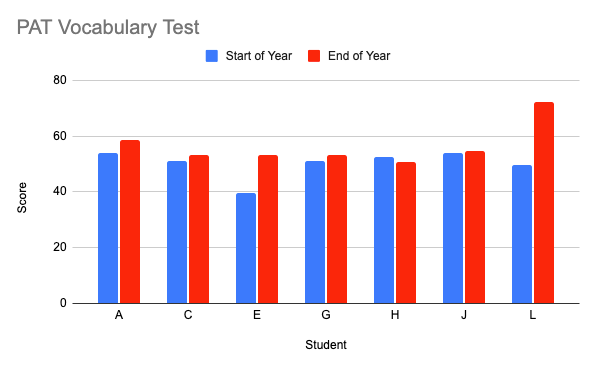
I compared the vocabulary test results for children who took both tests. Note that this test demonstrated ability to understand vocabulary through reading, a skill which we know these children are good at. Results showed that all children (except one) improved in their ability to understand a range of vocabulary they come across when reading. The one child who did not show an improvement stayed at relatively the same level.


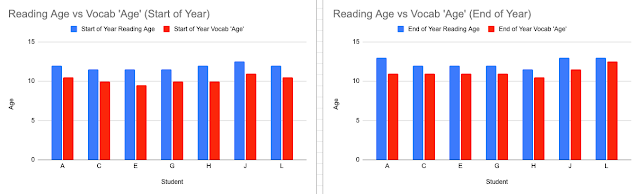
Next, I turned the PAT vocabulary test results (above) into an approximate 'age.' I wanted to see whether we have managed to close the gap between reading age and vocabulary level. Note, that the focus was to increase children's vocabulary levels in order to achieve this. You can see on the graphs that the gap for each child (difference between the blue and red column) does appear to be closing up for most children. 


 Unfortunately, I was unable to collect final term 4 data to show any increases in oral language of these children. However, I was able to collect a few second oral responses in term 3. These changes are explained in another blog post.

In all, I believe my focus on increasing speaking mileage with the support of speaking prompts has supported the children in the Extension class learning environment. It is something I highly recommend as a focus in all classrooms to support development of our children's oral language capabilities.

Monday, 1 November 2021

Making my own Curiosity cards

In response to learning about the Fertile Question cards (Curiosity Cards) by the National Library which support my inquiry focus and implementation this year, I have created my own curiosity cards around our Term 4 topic about Marine Biology. 

The children responded really well to these cards and were encouraged into deep conversation around the topic. 

In a future post, I will share some of the responses I have got from the first of the curiosity cards in this pack.

Wednesday, 13 October 2021

Fertile Questions and the National Library Curiosity Cards

While looking into resources for term 4, I found that the National Library had these fantastic cards which have been created around the Fertile Questions model by Yoram Harpaz and Adam Lefstein. 

What are fertile questions?

Fertile questions have a number of characteristics. They are open, undermining, rich, connected, charged and practical. You can read the definitions of these characteristics here.

The idea behind this is exactly what I have been aiming to achieve in my inquiry this year so I was very excited to find this awesome resource backed by research. 

The National Library provide two sets of Curiosity Cards based around the history of Aotearoa. Each card includes a photograph or image with a short title. Below is the template for creating your own Curiosity cards. You can find this on the links to the pre-made Curiosity cards. 


Set 1: He Tohu and Tuia - Encounters 250

Set 2: Tuia Mātauranga

I am really looking foward to using these cards with my year 7 & 8 extension class in term 4. I am also looking forward to beginning to create my own curiosity cards going forward. This will be a skill that will take some developing but I am excited for the potential of using them in the extension classes.

Thursday, 30 September 2021

Monitoring the effects of the implementation of the intervention

Changed practice/intervention: Providing children with prompts/scaffolds to support speaking and presenting to encourage use of language.

How am I going to monitor the effects of the implementation of this intervention/changed practice?

In a spreadsheet, I will record how children respond to use of this intervention each time it is used.

Here is an example:

Date: 5.08.21

Task: How does a Long Jumper's body move?

.
.
.

Child: Ana

Prompt: I was thinking about what ________ said, and I was wondering what if ___________ .

Response: I was thinking about what John said about the length of a long jumpers legs, and I was wondering what difference it would make if a long jumper had longer arms. Would they be able to propel themselves further forward?


Tuesday, 10 August 2021

Data collection: 10 August

 In class today, I used the prompt cards with the children.

Tasks: Scratch - How an athlete's body moves.

Speaking & Presenting Opportunity: Respond to learning from today as you work your project.

Time spent on new intervention: 30 minutes think time.

Responses:

NB: Prompt is in red

- Child 1: "I learned how to draw ears."

After he said this, I explained how he could add detail to this idea.

- Child 2: "I decided that I wanted to make my character get bigger as he moved towards the camera."

After he said this, I asked the children if they knew the name for this. We discussed how this was perspective.

- Child 3: "My friend ________ asked how you could make a bone appear in scratch...whether that was possible. If anyone is thinking how to do that, I can help you."

- Child 4: "If you want your sprite to move in a different direction then you need costumes to make the animation happen."

When I encouraged this child to share something about the topic focus (i.e. How an athlete's body moves) rather than the medium for creating (Scratch), they found this really difficult. They finally responded based on their sport of boxing, "If someone is punched in the head then they will be knocked out."

- Child 5 (talking about another child's project on boxing as a sport at the Olympics): "I was walking around to have a think about what I was going to say and I saw ______'s work. He just had the person standing and punching. I asked him a question and I told him that before he started to punch he could change the position (put the hand here) to make it animate."

- Child 6: "I don't understand what happens to the Archer's hand when they let go of the arrow? Do they just let go with two fingers or the whole hand?"

- Child 7: "I still want to know how a sailor actually sails the boat because it is very confusing."

- Child 8: "I'm confused about how the runner's bones get stronger each time they take a step."

- Child 9: "One reason for making my pad [crash mat] 3D was I wanted to see / I wanted the pad [crash mat] to perform like in real life."

- Child 10: "_________ pointed out when I was drawing the legs on my person that the bottom part was thinner and the top of the leg is thicker so I changed it around."

- Child 11: "_______ mentioned that if you use your whole hand or 2 fingers it...

At this point, I mentioned that we needed more information. It wasn't clear what was being talked about. I wanted this child to be explicit by stating what sport was being talked about. She responded with:

"If you use 2 fingers then it will go way further than your whole hand. If you use your whole hand it will just flop on the ground. "

Based on this response, more work needs to be done to teach the children what it means to be explicit with their responses so the audience knows exactly what you are talking about. In this case, the child was talking about archery however there was no information to tell us that.

Five children did not know how to respond, even with the support of the prompt, which they had been given 30 minutes before the time of sharing. During this time, they were also encouraged to talk with their neighbours about how they could respond with the prompt they were given.

What can I do next?

As a result of this, the children who did respond were thoughtful and purposeful with what they shared. I need to teach the children what it means to be really explicit with what they are talking about so their audience understands them.

I need to teach the children how they can add detail to their ideas, rather than just sharing one sentence.

Conclusion:

This was a really good attempt of using these prompt cards. Many of these children need support with their confidence in sharing their ideas via speaking and presenting and this supports many of these children. I need to figure out what I can do to support those children who did not share any ideas.

Victoria-RuizVD, CC BY-SA 4.0, via Wikimedia Commons


Thursday, 5 August 2021

Restating my Inquiry Question and Chain of Events

We are now half way through the year. In this post, I am going to restate my inquiry question to ensure I am still on track with my inquiry focus this year.

Inquiry Question: How can I change my teaching to support oral language progression towards the level of language which children can comprehend when reading?

Inquiry Goals: To improve oral language.

To reduce the disparity between the level of oral language and vocabulary used and the level of language and vocabulary they can read and recognise in written texts. To increase confidence when speaking and presenting.

Challenge: There is a disparity between the level of oral language and vocabulary which the year 5-6 extension children use and the level of language and vocabulary they can read and recognise in written texts.

Hypothesis: Giving children many opportunities to speak in front of each other (through sharing and presenting their ideas and learning within a small and a larger group), with the support of prompts and scaffolds will improve their confidence to speak and therefore improve their use of oral language.


Thursday, 29 July 2021

Implementation of a new tool into my practice

This term, I have begun implementing my new tool for the year 5&6 extension class. Using a range of conversational and discussion prompts from online, I have made a set of speaking prompts for the children. During each session with me, the children will be given a laminated card with a prompt. Their job is to respond to the work from the session using the prompt they have been given. This could be in response to a video they have watched, a discussion point or a text they have read, for example. 

From today, I would like to start giving them their prompt at the beginning of the session so they have a longer amount of time to prepare their response. We will finish each session 10 minutes before the end of the day so the children can share their responses. 

The initial implementation of this tool has been really successful. The children find the prompts useful and they appear much more confident when they have the prompt to support them in speaking and presenting. Here are copies of the prompts:


I have had discussions with a year 2 teacher at school who really liked the idea and thought her year 2 children could benefit from a similar approach. This began me thinking about how we could adapt the design for different age groups.

Thursday, 1 July 2021

Profile of my Teaching

The challenge: There is a disparity between the level of oral language and vocabulary which the year 5-6 extension children use and the level of language and vocabulary they can read and recognise in written texts.

My target group of children are all very good readers however find it challenging to demonstrate the same level of understanding and use of vocabulary through speaking and presenting.

Purpose: Create a profile of my teaching to support design of a useful intervention.

What do I currently do, relevant to my inquiry?

Currently, I teach the year 5-6 extension class 2x a week which equates to approximately 3 hours a week. The children work on group projects over a term where they have to demonstrate team work, collaboration, and practice speaking and presenting in their group and then finally in front of their peers. Also during this time, I read a novel aloud to the children. Once a week, the children also complete questions on a reading text with a focus around vocabulary development.

At the end of the term, the children are assessed off a rubric for their collaborative projects.

Manaiakalani Observation

This term, I had Fiona Grant from Manaiakalani observe how I incorporate reading into my Extension class programme. She used the Manaiakalani Observation Checklist during the observation. The following description comes from this observation.

It was observed that the purpose of reading in the extension classroom was for reading to learn. This is in line with the fact that these children are all at a level of their reading where they are accessing texts in order to find information. In the planning for this session, it was observed that I had planned for teaching comprehension strategies, critical thinking (analysing), critical thinking (synthesising), critical thinking (making connections to the wider world), and student reflection. In my planning, there was also evidence of literal questions and open ended questions. In the session, the children had opportunities to see short texts, non fiction texts, a text for a general audience (e.g. newspaper), printed text, digital text, pictorial text (e.g. image), video text, teacher selected text and a text set. Through the session, it was observed that I had ambitious learning intentions. This is what I want to be including for the extension learners as well as to build their oral language skills. I also planned for activities to support consolidation of learning and mileage.

It was observed that I had a purpose to the learning and provided the children with a provocation. However, engagement was lacking. This is a really important part of the observation as I need to think about how I can create better engagement for the children. I wonder whether providing more choice for the children will support better engagement.

In the direct instruction, I included teaching of new vocabulary as well as giving a new context for known vocabulary. This is something I need to ensure I keep doing to develop the children's knowledge and confidence.

In learner follow up activities, it was observed that I provide reflection on strategy use. This will be important to explicitly teach and do so children know the strategies which will support their development of speaking and oral language. Follow up activities were collaborative which supports development of oral language.

I could be doing a better job of planning for critical thinking (evaluating) and critical literacy as well as giving the children opportunities to take part in extended discussions and providing them with conversation scaffolds. It was observed that I did include opportunities for evaluation in the lesson, however I need to be explicitly planning for this. I could be considering providing children with longer texts, audio texts and learner selected texts in relation to the topic.

Even though conversation scaffolds were not evident in my planning, they were evident in the direct instruction. I therefore need to ensure I am explicitly providing the children with these conversation scaffolds.

What are my strengths?

1. Giving the children choice. I like to give the children choice in terms of how they present their final product from their project. 

2. Encouraging deeper thinking using causal links. I ensure that I do not accept yes/no answers from the children. I set up an expectation that the children have to answer a yes/no question with an explanation. That is, 'Yes/No because..." or "I thinking ________ because." for example. Using causal links has been a big focus of my previous inquiries so it is engrained in my teaching practice. 

3. Collaboration. Creating collaborative opportunities.

4. Teaching new vocabulary and sharing this vocabulary in new contexts. I can do a better job of keeping a record of this new vocabulary which we learn.

What are some areas I could develop?

For this question, I want to reflect on my latest lesson that I planned for this class. This term, we are looking into the topic of meteorology. For this topic, I first had the children research a number of weather instruments that are used to measure weather conditions. Here are the slides which the children worked from:


This first lesson was extremely scaffolded as I wanted to ensure the children all had a broad understanding of weather and how it is measured before the children moved off into their group projects. Interestingly, many of the children really struggled with what I thought would be quite a simple task. As a result, I had to stop and think what I could be doing better to support the children with this task.

1. I could be doing a better job of giving these children more real-life experiences before getting them to research. Perhaps what the children needed in this research activity was to see the weather instrument in action. 

2. I could be doing a better job of explicitly teaching alongside project-based learning. I need to improve in my ability to ensure that each child is presenting on NEW learnings, not just things they already know. In last term's project, the children really enjoyed creating their DLO which they would share with the class, whether it be a movie, a poster or a coded animation. One common observation though was the number of groups who tended to present on information they already knew, rather than included NEW information. Perhaps this is partially a confidence issue but I also need to look into what I can be doing as the teacher to support them to share their new learning. I need to be asking myself the following question:

"Could this child/these children presented this at the start of the term or have they only presented this as a result of their new learning?"

I could be getting the children to ask themselves this question:

"What is some new learn from this experience that I didn't know before?"

Something that came up from the observation which I would like to work on is creating more engagement learning experiences. I wonder whether part of this is that we have had limited time together as a class this term so I have not provided as much choice as I would have previously. Even so, it is an element of my teaching which I should really focus on.

I also need to think about how I can provide opportunities for the children to be part of extended discussions. Often I find that the children have difficulty focussing long enough to participate in extended discussions. As a result, part of my inquiry should be on providing children with conversation scaffolds which could support their engagement in an extended sense.

What do the students say (student voice)?

In the student voice survey, this is what the children told me I could help them with in terms of speaking and presenting:

1/17: Management of emotions/ feeling
1/17: Using better vocabulary
1/17: Handwriting
1/17: Memory
1/17: Knowing how to explain my thinking
1/17: Spelling
2/17: Other people showing respect while I'm speaking
2/17: Get better at Maths, Writing and Reading
3/17: Give me books to read
5/17: Give me opportunities to talk so I don't feel nervous and can practice speaking up and expressing what I feel when I talk / Confidence

Interestingly, some of these are points really resonate with the data I collected from observation and assessment. For example, the children know they need help with using better vocabulary when they speak and present. They also know they need help with knowing how to explain their thinking and being given opportunities to speak to develop their confidence. Some of their other responses though show a possible lack in knowing what they need to get better at speaking and presenting. For example, thinking that getting help with handwriting and spelling will help their speaking and presenting. 

Current analysis of The 'Big Six'

1. Ambitious outcomes for all. The learning experiences that I develop for these children are ambitious and provide opportunity for growth and development for all. The learning experiences have both a low floor and a high ceiling so all can access learning from them at all levels.
2. Eyes on text. This is something I can continue to work on developing. When I have these children for a short time, I need to find these best way to do this. I need to continue gifting texts to the children at their level which are related to the topic focus. This would still be possible through group projects where the children read a text and pull new learning from it to support their projects. 
3. Language and vocabulary development. I am providing opportunities for the children to do this as a result of it being the focus of my inquiry. I am doing this through weekly texts, reading of novels, opportunities to work as a team and opportunities to speak and present.
4. High Level Discussions. This is something I can continue to work on developing. This needs to be working hand-in-hand with the third point (Language and vocabulary development) as a result of doing the second point (Eyes on text). I need to be giving the children strategies and prompts to be able to have these high level, effective and productive discussions.
5. Transforming and transference of knowledge through creation. As a said above, I need to be teaching the children to transform and transfer NEW knowledge through creation, not just the knowledge that they previously held.
6. Making thinking visible. This is happening as an end product however I could be encouraging the children to complete video diary entries to share their learning during the term as well.

Causal Chain


(Click on image to enlarge).

Thursday, 13 May 2021

Collaborative Inquiry Group

Today at staff meeting we met in three groups:

- Those with a focus group of children who learning to read.
- Those with a focus group of children who are reading to learn.
- Those with an inquiry focus on maths.

I went along to the group of people who were focussed on those children who are reading to learn, as this covers my focus group of children. Our group was led by our Principal, Russell Burt. Others in the collaborative group were:

Gabriel Hughes - Year 5/6
Kelsey Parrant - Year 5
Latini Ilaoa - Year 7/8
Sally Va'afusuaga - Sport
Jenni Clarke - Reading Support
Migi Siō - Year 4/5
Adina Iordache - Year 4

Through discussions around my inquiry, we came to identify that my focus group have an output mileage problem. That is, the children are not being given enough opportunities to practice 'output' through speaking and presenting.

Through discussions around other people's inquiries, I identified areas that could be useful to explore such as teaching understanding around lexical chunks rather than individual words as well us looking into pragmatics of oral language, being the way we interact socially with one another. More can be read about pragmatics here.

I found this collaborative inquiry session really valuable in terms of supporting one another, making links between different groups of children at different levels and sharing knowledge.

Thursday, 4 April 2019

Language Acquisition

At our CoL meeting, Dr. Jannie Van Hees talked to us about language. She referred to language in two different ways:

- Being able to receive the language (decoding)
- Being able to use the language (comprehension)

She emphasised the importance of learning being active. This is important to retain learner attention. This includes the process of being metacognitive with the children. This process of metacognition is something which we are always looking into and is a huge part of the way we do maths in our school (DMIC maths).

Jannie discussed the importance of detail. She talked about how it is easy for the default to become less detail however as teachers, we should constantly be trying to pull more detail out from the children.

Another thing that Jannie talked about which matches messages we have received from the DMIC mentors who come into the classroom is the idea that expecting hands up is something that is hindering language.

Jannie challenged us to think about whether this is something that is common across the classrooms in our school and also across our schools in Manaiakalani. I strongly believe this is a common occurrence and is something which we are constantly reflecting on, particularly in maths. A challenge to myself is to think about how I can extend this understanding to reading and writing so that language acquisition (particularly oral language) is a focus right through the school day and then also into the digital world when children are learning from home.


Reference:
Dr Jannie Van Hees (2019)

Thursday, 16 August 2018

Promoting use of Oral Language and reflection in Writing

This term in Ako 3, we have been promoting use of oral language through purposeful collaborative learning experiences. During writing, we have incorporated this into our weekly schedule through peer editing. The tool which we have introduced to the children to support them in the peer editing of their writing is a rubric. This rubric has been highly successful with our year 5 learners.

Click the rubric to open the google drawing in a new tab (and make a copy if you would like to). Any feedback on this rubric and how it could be made better is warmly welcomed!
Each Thursday morning, the children pair up. These groupings change from week to week. Together, the children decide whose writing they are going to focus on first. Once decided, that child opens their writing doc on their chrome book while the other child opens the peer editing rubric on their chrome book. 

The rubric is broken into four sections: punctuation, correct sentences, vocabulary and organisation/structure. The nice thing about this rubric is that it is accessible for ALL learners. Together, the children have to agree on where the piece of writing fits on the rubric (for each of these sections). Once this is decided, there is a clear 'action' for the children to follow in order to improve their writing. 

Although it is early days using this rubric, we have been really pleased with how the children have responded to using it. It is clear that as the children become more familiar with the rubric, they will begin having more and more quality learning conversations with their buddy. Already, we are seeing the potential that this tool has for the ākonga in our space.

I don't believe that this rubric would be as effective if it didn't have the action prompts. These prompts give the children a clear direction so that they can be critical of their own and their classmates' writing.