Showing posts with label LReflect. Show all posts

Friday, 25 August 2023

Where am I up to as an "Action Researcher"

 Yesterday at our Kāhui Ako (CoL teachers) meeting, Russell Burt shared a thought invoking message which really supported pulliing me back into the reality that research as a teacher isn't going to look the same as research you may do in a university. We are, what he called, "Action Researchers." It is important in our jobs as teachers that if we find something that is working, we don't withhold this from other children (as you might do with a 'control' group in other forms of research). If something works, why wouldn't we give the opportunity to ALL students!? 

I am in a position where, since I am not in a classroom, I am not in a position to see a whole class of children. However, I am seeing a group of 14 children for an hour a week. These children are all getting equal opportunities in what they get when they come to see me.

Russell's korero made me ask myself whether what I am doing is beneficial to the children in front of me. My answer to this question is, YES. I believe that what I am doing is supporting these children with confidence and acceleration of their maths learning. I am using a strategy which is known to support acceleration for children in reading in our Manaiakalani schools: Mileage. Mileage in reading refers to giving the children lots of opportunities to read. Mileage in the maths sense, and with my inquiry group looks like the students being given lots of opportunities to apply their understanding in a variety of ways.

Is 'believing' this really enough? No. As teachers, we still need evidence to show that what we are doing is benefiting the children. In our meeting yesterday, I realised that I had such a focus on ensuring I had good pre and post data, that I hadn't put much thought into the formative assessment and data gathering throughout the process.

So how am I going to do this?

From now, I am going to make sure I gather up the work that each child is doing from week-to-week. This will support me in knowing whether there is an improvement in how students are solving the problems and showing their working compared to earlier in the intervention.

Friday, 11 August 2023

Thinking about the affordances of Learn Create Share that cause accelerated shift

 The affordances of Learn-Create-Share that cause accelerated shift are:

- Engagement
- Teaching conversations
- Cognitive challenge
- Visibility
- Scaffolding

Manaiakalani Research Presentation: Manaiakalani Hui: 26.08.16 - Rebecca Jesson, Aaron Wilson, Woolf Fisher Research Centre.

I analysed the intervention that I am implementing in relation to this list. This is what I found:

Engagement: The students are all engaged with the learning. They are keen to give the problem solving a go, knowing that they will get supported after about 15 minutes with more information to help them solve the problem.

Teaching conversations: I have been having lots of conversations with teachers who also teach these children to ensure that what I am doing supports what they are doing back in the classroom.

Cognitive challenge: The children are definitely being cognitively challenged with the problems. They are all being given opportunities to extend their thinking.

Visibility: This is an area I think I am currently lacking in. The problems we have been looking at are added to a google slide which is visible for the children however the learning that goes with the problems is not being made rewindable and visible to the children. I need to think of ways I can make the learning more visible and rewindable.

Scaffolding: The way I am structuring the lessons is a good balance of allowing the children a chance to grapple with the problems whilst also scaffolding them through the process and new learning.


Monday, 19 September 2022

What does Enthusiasm tell us?

 Over the last couple of weeks, I have had two videographers from my target group of students who have shown interest in being the videographer at in-school events. In these situations, they have been the ones who have suggested being the videographers. This sign of enthusiasm tells me a lot about the mindset of these students, how they feel valued and confident in themselves and that being a videographer is something they are good at and can lead in.

This anecdotal evidence is hugely valuable to see the success in using videography as a way of developing confidence in some children.


In an article on the Western Weekender, an opinion piece (Confidence and enthusiasm) talks about the importance of enthusiasm and confidence in a business environment. I think the same can be said in education. In the article, it states that "being enthusiastic in what you do breeds confidence." This article also makes an interesting point about confidence. It explains how people feel reassured by people who are confident which in turn leads to greater trust. I would add an extra element to this which is that this could be seen as a never ending cycle as feeling trusted by others can also help your confidence to grow. 

Monday, 5 September 2022

Anecdotal Reflection

So far, my inquiry is going very well. I have started sending my target group of children off on sports tournaments as videographers and the response from them is really positive. One student has now filmed at 2 tournaments so I am beginning to get self assessment responses to form a comparison.

Responses from the students has been positive and they are starting to be more reflective with the improvements they are making. 

As the students begin going to more tournaments, I will be able to start comparing their footage to see how it has improved. I therefore need to create a rubric to assess the quality of the filming.

Tuesday, 9 August 2022

Inquiring into my teaching practice

Hypothesis:

If a less experienced classmate is supported by a more experienced classmate to learn a new skill, then their confidence in this skill will begin to develop. Confidence will begin improving in this skill as well as in other areas of school and life once they are out making decisions for themselves as members of the PENN (school news) crew. 

What specific aspects of my current teaching are relevant to my hypothesis:

How am I teaching the more experienced classmate how to follow the values of the Tuakana Teina approach?

- Ako (learning/teaching)

- Manaakitanga (caring/uplifting each other)

- Rangatiratanga (uplifting students)

- Whanaungatanga (relationships)

- Tuakana Teina (apprentice-expert)

At what point do I as the teacher let the less experienced classmate start having more independence from their more experienced peer?

What is my role in this if the more experienced peer is taking on the 'teaching' role?

Formative information about your current strengths and areas for development:

Student voice (also in previous blog post):

Findings: Three children felt confident with knowing how to tell their teacher that they needed help. Four children felt that their confidence with this dropped compared to their primary responses. I'm not entirely sure for the reason for this however, it could result in the fact that in a Tuakana Teina relationship, the more skilled peer is like their 'teacher' and my role as the teacher was to step back from that "traditional" role. The children need to be seeing their peer as their teacher in this pedagogical approach which may still feel slightly uncomfortable to the children.

Practices which are currently implemented to support the hypothesis:

I was fortunate enough to have a whole day with my target group and their more skilled peers during our recent Matariki day. However, what practices am I implementing for general day to day improvement?

- Daily PENN crew - photography, video editing & presenting, studio technicians

During the daily PENN session, I teach children skills for developing their photography, video editing and presenting.
Presenters come in at 8am, open the script and rehearse before their turn to present.  I give the presenters in the moment support and tips based on their own individual needs.
Photographers get opportunity to develop their skills learned through Creative Space. I give them feedback on their photos on their return, explaining what makes their photos good.
Video editors get autonomy to learn how to transfer files between SD card and iMac. They also learn editing skills through iMovie.
Studio technicians set up the studio (lights, green screen etc).

- Sports events - Videographers and Photographers

Students attend sports event with video camera and still camera. This is a challenging area as I cannot attend the sports event with these children to teach them new skills and techniques. 

What changes can I make to my practice?

Currently, there is no implementation of a weekly training time for the children who are photographers and videographers. This is something I should definitely be implementing to explicitly encourage confidence for these children. This could be a before school on Friday session (since I don't run PENN on this day) OR a weekly lunchtime session (where we go and film sports trainings to learn skills). 

What do I need to do to implement this?

Videographers lunchtime club - Meeting together regularly to learn the skills of videography and photography.

More mileage of videography and photography for these children.

How can I measure changes to my practice?

I will measure changes to my practice by:
- Continuing to gather student voice about how students feel they can ask for help.
- Making a comparison of the interventions and implementations that I have added during the year.


Monday, 13 June 2022

Stopping, Reflecting and Refocussing my Inquiry

 Today I continued looking into research but realised I was still uncertain about what I was actually trying to achieve. I stopped and reflected on who my target group are. The target group are children who showed low confidence in terms of speaking, presenting and sharing ideas. Understandably, I have gone down the path of oral language and what makes a good 'speaker' however when considering the big picture, I don't believe I am going to get good results if this is my focus with this group of target learners. I first need to support development of their confidence before I even consider supporting them to become better speakers. 

During a Kāhui Ako meeting at the beginning of this term, Across School Teacher Amy Tofa, suggested using Tuaka Teina to develop children's confidence. I am in a unique position where I have children ranging from year 5 up to year 8 who are all experienced and skilled in Presenting, Videography and Video Editing. I also have children who could benefit from being paired up with a supportive, patient and experienced student who can support my target learners in developing  their confidence through various roles in the production of our school news.

This week, I plan to introduce these Tuakana-Teina partnerships.

How this will look: 

1. Presenters. Any children who have been paired to develop a potential presenter will attend our news filming at 8am on Monday through to Thursday. They can being by practising the same script as the Tuakana and as buddies, will decide when the Teina is ready to present. They can use tools such as quicktime to develop the confidence of the Teina, even if they don't yet have the confidence to present in the actual news. 

2. Videographers. Each Tuakana will support a Teina by taking them along to sporting events and other school events to film together.

3. Video Editing. Each Teina will work with Tuakana to edit footage from sporting events, student movies from around the school that have been filmed by Videographers. This could be the same children who were the videographers.

Monday, 21 March 2022

Example of using movie as a medium to create meaningful learning experiences for children

At the beginning of the year, I sent an email out to our teachers at Pt England School. A large element of the Pt England Network News is sharing learning from across the school. During lockdown last year, it was challenging to expect each teacher in the school to do this. I would sift through the children's blogs to find great learning examples and share these daily on the news. Now we are back at school, it is important that I place that responsibility back onto the teachers so that each class and the tauira in that class have their learning showcased in some way. 

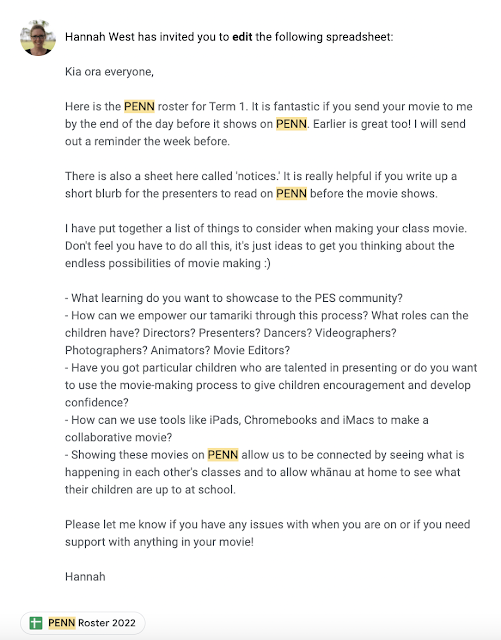
Here is the email I sent out to the teachers to encourage this:


In the email, I created a list of suggestions to teachers to support them in making movies which are meaningful for our tauira. 

Last week, I came across a wonderful example of a teacher who used these suggestions to make an awesome movie! Heidi Davis is a third year teacher who teaches year 2 and 3 children. Heidi looked over the list I had sent and wanted to use her term 1 PENN movie to create a meaningful learning experience which would challenge and excite her learners.

In her movie, she had one of her year 3 children read the script. You can hear the confidence, fluency and clarity as he reads. What a fantastic, engaging, REAL learning experience for this child! Other children showcased their learning through the term. Heidi included her children and they were highly aware of the purpose as they created the movie together. Heidi said that the children were so excited to see the finished product! The anticipation of waiting now until it shows on PENN is engaging and will create a fantastic intrinsic reward for the children too! 

Here is Heidi's movie:


This is such a great example of what I hope to see more of through my inquiry this year. I want to see more movie making happening across the school which engages children, creates real learning experiences and gives children a purpose in their learning. I want to be able to watch movies like Heidi's class movie and be able to see the learning that the children have had through the experience of making the movies.

Having taught in the classroom, I do understand and appreciate the time that is required to do this well. Therefore, part of my role will be to support teachers in making this happen. 

Monday, 28 February 2022

Good inquiry happens in teams

At our Kāhui Ako meeting, we discussed the importance about inquiry happening in teams to make them effective and successful. I thought it would be useful to think about who my team will be.

So far, I am thinking about inquiring into my role as leading the PENN (Pt England Network News) programme and how this programme can be used to support confidence in children's oral language capabilities. 

So...who would be in my 'team' ?

Russell's inquiry into having "present, happy, healthy, engaged tauira who are learning in the goldilocks zone" definitely fits nicely with my inquiry. There are many opportunities for children to get excited about through the PENN programme. These include presenting, being a videographer or photographer and movie editor. 

The teachers of Team 4 and 5 are very much important in my 'team' as they are the ones who teach these children on a day-to-day basis. In the environment of living in a pandemic, having these teachers on my team is important to ensure the day-to-day running of the news, even if the children or myself have to be isolating at home. It will be important to consider how we will continue to have the news running if and/or when these scenarios arise. Regular conversations with these teachers will be important to decide on these children who would benefit greatly from the opportunities of the news as well as seeing progress of these children in their confidence and oral language.

In this inquiry, it is going to be important to have an 'innovation team' as well. This could begin through my 'Team 6' colleagues as well as the enablers group. These people will be important to bring new ideas to fruition to change up the news and provide more opportunities to develop confidence and oral language.

My Kāhui Ako teachers will also be extremely valuable. Through looking at my colleague's blogs I will find those teachers whose inquiries match with mine and which could benefit from each others findings.

Wednesday, 23 February 2022

Kāhui Ako: First meeting of the year

Last Thursday we had our first Kāhui Ako meeting of the year. Russell and Chris challenged us to rethink our inquiries for the year, pondering what is realistic and important in the world we are currently living in. Russell gave a personal example with his own inquiry, "How do we reliably get a 'threefer' - three core subjects accelerating simultaneously, 3 years in a row?" Realising this was no longer a realistic expectation with so much disruption to school, he has considered changing his inquiry to, "How do I have present, happy, healthy, engaged tauira who are learning in the goldilocks zone." Russell then discussed the fine balance between social connection/ building relationships and risk mitigation/ public health goals. These two things are so important at the moment however class terribly in terms of giving them both 100%! So how do we do it?

Russell's korero got me thinking about what I can be doing for our tauira to ensure they are coming to school engaged and happy, and to continue to build their confidence - something my programme lends itself beautifully to. 

My role is divided between teaching in the Creative Space, teaching the Extension classes and teaching children through the daily production of the Pt England Network News (PENN). All of these programmes are things that already engage and excite our children. So how can I develop these programmes deeper, to better develop the confidence and key competencies of our children?

Going through lockdown last year made me realise that the children I connect with the most on a daily basis whether I am at school or at home, and therefore can have the largest impact on in this world where we have to be so flexible and resilient, is my PENN crew. During the long 2021 lockdown, I was in daily email contact with these children to ensure the news was created and online each day. This real experience in itself created a huge amount of motivation for the children involved.

Since we have returned to school, a group of keen presenters come to school early to film for the day's news. The motivation is there. So what can I do to further benefit children in our school? In particular, which children would benefit the most from participating?

Since I know I already run creative-based programmes which provide a high level of motivation for the children involved, I now need to consider how I can support children who need to develop confidence through presenting, videography and photography, and editing. 

Thursday, 13 May 2021

Collaborative Inquiry Group

Today at staff meeting we met in three groups:

- Those with a focus group of children who learning to read.
- Those with a focus group of children who are reading to learn.
- Those with an inquiry focus on maths.

I went along to the group of people who were focussed on those children who are reading to learn, as this covers my focus group of children. Our group was led by our Principal, Russell Burt. Others in the collaborative group were:

Gabriel Hughes - Year 5/6
Kelsey Parrant - Year 5
Latini Ilaoa - Year 7/8
Sally Va'afusuaga - Sport
Jenni Clarke - Reading Support
Migi Siō - Year 4/5
Adina Iordache - Year 4

Through discussions around my inquiry, we came to identify that my focus group have an output mileage problem. That is, the children are not being given enough opportunities to practice 'output' through speaking and presenting.

Through discussions around other people's inquiries, I identified areas that could be useful to explore such as teaching understanding around lexical chunks rather than individual words as well us looking into pragmatics of oral language, being the way we interact socially with one another. More can be read about pragmatics here.

I found this collaborative inquiry session really valuable in terms of supporting one another, making links between different groups of children at different levels and sharing knowledge.

Thursday, 18 March 2021

CoL - finding my collaborative inquiry partner

In preparation for our CoL meeting this afternoon, I have planned to meet with 5 other CoL teachers who I will chat with about their inquiry focus this year. Here are the teachers I plan to meet with:


I will update my blog with notes after I talk to each of these teachers.


Thursday, 11 March 2021

Novel studies - WHY is this beneficial?

 As mentioned in my previous blog post, I have observed that our year 5 and 6 children are really good at reading short texts that challenge them however many of them find it challenging to focus and be engaged in extended texts at their level which challenge them. There are a few questions I have around this.

- Why do these children find it difficult to engage in extended texts that challenge their thinking when they are good readers?
- How can reading extended texts (novels) excite and develop the learning of these children?
- What programmes have been used in other schools to have novel studies as part of their reading programme?

books on ground

To make a start on this inquiry, I first want to gather some student voice around the children's engagement in reading extended text. I am interested in knowing such things as what genre of texts these children enjoy reading, how often they read in their own time (at home) and why they read texts (i.e for enjoyment or to learn new information). 

It will be important for me to understand why I want the children to be reading novels. What will they get out of reading novels?

- One teacher writes about observing children discussing such things as character relationships, viewpoints and inferences (Differentiated Teaching). This teacher goes on to discuss research-based reasons to teach using novels:
1) Giving children experiences that go beyond their own world.
2) Vocabulary development.
3) Communication & Dialogue skills and strategies
4) Social skills development.
5) Engagement

Some books that might suit 10-11 year old children as suggested in The Teaching Bank:
- Number the Stars by Lois Lowry
- Sadako and the 1000 paper planes by Eleanor Coerr
- Esperenza Rising by Pam Munoz Ryan
- Wonder by R.J. Palacio
- Holes by Louis Sachar
- Hoot by Carl Hiaasen
- Bud, not buddy by Christopher Paul Curtis

Some books that might suit 10-11 year old children as suggested in Wheeler books:
- Lion: A long way home (Young Readers' Edition)
- Hidden Figures (Young Readers' Edition)
- Owl

The next step for my inquiry will be to have discussions around this inquiry focus with various people around the school. While I am doing that, I will also gather information around the children's reading habits.

Wednesday, 3 March 2021

Inquiry focus 2021: Initial Data Collection

For my 2021 inquiry this year, I have been thinking about what a challenge is for the year 5 and 6 extension children who I teach twice a week. I am in an interesting position where I do not have my own class of children. My role could perhaps be most likened to how secondary teachers teach multiple groups of children each week. I believe that the year 5/6 group would be the most appropriate group to base my inqury on as I see them twice a week. As a result, I would have more of a chance to implement a regular pedagogical approach with them. 

I asked myself this: What do the extension children have as a challenge/ something they need to work on which I could inquire into?  Alternatively: Is there something totally different which could be beneficial for me to focus on in my unique role?

I have come from teaching year 5 children. As a result, I can draw upon observations and knowledge of some of the children who would be my focus for this inquiry. I have observed that some children in year 5 who read above their chronological age in reading have some difficulty with spelling. Therefore, I was wondering whether a focus on spelling with these children could be beneficial. I tested the group of children and came up with some data.

Test 1: Schonell Spelling Test

Data:

Interestingly, only 4 out of 17 children have spelling as an area of concern according to the Schonell test I gave them.

As a result, I decided that spelling was necessary to focus on for those 4 children whose spelling level did not reciprocate their strong reading levels however, it was not an area that I needed to focus on for the whole group for the year. 

I had a conversation with Angela Moala, the year 3/4 team leader. We used to co-teach in a year 5 space and do well with putting ideas past each other. Through this conversation, I mentioned another observation I have made whilst teaching year 5 children who are strong readers. This observation was seen when I gave a group of 4 year 5 boys a novel to read. We had built up this novel and the children were all excited to read it. However, when it came to reading the book, only 2 were engaged to read it independently from start to finish. In my conversation with Angela, we realised this is a real challenge for this particular group of children. They are very good at reading short texts at their level however they do not all show an ability to focus on reading an extended texts independently. 

My second idea for my inquiry is therefore, how can I support extension children in year 5 & 6 to be engaged in extended texts which are challenging and which encourage critical thinking. How can I get the children to engage in deep and thoughtful conversations about these extended texts which they read?

I am going to spend this week exploring this second inquiry idea.

Thursday, 11 February 2021

What's in store for 2021??

2021 is going to be a different year for me at Pt England School. I have taken over as the Creative Space and Extension Teacher. In this role, I will be producing the school news, PENN, every Monday to Thursday, taking children from year 1 to 6 for lessons in the creative space and teaching the year 5-8 extension children. With this change in role will come a change in inquiry focus. 

So far this year I have had a clear out and made sense of what gear I have to utilise around the school. I have created three episodes so far for the school news (PENN) and taught three days of classes.

Creative space lessons this year are going to be broken up into Sight, sound and motion. 

- Term 1: Focus on Sight
- Term 2: Focus on Sound
- Term 3&4: Focus on Motion

This term, the creative medium we are using is photography. For years 2 and 3, photos will be taken using the camera on their iPads and will include a focus on digital fluency. For years 4-6, photos will be taken using digital cameras. Part of the planning for these sessions has included me figuring out the progressions between year levels, which has come about from the progressions in the digital curriculum and my knowledge of children in year 5 & 6 and what they would be capable of achieving.

With having had three days with the children in front of me, and with the term well under way, I am now in a position to think about what my inquiry focus should be this year. To make this decision, I need to consider what is going to benefit me in this new role, what is going to benefit the children and what other teachers can learn from and implement themselves.

Here are some of the ideas I have had so far:

- Do I focus on the Extension children OR children participating in the Creative space programme OR children in the PENN (news) crew?
- Do I focus or compare engagement (or key competencies) between creative space and in class?
- Do I focus on progression of learning through the years using various creative elements?
- Do I focus on how participating in the school news supports reading level?
- Do I focus on how participation and engagement in the creative space impacts class engagement?
- Do I continue to focus on critical thinking with the extension children?

There are many questions I have regarding what my inquiry should be this year. I now need to have conversations with a number of people to decide what is most important to focus on.

Wednesday, 2 December 2020

The Challenges of the Concept Box Framework

The children who have been using The Concept Box in their reading groups are really motivated and now know the routine when it comes to reading. One challenge I have is how I focus in on the children's decoding whilst using The Concept Box framework. Technically, children reading at their level (reading age 10-11) should have strong decoding however I have begun to notice that some of these children are still having difficulty with simple decoding. I have attempted to hear the children read during the time they are silently reading however this means we then don't have enough time to do a good job of the Concept Box.

Teaching critical thinking is something which takes time. Going forward, teachers who use the Concept Box in reading may have to ensure that at least one lesson a week has a decoding focus while another lesson has a focus on the Concept Box. This will come with other limitations as it will mean that reading mileage may reduce as children will be reading less texts with the teacher per week.

Challenge

Image Attribution: Challenge by Nick Youngson CC BY-SA 3.0 Alpha Stock Images
From Picpedia

Thursday, 20 August 2020

Season 2 of NZ's Lockdown

In a time full of seriousness and worry, there is some humour coming out. In particular, the 1pm daily update has made it onto IMDB, the well known international website reviewing movies and TV series. Amusingly, it has 2 seasons and has a rating of 9.6/10! Therefore, here I bring to you an update from inside season 2 of NZ's Covid-19 lockdown!

COVID-19: FMC's advice to clubs and backcountry users – FMC

We have made it through the first week back in lockdown up here in Auckland. The children have been amazing - the real stars of the show! We had 20 children show up to our daily google meet today and have had 31 active children posting, commenting and attending google meets. What a success!

Once again, this latest blip in the year 2020 has caused me to stop and rethink my professional inquiry for the year. After some consideration, I am determined to continue with my focus on children and their ability to think critically. The reason for this is that in many scenarios I am noticing how much our children could benefit from learning how to think deeper about their learning. Here are some examples from the last week:

During a google meet: During a conversation about food in Canada, one child ran to their kitchen and brought back a bottle of maple flavoured syrup. They confidently declared that they had some maple syrup. Here is an approximation of the conversation:

Child 1: "I have some maple syrup" [holding maple flavoured syrup up to the screen].
Child 2: "Miss West, I don't think that is real maple syrup."
Me: "Oh, why is that?"
Child 2: Because maple syrup comes from Canada.
Me: Can you think of any other reason why it might not be actual maple syrup?
[No response]
Me: What does it say on the front of the bottle?
Child 1: Maple flavoured syrup
[No elaboration]
Me: What do you think it means by maple flavoured?

From this point on, it required a lot of prompting from me for the children to be able to contribute to a critical discussion with causal reasoning. In a group of about 12 children, only 2 children contributed fully to the discussion. In this example, there were signs of one child thinking critically, however they struggled to elaborate, add causal reasoning and justify their critical thinking.

In other examples, when children were completing a task where they had to find facts about animals in Canada, many interesting facts were found however a level of causal reasoning/ critical thinking was lacking.

Examples:

"There are Polar Bears in Canada."
No elaboration. A response that could provide elaboration could be, "There are Polar Bears in Canada because Polar bears live in cold climates. Northern Canada has an extremely cold climate with snow and ice. Polar bears thrive in this climate and eat many animals that also live in this area."

"The marmot is the most endangered animal in Canada."
No elaboration. A response that could provide elaboration could be, "The marmot is the most endangered animal in Canada. This could be because of predators that eat the marmot or it could also be due to such issues as climate change or humans destroying parts of their habitat. To understand this more, we could look at whether temperatures have changed much in the area of Canada where the marmot lives or whether their habitat has been threatened by humans."

These are just examples. To get children showing this level of causal reasoning or critical thinking, I could create a causal chain template for the children to learn to use and work through when working on tasks. This causal chain template could be something to help the children when working independently. This will be important, particularly when we don't know how Covid-19 could impact us going forward. 

Tuesday, 30 June 2020

Reflection: Summarise your main learning about your teaching and next steps

Task: Write a reflection in which you summarise your main learning about your teaching and next steps. This will prepare you to design an intervention next time.

Hypothesis: A focus on critical thinking and causal reasoning when responding to texts will support increased levels of critical thinking and ability to create causal links in online written interactions with others for year 5 children reading between 10 and 12 years.

Main learnings from peer observation and self assessment of my teaching practice:

Over the last few weeks, I have done both a self assessment and had a peer observation of my teaching practice. The focus of these observations was on how I encourage critical thinking and causal links in a reading group. Below are my main findings from this process:

1. I am often too quick to repeat or rephrase my questions. This doesn't give the children enough time to think and respond to what I have asked.

2. I need to be thoughtful and careful with the questions I ask so I provide a good prompt/provocation to get the children thinking but not too much to take over their ability to think critically.

3. I need to take a step back and allow the children to do more of the talking. This will be a fine balance because I still need to be providing support and teaching the children new strategies.

4. The children are quick to respond to me as the teacher but not so much to each other. The children do not tend to ask each other questions. It is very much a conversation between each of them and me. The experience needs to be more of a network where the children feel they can ask and respond to everyone in the group.

Network Totally

Next steps:

- Observe a number of teachers taking reading groups of a similar level to this group. Observe the types of questions these teachers ask and how they encourage the children to do the thinking.

- Encourage the children to respond to each other and to ask each other questions from the text.


- Encourage more causal links by the children. Teach a number of ways that this could look. They don't just have to use the word 'because.'