Showing posts with label reading. Show all posts

Wednesday, 7 May 2025

Inquiry focus for 2025

 Core Learning Area: Literacy

Focus Group: The group of students I am focussing on this year are Year 5-8 students who have been assessed as being strong academically in their year group, however who are behind their expected level in reading and/or writing.

Evidence:


You can see from this data that there are a high proportion of these students working below their expected year level in Reading or Writing in Year 5, 6 7 and 8.

Observations and Initial Questions:

From this group of students, there are some students who are extremely capable with using their reading and writing capabilities to access the curriculum and share their learning. There are also students in both classes who find the learning more challenging, either because they find it difficult to ‘read to learn’ or they find it difficult to share their learning or express their thoughts through writing.

For every child in this group that has a lower than expected reading age, their PAT Reading and/or Vocabulary levels were a lot stronger. Why is this? Is the issue with how these students are testing?

Does lack of ability to complete their work and manage their time have a correlation to reading or writing level?

Does reading and/or writing level have a correlation with language acquisition or oral language capabilities?

How I might verify this defined problem:

  • Performance in most current testing
  • Observations of classroom behaviours
  • Language Acquisition
Draft Inquiry Focus:

How can I support students in Year 5 to 8 who have been tracked as being strong academically compared to their year-level peers, however who are working ‘below’ expectations for literacy levels (reading &/or writing).

Possible Research/ Resources:

Sheena Cameron Reading and Writing books
Literacy Learning Progressions
Revised English Curriculum Progressions
Research looking into the correlation of input (reading/listening) and output (writing/ speaking)

Possible Strategies:

  • Think-Peer-Share. Pairing children up so they are working with a peer who is stronger in that area.
  • Converstaion Starters/ Sentence Starter prompts
  • Shorter activities which really focus in on building individual student needs (e.g. challenged more with input or output)
Next Steps:

  • Provocations
  • Integrated projects
  • 1:1 readings or writing with individuals who need more support (including extra activities targeted at individual needs)
  • Strong focus on reading and writing in extension classes.

Thursday, 11 March 2021

Novel studies - WHY is this beneficial?

 As mentioned in my previous blog post, I have observed that our year 5 and 6 children are really good at reading short texts that challenge them however many of them find it challenging to focus and be engaged in extended texts at their level which challenge them. There are a few questions I have around this.

- Why do these children find it difficult to engage in extended texts that challenge their thinking when they are good readers?
- How can reading extended texts (novels) excite and develop the learning of these children?
- What programmes have been used in other schools to have novel studies as part of their reading programme?

books on ground

To make a start on this inquiry, I first want to gather some student voice around the children's engagement in reading extended text. I am interested in knowing such things as what genre of texts these children enjoy reading, how often they read in their own time (at home) and why they read texts (i.e for enjoyment or to learn new information). 

It will be important for me to understand why I want the children to be reading novels. What will they get out of reading novels?

- One teacher writes about observing children discussing such things as character relationships, viewpoints and inferences (Differentiated Teaching). This teacher goes on to discuss research-based reasons to teach using novels:
1) Giving children experiences that go beyond their own world.
2) Vocabulary development.
3) Communication & Dialogue skills and strategies
4) Social skills development.
5) Engagement

Some books that might suit 10-11 year old children as suggested in The Teaching Bank:
- Number the Stars by Lois Lowry
- Sadako and the 1000 paper planes by Eleanor Coerr
- Esperenza Rising by Pam Munoz Ryan
- Wonder by R.J. Palacio
- Holes by Louis Sachar
- Hoot by Carl Hiaasen
- Bud, not buddy by Christopher Paul Curtis

Some books that might suit 10-11 year old children as suggested in Wheeler books:
- Lion: A long way home (Young Readers' Edition)
- Hidden Figures (Young Readers' Edition)
- Owl

The next step for my inquiry will be to have discussions around this inquiry focus with various people around the school. While I am doing that, I will also gather information around the children's reading habits.

Wednesday, 2 September 2020

The Concept Box (Peter Worley) - Attempting this in class

Today I trialled using the Concept Box, a teaching strategy which comes from Peter Worley's book, Once upon an if. It was a huge success! The children were engaged and I saw a vast difference in the amount of critical thinking occurring. We trialled it using the poem, The Square that Didn't Fit In, on page 172 of Once upon an if. Here are some of my observations/ notes from the learning experience. I have broken it up into the different elements of the Concept Box.

Comprehension Stage
Here are some of the comments that children made and questions they asked in this open conversation about the text:

- Couldn't the monster eat small circles? They'd fit.
- How did the monster get fooled?
- There are those crackers called shapes which come in lots of different shapes and sizes.
- Started talking about which shape they would like to be.

Lots of questions were asked by the children during this comprehension stage. I need to remind myself to sit back and observe rather than take part in the conversation.

Concept Fishing
Most children found this section of the Concept Box difficult. One child did a really good job of describing text however used a lot of detail. Here are the words they came up with to describe the text:

Different
Dumb
Confused
Personality
Confident
Life
Circle
Feeling
Purpose
Inside-out
Normal


Concept Funnelling
I got a bit confused at this point and combined this section with the final Exploring central concepts section. Next time, I will work at splitting these two sections up.  I need to remember that this section gives children a chance to share which one word they think is the best and why. Once have shared 5 words, move onto the last section.

The children gave some great explanations for and against the above words. We then filtered it down to:

Different
Normal
Personality
Purpose
expressing
feeling

 The children found it really trick to get the list down to five words. They finally decided to take 'feeling' out as they felt 'expressing' incorporated 'feeling.'

Next time, I will do a better job of splitting up Concept Funnelling and Exploring central concepts.

Wednesday, 5 August 2020

In-school Reading Professional Development

This term, we have begun some in-school reading professional development. This professional development has some overarching goals:

1. For learning to be transparent, explicit and cooperatively owned.
2. To have a shared understanding around best practise and a shared language in reading that is explicit and consistent.

There are some critical components of reading that we have to be aware of. We are using a number of resources to support us in this, including:

- Sheena Cameron and Louise Dempsey: The Reading Book

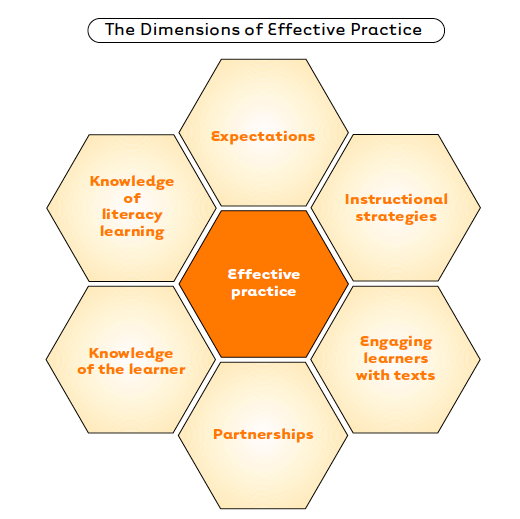
Dimensions of effective practice

This diagram shows the different dimensions of effective literacy practice. During this reading professional development, we will be focusing mainly on the instructional strategies section of this diagram.

After the first session, we were asked to go away and observe the errors that children in our target group were making.We needed to think about what they were doing, why they might be make that error and the needs of this particular child to move them away from making these errors.

Here are some of the patterns I noticed in a group of children reading at 8-8.5 years.

- 6/6 children showed signs of missing the middle of longer words. These children need strategies to attend to and correctly decode medial blends.
- 4/6 children showed signs of not attending to the ends of words. These children need strategies to support them in attending to the ends of the words.
- 5/6 children seemed to lack confidence when it came to decoding. This showed in a number of ways. Sometimes these children froze on challenging words and did not attempt to use any strategy to decode. Some children read extremely quickly and did not correct errors (either add ins or omissions). 2/6 children often added words in or omitted words and did not go back to correct themselves.

In my next blog post about in-school reading PD, I will explain strategies and prompts we are learning to support each of these above errors that are happening for these children.

Monday, 27 August 2018

Inquiry into reading

We met as a team to discuss how we can better plan for explicit teaching in reading. When teaching reading, it can be difficult to make strong links between what you teach in a guided reading group and what the children do as a task when they are not with you. Therefore, we worked together to discuss how we currently do this, and how we can improve our practice.

Here are some notes towards a potential reading plan for a group learning to infer and understand different points of views:

WALT make an inference about the author's purpose and their point of view when they don't state it explicitly.
[Make connections/ inferring/ applying knowledge]

Direct instruction idea: Questioning/ prompting the children to discuss.

Learning experience idea: Ask ourselves: Do they need the text to be able to complete the task - if not, it's not achieving what it should. Video contrasting two scenarios which are present in the text (teamwork vs. not showing teamwork).

Cycle rate idea: 2x a week guided reading + 1x check in.

How will I know what difference it made? Do similar WALTs for 2 lessons then tweak learning experience ideas. Seeing how they answer relevant questions in guided reading sessions.

Things to watch out for: Children who are mid-way through year 5 and reading at around 9 years need to be getting enough mileage so we need to ensure that enough texts are being read in a week.