Showing posts with label SGuide. Show all posts

Friday, 17 December 2021

End of Year Analysis: CoL Inquiry 2021

We are at the end of 2021 and what a year it has been! Since coming back to school, I have been unable to teach my Extension classes due to Covid-19 restrictions. As a result, I have formed a final data analysis to show what potential the implementation of my 'tool' could have had, had we had more time in the classroom this year.

I hypothesised that providing speaking prompts and increasing speaking mileage would close the gap between reading and vocabulary level when it comes to speaking and presenting. This was decided after I found that my target group were all great readers (above their chronological age) yet they did not demonstrate the same vocabulary understanding, use and knowledge when it came to speaking and presenting.

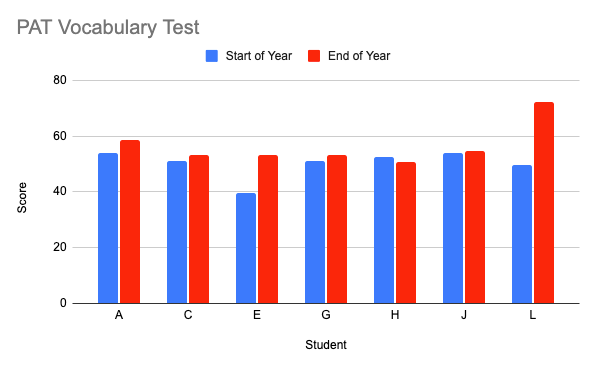
I compared the vocabulary test results for children who took both tests. Note that this test demonstrated ability to understand vocabulary through reading, a skill which we know these children are good at. Results showed that all children (except one) improved in their ability to understand a range of vocabulary they come across when reading. The one child who did not show an improvement stayed at relatively the same level.


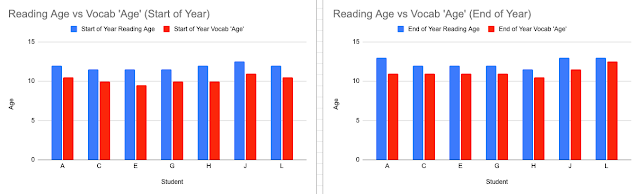
Next, I turned the PAT vocabulary test results (above) into an approximate 'age.' I wanted to see whether we have managed to close the gap between reading age and vocabulary level. Note, that the focus was to increase children's vocabulary levels in order to achieve this. You can see on the graphs that the gap for each child (difference between the blue and red column) does appear to be closing up for most children. 


 Unfortunately, I was unable to collect final term 4 data to show any increases in oral language of these children. However, I was able to collect a few second oral responses in term 3. These changes are explained in another blog post.

In all, I believe my focus on increasing speaking mileage with the support of speaking prompts has supported the children in the Extension class learning environment. It is something I highly recommend as a focus in all classrooms to support development of our children's oral language capabilities.

Thursday, 5 August 2021

Restating my Inquiry Question and Chain of Events

We are now half way through the year. In this post, I am going to restate my inquiry question to ensure I am still on track with my inquiry focus this year.

Inquiry Question: How can I change my teaching to support oral language progression towards the level of language which children can comprehend when reading?

Inquiry Goals: To improve oral language.

To reduce the disparity between the level of oral language and vocabulary used and the level of language and vocabulary they can read and recognise in written texts. To increase confidence when speaking and presenting.

Challenge: There is a disparity between the level of oral language and vocabulary which the year 5-6 extension children use and the level of language and vocabulary they can read and recognise in written texts.

Hypothesis: Giving children many opportunities to speak in front of each other (through sharing and presenting their ideas and learning within a small and a larger group), with the support of prompts and scaffolds will improve their confidence to speak and therefore improve their use of oral language.


Wednesday, 9 December 2020

End of Year Data Collection

My hypothesis was:

A focus on critical thinking and causal reasoning when responding to texts will support increased levels of critical thinking and ability to create causal links in online written interactions with others for year 5 children reading between 10 and 12 years.

After implementing use of Peter Worley's framework, The Concept Box, into reading lessons, I collected data to compare with the data I collected at the beginning of the year. Graphs from the beginning of the year are also in these slides to make comparisons.

Friday, 29 November 2019

End of year findings: comparing findings of the end of year cybersmart survey across classes


The data in these slides compares to different classes - one who had an intervention of creating cybersmart clips in class and with a focus on interpersonal skills and critical thinking online; the other who did not have the intervention.

Wednesday, 20 November 2019

End of year findings: comparing findings from the pre and post cybersmart survey


In this presentation you will see a comparison of graphs between the pre and post cybersmart survey data which I collected.

Things to note:
- More children responded at the end of the year than at the beginning of the year.
- These findings were not based on standardised tests but rather analysis of data collected from in-class cybersmart learning.

Thursday, 29 August 2019

1. SHARE: Evidence about what I have done differently

Link to overview blogpost

Share data that you have collected/ recorded about the implementation of your changed practices or intervention. What evidence do you have about what you did differently?

As a result of a lot of research, some data collection demonstrating the children's knowledge at the beginning of the year, and several years of observing and pondering, I have implemented a new way of teaching how to be cybersmart into my classroom. Basically, this change in practice/student learning includes a shared class brainstorm of a topic and then time for the children to collaboratively plan a 30sec-1min movie before filming and editing their movie to share their learning.

Data collection began in term 1 where I had the children in my class complete a cybersmart assessment to decipher their current knowledge and skills. This was followed by a lot of research. The combination of these two things clearly showed a need for the children to be taught interpersonal skills and critical thinking in a digital/ online environment. It also showed a clear connection between these two skills.

Since implementation of the intervention/tool/ change in practice began, I have been collecting a range of data which includes blog comments, collaborative planning, movie clips, student voice, and examples of when situations may not have gone as smoothly as expected online. These assessments have been ongoing throughout the year. Information collected in google forms (blog comments in particular) as well as movies (shared in blog posts) are time-dated.

Blog comments

These are documented in a spreadsheet so I can track blog posts of individual students.

Collaborative planning

Whole class plans:


Here is an example of a collaborative planning script which suggests deep connections being made by those in the group as well as successful collaboration:

______________________________________________________________________________
     The Words we Use…


                S.F.A: Welcome to S.F.A news.
A: Broadcasting to you live!
S: In this production we are telling you about…
S.F.A: The words we us
F: Meaning everyday life online.
S.F.A: Here's a short clip of some of the words we use.
F: How you say it is how you mean it.When do you use it?In your everyday life.
S: Why is it important?Well because it creates your reputation and your furture.Heres the words you should use. *F's comment does not sound right*Movie script: Then S and A come in and say* *Then F is about to press publish*


S and A: Whoa whoa whoa whoa stop right there. Is that what you really meant F? 


F: Yeah
S and A: Try read it again...it doesn’t sound as thoughtful as it could be...
*F reads comment* 
A: you realise you didn’t finish your last slide?
F: I didn’t mean it sound that way….
Now that I think about it.Could you guys help me?
*S and A help F* 
F: Thank you for helping me.


   *S and A correct her*


S & A: You're welcome F.
S.F.A: Did you enjoy this episode of S.F.A news?
S.F.A:Well we hope you did


S.F.A: Sayonara and goodbye.
______________________________________________________________________________

Movie clips


Student voice - What do you like about cybersmart learning?


Student voice - What would you like to do differently?


I have had to make changes and tweaks throughout the year. The current intervention/teaching practice is very different to what I first envisaged. I set out at the start of the year to create a set of child-friendly posters to instruct for a range of situations which may be faced online however, moved away from this when data, research and various conversations did not see this as the biggest need. You may notice that the first movies which were created (Passwords) were difficult to hear. These first movies were created much more independently by the children, without editing, however there were a lot of frustrations. In particular, the sound caused a lot of frustration for the children as they were not using microphones. We have now adapted this so the children use a microphone attached to the camera. We also use the camera on a tripod rather than the iPads now as this creates a more stable picture. Now the children are able to share their knowledge confidently and clearly through their cybersmart clips. I have also been providing them with a lot more support in the filming. I tell the children that I am their cameraman but they are the director so they are in charge. They enjoy the fact they can boss me around!
Thursday, 14 March 2019

Within school CoL: Intro to Inquiry

This year, I am going to be modelling the teaching as inquiry process as part of my role as a within school CoL teacher for Pt England School and Manaiakalani. I am fortunate to be part of MIT19 this year as well, which means I will be able to focus in on my chosen inquiry topic through two different roles. I have already attended a MIT19 two-day hui where we worked on refining our inquiry problems and began creating a prototype for a tool which we will use as part of our inquiry.

Here is the Manaiakalani Teaching as Inquiry Framework which we follow.


Over the last 5 weeks, my inquiry has been sitting in the LEARN section of the framework. As I begin creating a prototype and my idea of a tool begins to grown, I will be moving my thinking into the CREATE aspect of the framework. 

To begin thinking about my inquiry, I have looked at a number of inquiries from previous CoL teachers. This was a challenge due to the nature of my inquiry which I am undertaking this year. Below, I have posed my inquiry challenge and have followed this with several relevant links to previous CoL teacher inquiries:

Kāhui Ako Achievement Challenge 5: Improve the achievement of students with additional needs in the learning areas of English/ key competency using symbols, languages and texts.

My Inquiry Problem/ Challenge: Children living in a digital world, where key competencies are essential, require ubiquitous access to cybersmart scaffolds and resources which are not currently available.

Relevant previous CoL teacher inquiries:

Anita Unka (Stonefields School): Anita has explored the importance of creating a culture to empower learners to take ownership for their learning through student agency. This is relevant to my inquiry topic, where I want to be empowering children to be cybersmart citizens through use of child-friendly and rewindable resources. 

Clarelle Carruthers (Pt England School): Clarelle is looking at how to make teaching and learning more visible and rewindable. This is relevant to my inquiry topic, where I want to be giving children resources which can be accessed anywhere and at any time.