At the Kāhui Ako Bursts & Bubbles presentation this year, the 2023 Kāhui Ako Teachers present 3 minute bursts about their inquiries this year.
Here is my presentation:
Here is a video of the afternoon's presentations:
In 2022, I inquired into developing confidence using videography roles within the Pt England Network News programme. There were some great things I learned through this inquiry, particularly the value roles like videographers can provide to develop confidence in some children. Going forward into 2023, I want to continue to utilise roles within the Pt England Network News programme to develop confidence in children. I will continue to think about what the role of videographers may look like and add in more opportunities for children to do movie editing. I will work through challenges. One of the big things that played on my mind during 2022 was that I was very conscious not to have the same children out of class too often to video at sports tournaments as, even though there is huge value in leadership, creativity, problem solving and making decisions when out as videographers, I didn't want their role as videographers to hinder their progress in classroom subjects.
Next year, as I continue as a within school Kāhui Ako teacher, I want to look into a very different challenge. I want to use learning opportunities provided in the creative space to look at developing persistence and success in children who find focus and success a regular challenge in their schooling. How this looks, I will spend some time developing over the first term of 2023, so watch this space!
Last week, the annual Manaiakalani Kahui Ako Bursts and Bubbles was held! I picked out some of the inquiries which really resonated with me this year which I could utilise in my role.
Dot Apelu: Focus on supporting children to connect with their local community.
Scott Mansell: Emphasis on local histories to raise engagement with learners.
Jo Gormly: Building solid foundation of literacy.
Kelsey Parrant and Robyn Anderson both focussed on enjoyment of reading. Robyn's inquiry focus made me wonder how I could share tips for good reading etc on PENN. This is something to think about moving forward!
Christine Tupou-Fonua: Teacher & Student well-being - how does it influence achievement, engagement & enjoyment?
Poto Faalili: Preparing Year 8 students for Year 9.
Over the last couple of weeks, I have had two videographers from my target group of students who have shown interest in being the videographer at in-school events. In these situations, they have been the ones who have suggested being the videographers. This sign of enthusiasm tells me a lot about the mindset of these students, how they feel valued and confident in themselves and that being a videographer is something they are good at and can lead in.
This anecdotal evidence is hugely valuable to see the success in using videography as a way of developing confidence in some children.

We are at the end of 2021 and what a year it has been! Since coming back to school, I have been unable to teach my Extension classes due to Covid-19 restrictions. As a result, I have formed a final data analysis to show what potential the implementation of my 'tool' could have had, had we had more time in the classroom this year.
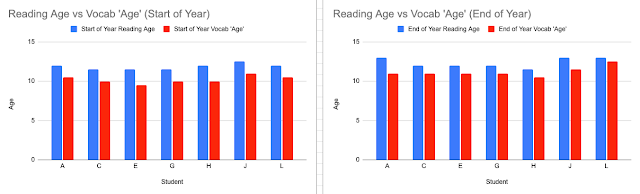
I hypothesised that providing speaking prompts and increasing speaking mileage would close the gap between reading and vocabulary level when it comes to speaking and presenting. This was decided after I found that my target group were all great readers (above their chronological age) yet they did not demonstrate the same vocabulary understanding, use and knowledge when it came to speaking and presenting.
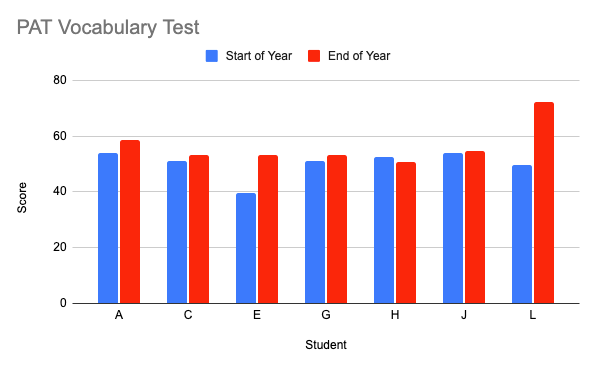
I compared the vocabulary test results for children who took both tests. Note that this test demonstrated ability to understand vocabulary through reading, a skill which we know these children are good at. Results showed that all children (except one) improved in their ability to understand a range of vocabulary they come across when reading. The one child who did not show an improvement stayed at relatively the same level.
Here is my Bursts in Bubbles 3 minute video to summarise my inquiry and findings this year:
During the Manaiakalani Kāhui Ako Bursts and in Bubbles event this afternoon, I took summary notes about the inquiries I felt I could utilise in my own current practice and incorporate with my own findings in my inquiry.
Anita Unka (Y1-2): How can I use feedback and feedforward in writing to build relationships with whānau, enabling greater shifts in student achievement for our tāmariki?
Gaps in oral language, limited vocabulary --> limited ideas when writing.
Writing flexi-connects - whānau on other end in a meet while teacher and child at school.
Through lockdown, the flexi-connects changed where the child was with their parent and Anita was on the other end of the call.
Poto Faalili (Y7&8): How will being culturally responsive in my teaching and an integrated approach to teaching and learning accelerate student achievement?
Engaging boys, particularly those that turn up to school late.
Student voice via talanoa.
Priority to see this group every morning at 8:30am. Changed to lunch with lunches. Well-being was important in this as well as talanoa about learning.
Amy Tofa (Y7&8): Will building self efficacy in students enable them to be more independent in Project Based Learning and accelerate their progress in Reading?
Lack of self efficacy for completing project-based learning.
Lack of confidence.
Frank Paris to build self efficacy.
High anxiety impacts self efficacy.
Christine Tupou-Fonua (Y7&8): Can we make accelerated shifts in literacy through teaching identity & cultural competencies?
Coconut Model Work (see her blog)
Clarelle Carruthers (Y4): How will using a variety of high interest texts and providing open tasks impact students critical thinking?
Critical thinking and vocabulary.
Frustration by children was a big issue.
Whole class theme for reading each week to encourage more collaboration and vocabulary development.
For true critical learning to happen, the children need to be doing the work - remove the scaffolds.
Kelsey Parrant (Y5): Will a focus on vocabulary and interest specific texts have an impact on reading achievement for my learners reading below 8 years?
Lack of understanding or strategies to understand meaning of vocabulary when reading.
Robyn Anderson (Y7&8): Will a focus on oral language in maths accelerate student confidence and capability to use spoken and written maths vocabulary and language?
Oral language and maths
Stepping in with scaffolds too early as the teacher wasn't helpful.
Robyn also developed some speaking prompts to support the children in learning to talk.
Giving children time to talk was essential.
Aimee Litchfield (Y1&2): How can I develop the use of oral language and use a wider range of vocabulary to see acceleration across all curriculum areas?
Unable to express themselves with more than one word.
Daily picture prompts.
Increase in vocabulary.
Next steps - to develop fluency.
Strongly implement learning in oral language through to writing.
We have spent most of this last term in lockdown due to Covid-19. During my time working from home, I have been responsible for the continuation of PENN, our Pt England Network News. I have been really fortunate to have an amazing team of children working with me to make this happen. Daily email correspondence with the children has been essential. Rather than me selecting which children are going to present each day, I have made it the responsibility of the children to commit by putting their name down to present each day. This has been really successful and there have only been a few occasions when I've had to follow up on children who have forgotten or find replacements when I can't get hold of someone.
Here is an example of the finished product:
You can see that another big part of my job from home has been to put together examples of learning that have been happening at home during lockdown. It has been great to share so much on PENN each day and to document this time in our lives! As well as looking through many children's blogs myself, I have received regular emails from some teachers with children's work they want me to share but I have also received emails from children who are proud of something they have done and want some of their learning shared. Celebration of this has been a huge part of what I have been working on from home.
In addition to producing the news each day, I have taken my year 5 & 6 and year 7 & 8 extension classes weekly and have run Creative Space meets each week for Team 4 (year 5 & 6) and for Team 3 (year 3 & 4). On Fridays, I have run an elective class for Team 5 (year 7 & 8).
Year 7 & 8 Controversial Topic Brainstorm: Which country should some Olympic athletes compete for? Click on the link to see the children's work for one of our google meets.

This term, I have begun implementing my new tool for the year 5&6 extension class. Using a range of conversational and discussion prompts from online, I have made a set of speaking prompts for the children. During each session with me, the children will be given a laminated card with a prompt. Their job is to respond to the work from the session using the prompt they have been given. This could be in response to a video they have watched, a discussion point or a text they have read, for example.
From today, I would like to start giving them their prompt at the beginning of the session so they have a longer amount of time to prepare their response. We will finish each session 10 minutes before the end of the day so the children can share their responses.
The initial implementation of this tool has been really successful. The children find the prompts useful and they appear much more confident when they have the prompt to support them in speaking and presenting. Here are copies of the prompts:


I have had discussions with a year 2 teacher at school who really liked the idea and thought her year 2 children could benefit from a similar approach. This began me thinking about how we could adapt the design for different age groups.
Last Friday, we had a Manaiakalani Teacher Only Day with a focus on literacy. We had a fantastic keynote presentation by Dr Rae Si'ilata. During the day, we also went to 3 workshops run by teachers in our schools. I took a workshop on my inquiry from last year, where I researched, used and adapted Peter Worley's Concept Box Framework into my teaching to support development of critical thinking.
Here are the slides from my workshop:
After implementing use of Peter Worley's framework, The Concept Box, into reading lessons, I collected data to compare with the data I collected at the beginning of the year. Graphs from the beginning of the year are also in these slides to make comparisons.
This afternoon, we had our annual Bursts and Bubbles function where all of the 2020 CoL teachers presented a snapshot of their 2020 Inquiry. Here is my 3 minute presentation.


