Showing posts with label LHypothesise. Show all posts

Monday, 12 June 2023

Kahui Ako Meeting: Looking at the Research Literature

 At our last Kāhui ako meeting, we looked into the research literature that we are using to support our inquiries. We collaborated in groups depending on what our inquiries were. I worked with Danni Stone and Clarelle Carruthers and we came up with the following:

Theme/ overarching topic or intervention type: Understanding student achievement and how to support maths progress for diverse groups of learners.

My formulating a hypothesis document

Literature we have looked at:

Basic Facts 

Nz students value in mathematics

The Education Hub - mathematics

Why fractions are hard!

Linchevski, L & Kutscher, B. (1998). Tell Me With Whom You’re Learning, and I’ll Tell You How Much You’ve Learned: Mixed-Ability Versus Same-Ability Grouping in Mathematics, Journal for Research in Mathematics Education, Vol. 29, No. 5, P533-554.


Further conversations with colleagues, school leaders


I have more of a need to focus on the children who aren’t applying their mult/div knowledge to solve problems.


How do I move children from knowing their times tables to applying their times tables?


Friday, 5 May 2023

Structure of Implemented Change

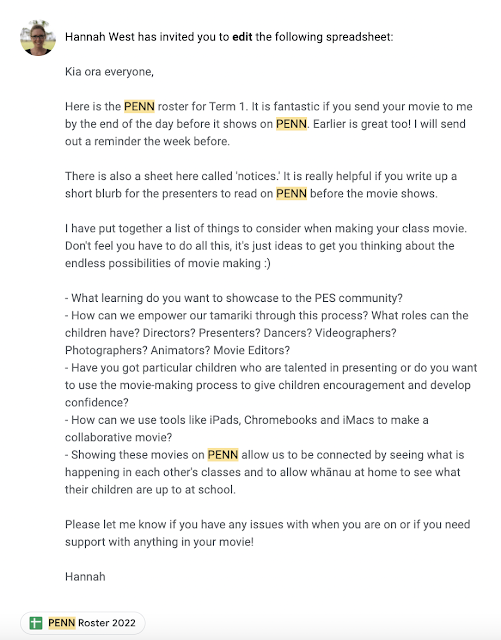
Here is my initial plan of a structure of implemented change.

Formulating a Hypothesis


This week in our Kāhui Ako meeting, we discussed formulation of hypotheses. I have chosen to summarise my hunches, as well as research that has supported these hunches and feedback from my Kāhui Ako colleagues. I believe that my hunches are still too broad and more work needs to be done to narrow down my focus to something which is going to be measurable. 

Thursday, 6 April 2023

Tools/ Measures/ Approaches - Part 1

Our challenge:

Student Challenge:  How do we accelerate achievement in maths when students have a range of maths abilities with various gaps in maths knowledge? 

Teacher Challenge: How do we accelerate achievement in maths when teachers are tasked with teaching a classroom of students with a range of maths abilities and with various gaps in maths knowledge?

Personal justification of running an extension maths programme (see previous blog post):

A typical classroom includes a range of mathematics levels. How do we as teachers realistically support the children who find maths really challenging while also extending those who find the logic of maths more natural? It is challenging, that's for sure! We have a really unique opportunity here where we can run an extension programme for those children who we identify as gifted in Maths, allowing the classroom teachers to spend that session focussing on building the knowledge for the rest of the class. The extension group can then return to their classroom and use their new knowledge and skills to work alongside their other classmates to build their maths knowledge.

What does the Manaiakalani research say to provide evidence and justification for this inquiry?

See previous blog post

What does the wider research say?

In any inquiry, it is important to have tools, measures and approaches which are planned for use so we can get a more detailed and accurate profile of students' learning in relation to a challenge. If we aren't doing this, then any implementation of something new is really just a guess!

To start this off, I went to the research. Over the course of this inquiry, I want to make sure I look at multiple view points to see how to best teach extension level maths students. 

Text: Linchevski, L & Kutscher, B. (1998). Tell Me With Whom You’re Learning, and I’ll Tell You How Much You’ve Learned: Mixed-Ability Versus Same-Ability Grouping in Mathematics, Journal for Research in Mathematics Education, Vol. 29, No. 5, P533-554.

Key Points:

  • Ability Grouping (subject-by-subject, also known as tracking vs. all subjects at once, also known as streaming).
  • Ability grouping can be used to change content, pace or teaching methods.
  • Some research has shown that by ability grouping, the gap between abilities increases. 
Personal note: does this mean it is negative effect for those who do better? We will be doing things differently where we will be reducing class numbers for an hour per week so the classroom teacher can give more time to those who need it for the basics of maths. 
  •  Quality of oral language used (within communication) differs greatly between lower ability groups and higher ability groups. With this comes differences in expectations (Gamoran, 1993).
Personal note: we will need to make sure we don't allow this to happen.
  • Preteaching (described in study on page 536). Mix of homogenous and heterogenous groups. Students have preteaching in homogenous groups. "Whenever a teacher felt that a large, specific homogeneous group of students would benefit from the teacher’s direct intervention, that setting was used—for example, to better prepare weaker students to be integrated into a planned heterogeneous group activity." Page 536.
Personal note: This sounds very similar to what we are trying to achieve.
  • Homogenous (children of same ability) vs. Heterogenous (children of different ability) grouping
  • Study 1: After 1 year, in 10/12 schools, Mixed ability grouping did not impact the gap between achievement between children of various abilities. In 2/12 schools, it widened the gap however there were signs of this gap reducing after two years.
  • Study 2: Mixed ability grouping was hugely benficial to average to lower ability students. Higher ability students did not lose any achievement by being in mixed ability grouping.
  • Goroman (1992) - workshop type pedagogy - look more into this.
  • Overall, this Journal Article and studies are in favour of Heterogenous grouping/ Mixed Ability Grouping for teaching mathematics.
Next Articles to look into:

Gamoran, A. (1992). Is ability grouping equitable? Educational Leadership, 50 (2), 11–17.
Gamoran, A. (1993). Alternative uses of ability grouping in secondary schools: Can we bring high quality instruction to low-ability classes? American Journal of Education, 102, 1–22.

Thursday, 9 March 2023

Collaborative Inquiry Group Meeting

 Today we had time in our staff meeting to meet and talk about our inquiries. Clarelle, Danni and I discussed what the challenge of learning was that we wanted to focus on. We realised that there were more than one challenge and we wondered whether dividing and conquering would be the best approach to tackle more than one of these challenges.

The challenges to student learning:

-Inability to apply knowledge 

-Not choosing the most efficient ways of solving problems

-Knowledge of gaps and next steps. (children being aware of these) 

-Self efficacy, learning from each other. 

We wondered whether tackling different challenges and then coming together collaboratively may be the best approach to our inquiry. For example, I will only be seeing a group of extension maths children so it would make more sense for me to focus on the first challenge (Inability to apply knowledge OR Knowledge of gaps and next steps).

We also heard from Rob Wiseman who is the Year 7&8 team leader. He is looking at the challenges in reading and discussed a challenge the children have when inferring.

Friday, 3 March 2023

Creating surveys to start painting a picture of the challenge school-wide

 While Clarelle and Danni have been gathering data from the students in their classrooms, I started creating some surveys to be sent out to Senior management, Teachers and Students from across our school. The three of us then sat down to add some more questions, make a few tweaks, simplify the surveys and then send them off. Our focus was to find out what our colleagues own views are around challenges in maths for their own students as well as their own teaching. 

Here are the surveys that we created.

Student Survey:


Teacher survey:


Senior Management Survey:

Tuesday, 9 August 2022

Inquiring into my teaching practice

Hypothesis:

If a less experienced classmate is supported by a more experienced classmate to learn a new skill, then their confidence in this skill will begin to develop. Confidence will begin improving in this skill as well as in other areas of school and life once they are out making decisions for themselves as members of the PENN (school news) crew. 

What specific aspects of my current teaching are relevant to my hypothesis:

How am I teaching the more experienced classmate how to follow the values of the Tuakana Teina approach?

- Ako (learning/teaching)

- Manaakitanga (caring/uplifting each other)

- Rangatiratanga (uplifting students)

- Whanaungatanga (relationships)

- Tuakana Teina (apprentice-expert)

At what point do I as the teacher let the less experienced classmate start having more independence from their more experienced peer?

What is my role in this if the more experienced peer is taking on the 'teaching' role?

Formative information about your current strengths and areas for development:

Student voice (also in previous blog post):

Findings: Three children felt confident with knowing how to tell their teacher that they needed help. Four children felt that their confidence with this dropped compared to their primary responses. I'm not entirely sure for the reason for this however, it could result in the fact that in a Tuakana Teina relationship, the more skilled peer is like their 'teacher' and my role as the teacher was to step back from that "traditional" role. The children need to be seeing their peer as their teacher in this pedagogical approach which may still feel slightly uncomfortable to the children.

Practices which are currently implemented to support the hypothesis:

I was fortunate enough to have a whole day with my target group and their more skilled peers during our recent Matariki day. However, what practices am I implementing for general day to day improvement?

- Daily PENN crew - photography, video editing & presenting, studio technicians

During the daily PENN session, I teach children skills for developing their photography, video editing and presenting.
Presenters come in at 8am, open the script and rehearse before their turn to present.  I give the presenters in the moment support and tips based on their own individual needs.
Photographers get opportunity to develop their skills learned through Creative Space. I give them feedback on their photos on their return, explaining what makes their photos good.
Video editors get autonomy to learn how to transfer files between SD card and iMac. They also learn editing skills through iMovie.
Studio technicians set up the studio (lights, green screen etc).

- Sports events - Videographers and Photographers

Students attend sports event with video camera and still camera. This is a challenging area as I cannot attend the sports event with these children to teach them new skills and techniques. 

What changes can I make to my practice?

Currently, there is no implementation of a weekly training time for the children who are photographers and videographers. This is something I should definitely be implementing to explicitly encourage confidence for these children. This could be a before school on Friday session (since I don't run PENN on this day) OR a weekly lunchtime session (where we go and film sports trainings to learn skills). 

What do I need to do to implement this?

Videographers lunchtime club - Meeting together regularly to learn the skills of videography and photography.

More mileage of videography and photography for these children.

How can I measure changes to my practice?

I will measure changes to my practice by:
- Continuing to gather student voice about how students feel they can ask for help.
- Making a comparison of the interventions and implementations that I have added during the year.


Monday, 20 June 2022

Cycling back to Hypothesis generation now I have identified a potential catalyst

"If you carry one handle of the kete and I carry the other handle we share the load." (Aroha Puketapu & Graeme (Kereama) Smith).

Check out this great description of Tuakana Teina on TKI.

Important Māori values in this Tuakana Teina approach to be aware of (see video below to see these explained):
- Ako (learning/teaching)
- Manaakitanga (caring/uplifting each other)
- Rangatiratanga (uplifting students)
- Whanaungatanga (relationships)
- Tuakana Teina (apprentice-expert)

Article from Inclusive Education with some great ways to build confidence in the classroom. Many of these are things we are currently doing at our school.

Potential Catalyst for Change: Using the pedagogical approach of Tuakana Teina

What I am trying to develop: Confidence/ Self-esteem

Potential Hypotheses ("If _____ then ______")

1. If I pair children up with more experienced classmates, then confidence of the less experienced partner will develop.

2. If a less experienced classmate is supported by a more experienced classmate, then their confidence will improve.

3. If a less experienced classmate is supported by a more experienced classmate to learn a new skill, then their confidence in this skill will develop as well as their confidence in other areas of school and life.

4. If children have opportunities to learn a meaningful and purposeful skill alongside a more experienced peer, then they will develop in their confidence to speak up and lead.  

Monday, 13 June 2022

Stopping, Reflecting and Refocussing my Inquiry

 Today I continued looking into research but realised I was still uncertain about what I was actually trying to achieve. I stopped and reflected on who my target group are. The target group are children who showed low confidence in terms of speaking, presenting and sharing ideas. Understandably, I have gone down the path of oral language and what makes a good 'speaker' however when considering the big picture, I don't believe I am going to get good results if this is my focus with this group of target learners. I first need to support development of their confidence before I even consider supporting them to become better speakers. 

During a Kāhui Ako meeting at the beginning of this term, Across School Teacher Amy Tofa, suggested using Tuaka Teina to develop children's confidence. I am in a unique position where I have children ranging from year 5 up to year 8 who are all experienced and skilled in Presenting, Videography and Video Editing. I also have children who could benefit from being paired up with a supportive, patient and experienced student who can support my target learners in developing  their confidence through various roles in the production of our school news.

This week, I plan to introduce these Tuakana-Teina partnerships.

How this will look: 

1. Presenters. Any children who have been paired to develop a potential presenter will attend our news filming at 8am on Monday through to Thursday. They can being by practising the same script as the Tuakana and as buddies, will decide when the Teina is ready to present. They can use tools such as quicktime to develop the confidence of the Teina, even if they don't yet have the confidence to present in the actual news. 

2. Videographers. Each Tuakana will support a Teina by taking them along to sporting events and other school events to film together.

3. Video Editing. Each Teina will work with Tuakana to edit footage from sporting events, student movies from around the school that have been filmed by Videographers. This could be the same children who were the videographers.

Monday, 9 May 2022

Preliminary Data

 I have begun gathering some preliminary data for my target group of children. These children were selected due to being at the 'reading to learn' phase of their reading development. I have selected children whose reading ages are at 9 years and above as these children will be required to read from a script which changes on a daily basis.

Using my knowledge of these children as well as asking for teacher recommendations, I have selected a group of children who are noted as lacking some confidence or oral language capabilities, despite their confidence in reading and writing. These children are also children who show potential in developing their confidence. This information was found through anecdotal notes from previous teachers, conversations with teachers as well as my own knowledge of these children.

I asked these children to fill in a questionnaire about their own confidence and communication abilities.

I colour coordinated responses from this survey to create a picture of self confidence.

Example 1:


Response 1 = Red
Response 2 = Red
Response 3 = Orange
Response 4 = Green
Response 5 = Green

Example 2:

Response 1 = Green
Response 2 = Green
Response 3 = Orange
Response 4 = Red
Response 5 = Red

From this survey, I have created a target group of students. Students in the target group are children who scored orange and red across a number of their responses.

Their responses sat alongside the responses of a group of children who demonstrate strong confidence, oral language and communication. These children will not be in my target group as they always have strong self confidence. This will be some of my baseline data which will be compared at the end of the year.

Once I have found all children in my target group, I will use a standardised self efficacy test to which will be used to compare the responses of individuals in this target from the beginning to the end of the year.

Monday, 21 March 2022

Data Collection

As I have mentioned in previous posts, my data collection will be focussed on confidence, communication and oral language. So how will I assess these three elements to create a profile of learners?

PAT Vocabulary Test: This will give me an idea of the children who need support in developing their vocabulary knowledge. 

Observation: I have emailed the team 4 teachers to ask them to observe and recommend children who could benefit from being a videographer, photographer, presenter or editor for the news to support development of confidence, communication or oral language.

Reading Age: The idea is that the children who are presenters for the news should be reading at 10 years or above. This is because the news requires children to read from a script fluently.

Student Voice: Asking the child about their confidence, communication and oral language and about the their speaking and confidence at home.

Whanau input: Gathering data through conversations with parents about their child and their confidence, communiation and oral language at home.

PENN episodes: Comparison of children in term 1 compared to term 4, presenting on the news. How have they improved? This could be measured using a rubric.


Example of using movie as a medium to create meaningful learning experiences for children

At the beginning of the year, I sent an email out to our teachers at Pt England School. A large element of the Pt England Network News is sharing learning from across the school. During lockdown last year, it was challenging to expect each teacher in the school to do this. I would sift through the children's blogs to find great learning examples and share these daily on the news. Now we are back at school, it is important that I place that responsibility back onto the teachers so that each class and the tauira in that class have their learning showcased in some way. 

Here is the email I sent out to the teachers to encourage this:


In the email, I created a list of suggestions to teachers to support them in making movies which are meaningful for our tauira. 

Last week, I came across a wonderful example of a teacher who used these suggestions to make an awesome movie! Heidi Davis is a third year teacher who teaches year 2 and 3 children. Heidi looked over the list I had sent and wanted to use her term 1 PENN movie to create a meaningful learning experience which would challenge and excite her learners.

In her movie, she had one of her year 3 children read the script. You can hear the confidence, fluency and clarity as he reads. What a fantastic, engaging, REAL learning experience for this child! Other children showcased their learning through the term. Heidi included her children and they were highly aware of the purpose as they created the movie together. Heidi said that the children were so excited to see the finished product! The anticipation of waiting now until it shows on PENN is engaging and will create a fantastic intrinsic reward for the children too! 

Here is Heidi's movie:


This is such a great example of what I hope to see more of through my inquiry this year. I want to see more movie making happening across the school which engages children, creates real learning experiences and gives children a purpose in their learning. I want to be able to watch movies like Heidi's class movie and be able to see the learning that the children have had through the experience of making the movies.

Having taught in the classroom, I do understand and appreciate the time that is required to do this well. Therefore, part of my role will be to support teachers in making this happen. 

Monday, 7 March 2022

Developing confidence, communication & oral language through film

Producing the Pt England Network News (PENN) for the school has started off with a bang this year! We have got some fantastic new equipment to improve the quality of the product we create at school. I have also already started seeing the potential that using film at school has on learning for the children, particularly confidence, communication and oral language.

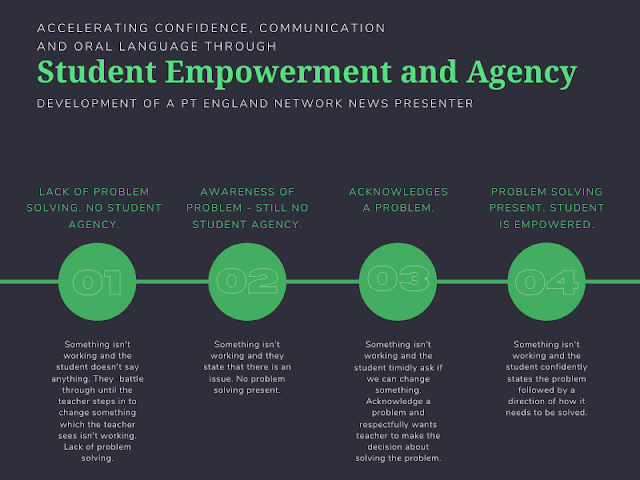
There is an understanding amongst my PENN crew that we are a team. I am at the same level as them in the team. This is the first step I use to create confidence amongst the children and it sometimes takes some time for the children to get to the point where they realise they can tell me what to do, rather than ask. An example of this is if the sun is in their eyes when filming. Rather than ask to move, the understanding is that the children can tell me that we need to move. When the script is scrolling too fast, the understanding is that the children tell me that it needs to be slowed down, rather than ask for it to be slowed down. 

The pattern I often see with new children is this:

On Thursday last week, one of my presenters said that they wanted to develop the weather section of the news to provide more important information. In particular, adding in UV levels and fire risk. We decided that having a UV level included was important for the audience to know about.

On Saturday, I received this email:

Yes, emailing you on the weekends is probably the wrong time but I want to add the UV level part. It's to tell whether you need to stay protected from the sun, or if it's ok and you won't get a sunburn.

Thanks if you want to add it.

Here is some of the email thread we had. My emails are in red, where the student's are in blue.

Hi _________,

I have taken the fire danger level out but thought we could include the tide times and water temperature at Pt England Beach. What do you think? Keeping the UV level in is great!

Miss West

YAY to UV level! I thought I was going to add that but I think that it was too much information. So that means that:

Tomorrow's weather, UV level, tide times (maybe for after school so they can play at the beach after school) and water tempo is going to be added for weather. And inquiry is the easiest one. For now...

That's it. Let's see what we think and decide if we want to remove anything this morning.

Ok, let's do more detail person to person in like 10 minutes

I was so impressed when this student re-voiced our conversation in writing, creating a great summary of what we had discussed (see above in blue). This is a great example of me working alongside a child at their level, encouraging them to solve the problems with confidence.

Here is the finished product of the weather segment this morning after the email stream (go to 6m36s).

Monday, 28 February 2022

How can we provide opportunities for the PENN crew outside of 'normal school'

Providing real life, authentic learning experiences has long been seen as valuable for children. It provides a strong purpose for the children. PENN has always had this but has become more so as it is shared on an online platform which whānau and the wider community can view. This has become even more important over the last few years, with children learning from home. 

A quote from one teacher, describing the importance of PENN during lockdown in 2021: "A constant presence on the daily to help us keep some of the normal going."

Our first opportunity for members of the PENN crew to create a purpose beyond the walls of school will happen this week. We are going to be filming a virtual visit to our school as part of a collaboration with the Digital Council for Aotearoa. This experience will provide opportunities for several videographers as well as several presenters who will provide the voice overs, commentary, lead an interview and will 'host' the virtual visitors.

The finished product will be able to be used by the digital council as well as by us for visitors to our website.

Going forward, I will need to consider how we can provide more of these opportunities to our children, particularly since one of our major external opportunities - sporting events - is not happening much at the moment.

Some opportunities which will lend itself to this:

- Te Oro - Baby Whale Tale on display
- Blake NZ-VR experience - could we get our children to organise a 'documentary style' short film which they could then utilise?
- Some community-focussed documentary style short films to learn about the amazing things happening in our community - Kereru Kidney Centre, Te Oro, Rocket Lab, Kai Collective Project, Ruapotaka Marae, Tāmaki Regeneration.
- Meet some heroes in our community - interview of local doctors, nurses, police, supermarket workers, Marsic Bros etc.

These could be fully created by the children - from videography through to post production.

Now, I know this is ambitious especially with the fact we can't even take children out into the community at the moment, but I strongly believe this would be the next step in developing the Pt England Network News to the next level. I am sure with a team behind me, we can make this happen!

Good inquiry happens in teams

At our Kāhui Ako meeting, we discussed the importance about inquiry happening in teams to make them effective and successful. I thought it would be useful to think about who my team will be.

So far, I am thinking about inquiring into my role as leading the PENN (Pt England Network News) programme and how this programme can be used to support confidence in children's oral language capabilities. 

So...who would be in my 'team' ?

Russell's inquiry into having "present, happy, healthy, engaged tauira who are learning in the goldilocks zone" definitely fits nicely with my inquiry. There are many opportunities for children to get excited about through the PENN programme. These include presenting, being a videographer or photographer and movie editor. 

The teachers of Team 4 and 5 are very much important in my 'team' as they are the ones who teach these children on a day-to-day basis. In the environment of living in a pandemic, having these teachers on my team is important to ensure the day-to-day running of the news, even if the children or myself have to be isolating at home. It will be important to consider how we will continue to have the news running if and/or when these scenarios arise. Regular conversations with these teachers will be important to decide on these children who would benefit greatly from the opportunities of the news as well as seeing progress of these children in their confidence and oral language.

In this inquiry, it is going to be important to have an 'innovation team' as well. This could begin through my 'Team 6' colleagues as well as the enablers group. These people will be important to bring new ideas to fruition to change up the news and provide more opportunities to develop confidence and oral language.

My Kāhui Ako teachers will also be extremely valuable. Through looking at my colleague's blogs I will find those teachers whose inquiries match with mine and which could benefit from each others findings.

Wednesday, 23 February 2022

Kāhui Ako: First meeting of the year

Last Thursday we had our first Kāhui Ako meeting of the year. Russell and Chris challenged us to rethink our inquiries for the year, pondering what is realistic and important in the world we are currently living in. Russell gave a personal example with his own inquiry, "How do we reliably get a 'threefer' - three core subjects accelerating simultaneously, 3 years in a row?" Realising this was no longer a realistic expectation with so much disruption to school, he has considered changing his inquiry to, "How do I have present, happy, healthy, engaged tauira who are learning in the goldilocks zone." Russell then discussed the fine balance between social connection/ building relationships and risk mitigation/ public health goals. These two things are so important at the moment however class terribly in terms of giving them both 100%! So how do we do it?

Russell's korero got me thinking about what I can be doing for our tauira to ensure they are coming to school engaged and happy, and to continue to build their confidence - something my programme lends itself beautifully to. 

My role is divided between teaching in the Creative Space, teaching the Extension classes and teaching children through the daily production of the Pt England Network News (PENN). All of these programmes are things that already engage and excite our children. So how can I develop these programmes deeper, to better develop the confidence and key competencies of our children?

Going through lockdown last year made me realise that the children I connect with the most on a daily basis whether I am at school or at home, and therefore can have the largest impact on in this world where we have to be so flexible and resilient, is my PENN crew. During the long 2021 lockdown, I was in daily email contact with these children to ensure the news was created and online each day. This real experience in itself created a huge amount of motivation for the children involved.

Since we have returned to school, a group of keen presenters come to school early to film for the day's news. The motivation is there. So what can I do to further benefit children in our school? In particular, which children would benefit the most from participating?

Since I know I already run creative-based programmes which provide a high level of motivation for the children involved, I now need to consider how I can support children who need to develop confidence through presenting, videography and photography, and editing. 

Thursday, 3 June 2021

Plan for Baseline Line vs End of Year Data Comparison

I have collected baseline data from a number of sources which I will be able to compare with data which I will collect at the end of the year. I have and will continue to use this data to build a profile of student learning in terms of oral language and vocabulary. This diagram plans out how these comparisons will be made:

Thursday, 27 May 2021

Forming my hypothesis: Academic and Professional Readings

Share three pieces of academic or professional reading and explain how they and other sources helped you form hypotheses about aspects of teaching that might contribute to current patterns of learning.

Speech, Language and communication needs: A resource for educators (Ministry of Education Resource)

Page 21-25, page 29

This resource works through a number of inquiry questions teachers could work on to support speech, language and communication needs. The children who are my focus are strong academically however need support in developing their oral language and communication skills.

Strategies to support participation and contributing (p21)
- Encourage children to talk to a visual aid or use cue cards
- As a teacher, use prompting to support the child to contribute their ideas
- As a teacher, use questioning
- Conventions of conversation - be explicit about this and how they differ between cultures/contexts

Strategies to support listening and communication (p22)
- Model what good listening looks like
- Add to each other's ideas

Strategies to support development of language and vocabulary (p23-24)
- Explicit vocabulary learning with variety of vocabulary which can be used to mean the same thing
- Page 24 - Steps for learning new words

Using group work:
- Sharing ideas, negotiating, collaborating
- Possible roles: speaker, listener, note taker
- Beginning and ending a conversation; keeping a conversation going; ask/answer questions
- Things for the children to discuss about conversation: feelings, facial expressions, use of voice, formality, genre.
- What oral language strategies to I want to teach?
- Practice, practice, practice using oral language!

Social skills:
- Environment needs to allow children to see each other
- Turn taking
- Look at who is talking
- Body language cues
- Voice tone
- Non-verbal cues - recognition and interpretation
- Social language skills: negotiating, expressing disagreement, make collaborative decisions, explain, Help & encourage, graciousness
- Framework for sorting out disagreements

Primary Milestone Poster: I liked how this poster shares progressions of expectations as a child moves through the primary school years. It also shares examples of what this might look like.

This poster breaks oral language down into 5 sections: 
- Attention, listening and understanding
- Vocabulary
- Speech sounds, grammar and sentence building
- Verbal storytelling and narrative
- Conversations and Social Interaction

Communicating the curriculum guidance statements - by year level & by programme

These are another way of looking at progressions across year levels for different aspects of oral language. 

Why questions for kids

This article discusses the importance of teaching children to independently ask WHY. The first example this article gives is to encourage children to ask WHY questions about events that are happening. The ideas they give is simple. They suggest having a car with WHY? on one side and BECAUSE... on the other.

The second example this article gives is to encourage children to ask WHY questions about events that have already happened. The final example this article gives is to encourage children to ask WHY questions about hypothetical events. It is in these examples where children will start being encouraged to think beyond their own world.  

ERO: Extending their language - expanding their world

This ERO article states that we should "offer rich, broad learning opportunities to support children’s oral language learning and enable them to develop oral language capabilities foundational to their learning across the curriculum." (page 5). Teaching the extension children is a perfect opportunity to do this for these children as it is a space where I can plan for children to be working on group projects across the curriculum.

One of the main ways suggested to develop oral language is through shared conversations. Children need to practice:

- hearing rich/abstract vocabulary
- listening to a rich/abstract vocabulary
- using a rich/abstract vocabulary
- hearing complex sentences
- constructing complex sentences
- expressing ideas/feelings
- asking questions
- answering questions

                                        (page 8)

From these readings, I have thought about deliberate acts of teaching that I can be doing to support the development of this group of children's oral language. 

Thursday, 13 May 2021

Collaborative Inquiry Group

Today at staff meeting we met in three groups:

- Those with a focus group of children who learning to read.
- Those with a focus group of children who are reading to learn.
- Those with an inquiry focus on maths.

I went along to the group of people who were focussed on those children who are reading to learn, as this covers my focus group of children. Our group was led by our Principal, Russell Burt. Others in the collaborative group were:

Gabriel Hughes - Year 5/6
Kelsey Parrant - Year 5
Latini Ilaoa - Year 7/8
Sally Va'afusuaga - Sport
Jenni Clarke - Reading Support
Migi Siō - Year 4/5
Adina Iordache - Year 4

Through discussions around my inquiry, we came to identify that my focus group have an output mileage problem. That is, the children are not being given enough opportunities to practice 'output' through speaking and presenting.

Through discussions around other people's inquiries, I identified areas that could be useful to explore such as teaching understanding around lexical chunks rather than individual words as well us looking into pragmatics of oral language, being the way we interact socially with one another. More can be read about pragmatics here.

I found this collaborative inquiry session really valuable in terms of supporting one another, making links between different groups of children at different levels and sharing knowledge.

Thursday, 15 April 2021

Student Voice: Reading Habits

The challenge: There is a disparity between the level of oral language and vocabulary which the year 5-6 extension children use and the level of language and vocabulary they can read and recognise in written texts.

 I asked the children in my year 5 & 6 extension class about their reading habits using this google form:


Here are their responses:

1. Tick the genre of books you MOST prefer (choose as many as you want):


2. How often do you read at home?

3. Why do you read?