This week in our Kāhui Ako meeting, we discussed formulation of hypotheses. I have chosen to summarise my hunches, as well as research that has supported these hunches and feedback from my Kāhui Ako colleagues. I believe that my hunches are still too broad and more work needs to be done to narrow down my focus to something which is going to be measurable.
Showing posts with label collaboration. Show all posts
Showing posts with label collaboration. Show all posts
Friday, 5 May 2023

Friday, 28 April 2023
Initial Planning for Maths Group

Along with my colleague and inquiry partner, Clarelle Carruthers and Year 3 and 4 team leader, Angela Moala, we have created a group which I will take for maths once a week.
Initial planning leans towards me teaching these students using a problem-based learning approach with these students where the maths is applied. From these workshops, the students will gain knowledge which they will then be able to take back to their class to support the rest of their class learning for the week.
Thursday, 6 April 2023
Tools/ Measures/ Approaches - Part 1
Our challenge:
Student Challenge: How do we accelerate achievement in maths when students have a range of maths abilities with various gaps in maths knowledge?
Teacher Challenge: How do we accelerate achievement in maths when teachers are tasked with teaching a classroom of students with a range of maths abilities and with various gaps in maths knowledge?
Personal justification of running an extension maths programme (see previous blog post):
A typical classroom includes a range of mathematics levels. How do we as teachers realistically support the children who find maths really challenging while also extending those who find the logic of maths more natural? It is challenging, that's for sure! We have a really unique opportunity here where we can run an extension programme for those children who we identify as gifted in Maths, allowing the classroom teachers to spend that session focussing on building the knowledge for the rest of the class. The extension group can then return to their classroom and use their new knowledge and skills to work alongside their other classmates to build their maths knowledge.
What does the Manaiakalani research say to provide evidence and justification for this inquiry?
What does the wider research say?
In any inquiry, it is important to have tools, measures and approaches which are planned for use so we can get a more detailed and accurate profile of students' learning in relation to a challenge. If we aren't doing this, then any implementation of something new is really just a guess!
To start this off, I went to the research. Over the course of this inquiry, I want to make sure I look at multiple view points to see how to best teach extension level maths students.
Text: Linchevski, L & Kutscher, B. (1998). Tell Me With Whom You’re Learning, and I’ll Tell You How Much You’ve Learned: Mixed-Ability Versus Same-Ability Grouping in Mathematics, Journal for Research in Mathematics Education, Vol. 29, No. 5, P533-554.
Key Points:
- Ability Grouping (subject-by-subject, also known as tracking vs. all subjects at once, also known as streaming).
- Ability grouping can be used to change content, pace or teaching methods.
- Some research has shown that by ability grouping, the gap between abilities increases.
Personal note: does this mean it is negative effect for those who do better? We will be doing things differently where we will be reducing class numbers for an hour per week so the classroom teacher can give more time to those who need it for the basics of maths.
- Quality of oral language used (within communication) differs greatly between lower ability groups and higher ability groups. With this comes differences in expectations (Gamoran, 1993).
Personal note: we will need to make sure we don't allow this to happen.
- Preteaching (described in study on page 536). Mix of homogenous and heterogenous groups. Students have preteaching in homogenous groups. "Whenever a teacher felt that a large, specific homogeneous group of students would benefit from the teacher’s direct intervention, that setting was used—for example, to better prepare weaker students to be integrated into a planned heterogeneous group activity." Page 536.
Personal note: This sounds very similar to what we are trying to achieve.
- Homogenous (children of same ability) vs. Heterogenous (children of different ability) grouping
- Study 1: After 1 year, in 10/12 schools, Mixed ability grouping did not impact the gap between achievement between children of various abilities. In 2/12 schools, it widened the gap however there were signs of this gap reducing after two years.
- Study 2: Mixed ability grouping was hugely benficial to average to lower ability students. Higher ability students did not lose any achievement by being in mixed ability grouping.
- Goroman (1992) - workshop type pedagogy - look more into this.
- Overall, this Journal Article and studies are in favour of Heterogenous grouping/ Mixed Ability Grouping for teaching mathematics.
Next Articles to look into:
Gamoran, A. (1992). Is ability grouping equitable? Educational Leadership, 50 (2), 11–17.
Gamoran, A. (1993). Alternative uses of ability grouping in secondary schools: Can we bring high quality instruction to low-ability classes? American Journal of Education, 102, 1–22.
Thursday, 9 March 2023
Collaborative Inquiry Group Meeting
Today we had time in our staff meeting to meet and talk about our inquiries. Clarelle, Danni and I discussed what the challenge of learning was that we wanted to focus on. We realised that there were more than one challenge and we wondered whether dividing and conquering would be the best approach to tackle more than one of these challenges.
The challenges to student learning:
-Inability to apply knowledge
-Not choosing the most efficient ways of solving problems
-Knowledge of gaps and next steps. (children being aware of these)
-Self efficacy, learning from each other.
We wondered whether tackling different challenges and then coming together collaboratively may be the best approach to our inquiry. For example, I will only be seeing a group of extension maths children so it would make more sense for me to focus on the first challenge (Inability to apply knowledge OR Knowledge of gaps and next steps).
We also heard from Rob Wiseman who is the Year 7&8 team leader. He is looking at the challenges in reading and discussed a challenge the children have when inferring.
Friday, 3 March 2023
Creating surveys to start painting a picture of the challenge school-wide
While Clarelle and Danni have been gathering data from the students in their classrooms, I started creating some surveys to be sent out to Senior management, Teachers and Students from across our school. The three of us then sat down to add some more questions, make a few tweaks, simplify the surveys and then send them off. Our focus was to find out what our colleagues own views are around challenges in maths for their own students as well as their own teaching.
Here are the surveys that we created.
Student Survey:
Teacher survey:
Senior Management Survey:
Monday, 27 February 2023
Inquiry as a collaborative process
This year, Clarelle Carruthers, Danni Stone and myself have decided to undertake a collaborative inquiry with a focus on raising achievement in Maths.
We met on Friday to discuss our inquiry:
Inquiry Focus: How do we accelerate achievement in maths when students have a range of maths abilities with various gaps in maths knowledge?
Possible strategies/ hunches (What might work? What can I try? Ideas to investigate):
-Understanding the subtraction addition relationship, multiplication, division.
-Fractions of a set, order fraction, fraction to decimals.
- Maths as a real world skill.
-Discuss in maths.
-Maths as a collaborative skill. Multiple parts to a problem, individuals working in parallel.
The start of an Action Plan
Assessments:
- Gloss
- PAT
- IKAN
- Knowledge check lists.
- Asttle- Read to the kids
What does Maths Whizz add to the data?
We also discussed the Manaiakalani Data that I pulled out in my last blog post. We shared a concern of what this data showed and agreed that this inquiry is essential for our school. We are keen to survey our senior management team to figure out why they think this might be the case and what they think of maths in the school.
Since Clarelle and Danni are in the classrooms, they will be spending the next couple of weeks Gloss testing and undertaking the Maths PAT tests. I will then go in to support Clarelle with undertaking Asttle tests on children we identify as our priority group of students. We want to read this test to the children so remove any barrier that reading may have for these students. While Clarelle and Danni focus on the testing, I am going to put together a survey for our teachers as well as our senior management to start painting a wider picture of the challenge we face.
You can find more out about our inquiry by visiting Clarelle's and Danni's blogs.
Clarelle's blog

Danni's blog:

Monday, 27 June 2022
Beginning implementation
Last week, I had the perfect opportunity to implement my change in practice. We had a Matariki celebration day where I had a whole day to focus on capturing the day across the school! I created five groups of 3 students who worked in teams to capture the learning from the day for their allocated team. In each group, there was an 'expert' (a child who had already done some videography and editing) and two students who were to learn the skill.
The day was a great success! The groups talked lots, there was an instant improvement in confidence from the students who were learning the skill (as well as the student who was teaching the skill) and every group managed to film and edit a movie to get a finished product. From my point of view, I noticed the improvement in confidence through:
- Laughing, smiling and talking
- Focusing on the task
- Sharing of ideas
- Taking turns
- Asking questions
It is going to be important to find out from the children what the positive's were for them from this one day of Tuakana Teina. Today I am going to construct a survey to get feedback from the children about the day.
Monday, 7 March 2022
Developing confidence, communication & oral language through film
Producing the Pt England Network News (PENN) for the school has started off with a bang this year! We have got some fantastic new equipment to improve the quality of the product we create at school. I have also already started seeing the potential that using film at school has on learning for the children, particularly confidence, communication and oral language.
There is an understanding amongst my PENN crew that we are a team. I am at the same level as them in the team. This is the first step I use to create confidence amongst the children and it sometimes takes some time for the children to get to the point where they realise they can tell me what to do, rather than ask. An example of this is if the sun is in their eyes when filming. Rather than ask to move, the understanding is that the children can tell me that we need to move. When the script is scrolling too fast, the understanding is that the children tell me that it needs to be slowed down, rather than ask for it to be slowed down.
The pattern I often see with new children is this:
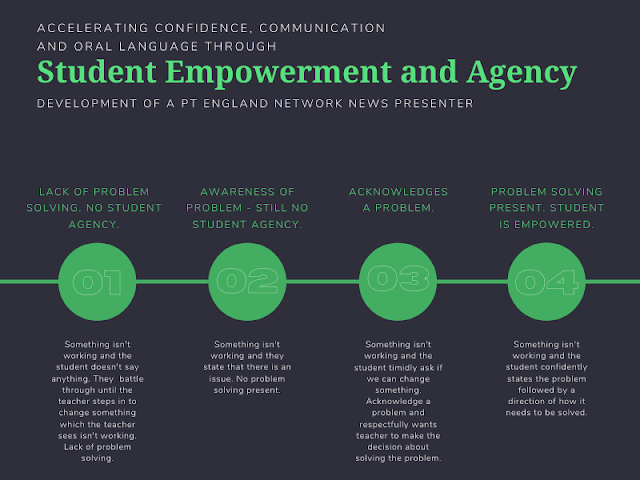
On Thursday last week, one of my presenters said that they wanted to develop the weather section of the news to provide more important information. In particular, adding in UV levels and fire risk. We decided that having a UV level included was important for the audience to know about.
On Saturday, I received this email:
Yes, emailing you on the weekends is probably the wrong time but I want to add the UV level part. It's to tell whether you need to stay protected from the sun, or if it's ok and you won't get a sunburn.
Thanks if you want to add it.
Here is some of the email thread we had. My emails are in red, where the student's are in blue.
Hi _________,
I have taken the fire danger level out but thought we could include the tide times and water temperature at Pt England Beach. What do you think? Keeping the UV level in is great!
Miss West
YAY to UV level! I thought I was going to add that but I think that it was too much information. So that means that:
Tomorrow's weather, UV level, tide times (maybe for after school so they can play at the beach after school) and water tempo is going to be added for weather. And inquiry is the easiest one. For now...
That's it. Let's see what we think and decide if we want to remove anything this morning.
Ok, let's do more detail person to person in like 10 minutes
I was so impressed when this student re-voiced our conversation in writing, creating a great summary of what we had discussed (see above in blue). This is a great example of me working alongside a child at their level, encouraging them to solve the problems with confidence.
Here is the finished product of the weather segment this morning after the email stream (go to 6m36s).
Thursday, 18 November 2021
Bursts in Bubbles 2021
During the Manaiakalani Kāhui Ako Bursts and in Bubbles event this afternoon, I took summary notes about the inquiries I felt I could utilise in my own current practice and incorporate with my own findings in my inquiry.
Anita Unka (Y1-2): How can I use feedback and feedforward in writing to build relationships with whānau, enabling greater shifts in student achievement for our tāmariki?
Gaps in oral language, limited vocabulary --> limited ideas when writing.
Writing flexi-connects - whānau on other end in a meet while teacher and child at school.
Through lockdown, the flexi-connects changed where the child was with their parent and Anita was on the other end of the call.
Poto Faalili (Y7&8): How will being culturally responsive in my teaching and an integrated approach to teaching and learning accelerate student achievement?
Engaging boys, particularly those that turn up to school late.
Student voice via talanoa.
Priority to see this group every morning at 8:30am. Changed to lunch with lunches. Well-being was important in this as well as talanoa about learning.
Amy Tofa (Y7&8): Will building self efficacy in students enable them to be more independent in Project Based Learning and accelerate their progress in Reading?
Lack of self efficacy for completing project-based learning.
Lack of confidence.
Frank Paris to build self efficacy.
High anxiety impacts self efficacy.
Christine Tupou-Fonua (Y7&8): Can we make accelerated shifts in literacy through teaching identity & cultural competencies?
Coconut Model Work (see her blog)
Clarelle Carruthers (Y4): How will using a variety of high interest texts and providing open tasks impact students critical thinking?
Critical thinking and vocabulary.
Frustration by children was a big issue.
Whole class theme for reading each week to encourage more collaboration and vocabulary development.
For true critical learning to happen, the children need to be doing the work - remove the scaffolds.
Kelsey Parrant (Y5): Will a focus on vocabulary and interest specific texts have an impact on reading achievement for my learners reading below 8 years?
Lack of understanding or strategies to understand meaning of vocabulary when reading.
Robyn Anderson (Y7&8): Will a focus on oral language in maths accelerate student confidence and capability to use spoken and written maths vocabulary and language?
Oral language and maths
Stepping in with scaffolds too early as the teacher wasn't helpful.
Robyn also developed some speaking prompts to support the children in learning to talk.
Giving children time to talk was essential.
Aimee Litchfield (Y1&2): How can I develop the use of oral language and use a wider range of vocabulary to see acceleration across all curriculum areas?
Unable to express themselves with more than one word.
Daily picture prompts.
Increase in vocabulary.
Next steps - to develop fluency.
Strongly implement learning in oral language through to writing.
Thursday, 18 March 2021
CoL - finding my collaborative inquiry partner
In preparation for our CoL meeting this afternoon, I have planned to meet with 5 other CoL teachers who I will chat with about their inquiry focus this year. Here are the teachers I plan to meet with:

I will update my blog with notes after I talk to each of these teachers.
Wednesday, 2 September 2020
The Concept Box (Peter Worley) - Attempting this in class
Today I trialled using the Concept Box, a teaching strategy which comes from Peter Worley's book, Once upon an if. It was a huge success! The children were engaged and I saw a vast difference in the amount of critical thinking occurring. We trialled it using the poem, The Square that Didn't Fit In, on page 172 of Once upon an if. Here are some of my observations/ notes from the learning experience. I have broken it up into the different elements of the Concept Box.
Comprehension Stage
Here are some of the comments that children made and questions they asked in this open conversation about the text:
- Couldn't the monster eat small circles? They'd fit.
- How did the monster get fooled?
- There are those crackers called shapes which come in lots of different shapes and sizes.
- Started talking about which shape they would like to be.
Lots of questions were asked by the children during this comprehension stage. I need to remind myself to sit back and observe rather than take part in the conversation.
Concept Fishing
Most children found this section of the Concept Box difficult. One child did a really good job of describing text however used a lot of detail. Here are the words they came up with to describe the text:
Different
Dumb
Confused
Personality
Confident
Life
Circle
Feeling
Purpose
Inside-out
Normal

Concept Funnelling
I got a bit confused at this point and combined this section with the final Exploring central concepts section. Next time, I will work at splitting these two sections up. I need to remember that this section gives children a chance to share which one word they think is the best and why. Once have shared 5 words, move onto the last section.
The children gave some great explanations for and against the above words. We then filtered it down to:
Different
Normal
Personality
Purpose
expressing
feeling
The children found it really trick to get the list down to five words. They finally decided to take 'feeling' out as they felt 'expressing' incorporated 'feeling.'
Next time, I will do a better job of splitting up Concept Funnelling and Exploring central concepts.
Comprehension Stage
Here are some of the comments that children made and questions they asked in this open conversation about the text:
- Couldn't the monster eat small circles? They'd fit.
- How did the monster get fooled?
- There are those crackers called shapes which come in lots of different shapes and sizes.
- Started talking about which shape they would like to be.
Lots of questions were asked by the children during this comprehension stage. I need to remind myself to sit back and observe rather than take part in the conversation.
Concept Fishing
Most children found this section of the Concept Box difficult. One child did a really good job of describing text however used a lot of detail. Here are the words they came up with to describe the text:
Different
Dumb
Confused
Personality
Confident
Life
Circle
Feeling
Purpose
Inside-out
Normal

Concept Funnelling
I got a bit confused at this point and combined this section with the final Exploring central concepts section. Next time, I will work at splitting these two sections up. I need to remember that this section gives children a chance to share which one word they think is the best and why. Once have shared 5 words, move onto the last section.
The children gave some great explanations for and against the above words. We then filtered it down to:
Different
Normal
Personality
Purpose
expressing
feeling
The children found it really trick to get the list down to five words. They finally decided to take 'feeling' out as they felt 'expressing' incorporated 'feeling.'
Next time, I will do a better job of splitting up Concept Funnelling and Exploring central concepts.
Tuesday, 7 April 2020
Online Digital Fluency Intensive
On Friday last week, I worked with the Manaiakalani online digital fluency intensive course by supporting a small group of teachers in creating a multi-modal google site for learning. As part of this, I chose a School Journal text, Becoming a Martian. We then collaboratively planned resources which could support this text and the children's learning around the topic of Mars and Resources needed for survival.
The teachers I worked with were:
- Phil Margetts
- Jess McMillan
- Vicki Swider
Here is our collaborative plan of resources spanning a number of year levels:
After we spent time finding a number of multi-modal resources that were readily available online, we made google sites which we could use to share the learning with children.
Here are the sites we created using our collaborative planning doc as our base.
Phil's site
Jess' site
Vicki's site
The teachers I worked with were:
- Phil Margetts
- Jess McMillan
- Vicki Swider
Here is our collaborative plan of resources spanning a number of year levels:
After we spent time finding a number of multi-modal resources that were readily available online, we made google sites which we could use to share the learning with children.
Here are the sites we created using our collaborative planning doc as our base.
 |
| Click the image to see my site. |
Phil's site
Jess' site
Vicki's site
Thursday, 18 May 2017
Holiday blogging
On the last day of term 1, most students went home for a break from school. So did we! However, a number of students in team 4 continued to share visible learning online throughout the two weeks of the holidays.
I have seen the great results of the holiday blogging programme, run by Rachel Williamson at the University of Auckland. However, these holidays were different. Other than a number of creative tasks suggested by one of the year 6 teachers, there was no organised blogging programme, and no one tasked with the job of ensuring students were receiving comments on their blogs. This meant that any student who blogged was motivating themselves to create and share the blog posts.
Another thing which we noticed was that not only were these students writing quality blog posts which were interesting, creative, and informative, they were also leaving quality comments on other students' blogs and replying to quality comments left on their blogs, creating an online discussion about their DLO.
Zaeeda posted 41 blog posts over the holiday period. I enjoyed seeing her 'Daily Animal News' posts which she shared daily. On each of these blog posts, she would draw her own images of a chosen animal, write a narrative story about this animal, and then create a short comic strip. Zaeeda also shared some interesting holiday events with her blog viewers.
Jahzara posted 25 blog posts over the holiday period. I was amazed with the creativity of Jahzara along with two of her friends from room's 6/7/8. These students created collaborative google presentations during the first week of the holiday. They each contributed to the presentations from afar. Like Zaeeda, Jahzara also shared some interesting holiday blog posts throughout the two weeks.
The students of team 4 made me extremely proud over the holidays. The energy and motivation evident from the students who blogged over the holidays was exciting and extremely positive. See our blog post about our holiday bloggers on our Room 10 class blog.
Wednesday, 30 November 2016
Miss West and the Protractors
During the process of completing a class on air episode, I was able to reflect on my teaching. Being able to watch myself teach allowed me to be critical of what I could be doing better, and what I have been doing well.
Follow the link below to see my Class on Air site!

Follow the link below to see my Class on Air site!
Friday, 18 November 2016
MDTA Documentary
I have come to the end of my first year teaching! It has been a year full of rewards and challenges, and I have had a huge amount of support throughout. Having the opportunity to work closely alongside my mentor teacher has been amazing and has supported me immensely in gaining confidence teaching in a digital environment.
One of our challenges is to accelerate the learning of our ākonga. To support this challenge, learners all have a digital device to help them overcome potential barriers to learning and to support them in being future-focused learners. In the same way, I am coming into a teaching career where schools look very different to how they did when I was at school. It is important for teachers to be future-focused in their pedagogy. Being part of the MDTA where I have had weekly digital immersion professional learning, part-time university towards my BEd (Hons), as well as working alongside my mentor teacher throughout the year, has supported me to accelerate in my learning to ensure I become a confident and future-focused teacher.
In this MDTA documentary, I share how learners in my class have used Learn-Create-Share:
Tuesday, 25 October 2016
Inquiry reflection: Week 3, Term 4
At our inquiry collaborative meeting for the beginning of term 4, we shared advice and ideas which we have learned throughout our inquiries this year.
Here are some of the discussion points that stood out for me:
- We need to be making exciting learning experiences which engage students. How do we create something purposeful for our term theme?
- For some students, we need to be extending them in reading using novels. However, how do we keep them engaged in the novel? We discussed student agency and choice. We thought about those students who are are beyond their current age for reading, however are not engaged or don't see the purpose in reading. We also thought about how these students need choice to read what they want. We need to be finding something which hooks them.
- How do we get students reading independently for information? We need to be creating and using learning experiences with our students, such as quizzes, which require students to have read texts to complete the task.
- Our learners need to have purpose. That is, they need to know why they are needing to learn something.
- How do we get learners past where we are aiming? Often, we make progress with students (e.g understanding phonetics for beginnings of words) but then are challenged to create further progression. How do we get students past this barrier to keep them moving forward?
 |
| Created on www.wordclouds.com/ |
Subscribe to:
Posts (Atom)