Showing posts with label SModel. Show all posts

Friday, 17 December 2021

End of Year Analysis: CoL Inquiry 2021

We are at the end of 2021 and what a year it has been! Since coming back to school, I have been unable to teach my Extension classes due to Covid-19 restrictions. As a result, I have formed a final data analysis to show what potential the implementation of my 'tool' could have had, had we had more time in the classroom this year.

I hypothesised that providing speaking prompts and increasing speaking mileage would close the gap between reading and vocabulary level when it comes to speaking and presenting. This was decided after I found that my target group were all great readers (above their chronological age) yet they did not demonstrate the same vocabulary understanding, use and knowledge when it came to speaking and presenting.

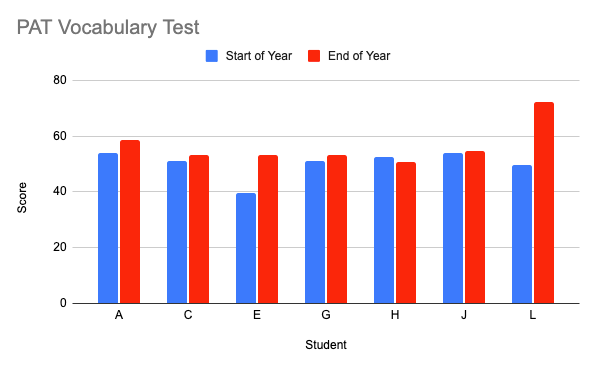
I compared the vocabulary test results for children who took both tests. Note that this test demonstrated ability to understand vocabulary through reading, a skill which we know these children are good at. Results showed that all children (except one) improved in their ability to understand a range of vocabulary they come across when reading. The one child who did not show an improvement stayed at relatively the same level.


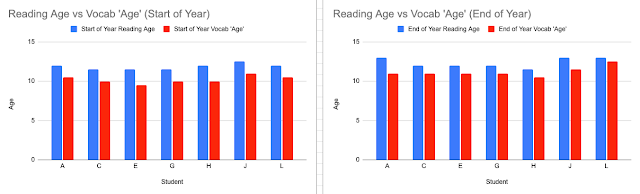
Next, I turned the PAT vocabulary test results (above) into an approximate 'age.' I wanted to see whether we have managed to close the gap between reading age and vocabulary level. Note, that the focus was to increase children's vocabulary levels in order to achieve this. You can see on the graphs that the gap for each child (difference between the blue and red column) does appear to be closing up for most children. 


 Unfortunately, I was unable to collect final term 4 data to show any increases in oral language of these children. However, I was able to collect a few second oral responses in term 3. These changes are explained in another blog post.

In all, I believe my focus on increasing speaking mileage with the support of speaking prompts has supported the children in the Extension class learning environment. It is something I highly recommend as a focus in all classrooms to support development of our children's oral language capabilities.

Thursday, 18 November 2021

My Bursts in Bubbles Presentation

 Here is my Bursts in Bubbles 3 minute video to summarise my inquiry and findings this year:

Bursts in Bubbles 2021

During the Manaiakalani Kāhui Ako Bursts and in Bubbles event this afternoon, I took summary notes about the inquiries I felt I could utilise in my own current practice and incorporate with my own findings in my inquiry.


Anita Unka (Y1-2): How can I use feedback and feedforward in writing to build relationships with whānau, enabling greater shifts in student achievement for our tāmariki?

Gaps in oral language, limited vocabulary --> limited ideas when writing.
Writing flexi-connects - whānau on other end in a meet while teacher and child at school.
Through lockdown, the flexi-connects changed where the child was with their parent and Anita was on the other end of the call.

Poto Faalili (Y7&8): How will being culturally responsive in my teaching and an integrated approach to teaching and learning accelerate student achievement?

Engaging boys, particularly those that turn up to school late.
Student voice via talanoa.
Priority to see this group every morning at 8:30am. Changed to lunch with lunches. Well-being was important in this as well as talanoa about learning.

Amy Tofa (Y7&8): Will building self efficacy in students enable them to be more independent in Project Based Learning and accelerate their progress in Reading? 

Lack of self efficacy for completing project-based learning.
Lack of confidence.
Frank Paris to build self efficacy.
High anxiety impacts self efficacy.

Christine Tupou-Fonua (Y7&8): Can we make accelerated shifts in literacy through teaching identity & cultural competencies?

Coconut Model Work (see her blog)

Clarelle Carruthers (Y4): How will using a variety of high interest texts and providing open tasks impact students critical thinking?

Critical thinking and vocabulary.
Frustration by children was a big issue.
Whole class theme for reading each week to encourage more collaboration and vocabulary development.
For true critical learning to happen, the children need to be doing the work - remove the scaffolds.

Kelsey Parrant (Y5): Will a focus on vocabulary and interest specific texts have an impact on reading achievement for my learners reading below 8 years? 

Lack of understanding or strategies to understand meaning of vocabulary when reading.

Robyn Anderson (Y7&8): Will a focus on oral language in maths accelerate student confidence and capability to use spoken and written maths vocabulary and language?

Oral language and maths
Stepping in with scaffolds too early as the teacher wasn't helpful.
Robyn also developed some speaking prompts to support the children in learning to talk.
Giving children time to talk was essential.

Aimee Litchfield (Y1&2): How can I develop the use of oral language and use a wider range of vocabulary to see acceleration across all curriculum areas?

Unable to express themselves with more than one word.
Daily picture prompts.
Increase in vocabulary.
Next steps - to develop fluency.
Strongly implement learning in oral language through to writing.
Monday, 1 November 2021

Making my own Curiosity cards

In response to learning about the Fertile Question cards (Curiosity Cards) by the National Library which support my inquiry focus and implementation this year, I have created my own curiosity cards around our Term 4 topic about Marine Biology. 

The children responded really well to these cards and were encouraged into deep conversation around the topic. 

In a future post, I will share some of the responses I have got from the first of the curiosity cards in this pack.

Wednesday, 13 October 2021

Fertile Questions and the National Library Curiosity Cards

While looking into resources for term 4, I found that the National Library had these fantastic cards which have been created around the Fertile Questions model by Yoram Harpaz and Adam Lefstein. 

What are fertile questions?

Fertile questions have a number of characteristics. They are open, undermining, rich, connected, charged and practical. You can read the definitions of these characteristics here.

The idea behind this is exactly what I have been aiming to achieve in my inquiry this year so I was very excited to find this awesome resource backed by research. 

The National Library provide two sets of Curiosity Cards based around the history of Aotearoa. Each card includes a photograph or image with a short title. Below is the template for creating your own Curiosity cards. You can find this on the links to the pre-made Curiosity cards. 


Set 1: He Tohu and Tuia - Encounters 250

Set 2: Tuia Mātauranga

I am really looking foward to using these cards with my year 7 & 8 extension class in term 4. I am also looking forward to beginning to create my own curiosity cards going forward. This will be a skill that will take some developing but I am excited for the potential of using them in the extension classes.

Thursday, 5 August 2021

Restating my Inquiry Question and Chain of Events

We are now half way through the year. In this post, I am going to restate my inquiry question to ensure I am still on track with my inquiry focus this year.

Inquiry Question: How can I change my teaching to support oral language progression towards the level of language which children can comprehend when reading?

Inquiry Goals: To improve oral language.

To reduce the disparity between the level of oral language and vocabulary used and the level of language and vocabulary they can read and recognise in written texts. To increase confidence when speaking and presenting.

Challenge: There is a disparity between the level of oral language and vocabulary which the year 5-6 extension children use and the level of language and vocabulary they can read and recognise in written texts.

Hypothesis: Giving children many opportunities to speak in front of each other (through sharing and presenting their ideas and learning within a small and a larger group), with the support of prompts and scaffolds will improve their confidence to speak and therefore improve their use of oral language.


Thursday, 29 July 2021

Implementation of a new tool into my practice

This term, I have begun implementing my new tool for the year 5&6 extension class. Using a range of conversational and discussion prompts from online, I have made a set of speaking prompts for the children. During each session with me, the children will be given a laminated card with a prompt. Their job is to respond to the work from the session using the prompt they have been given. This could be in response to a video they have watched, a discussion point or a text they have read, for example. 

From today, I would like to start giving them their prompt at the beginning of the session so they have a longer amount of time to prepare their response. We will finish each session 10 minutes before the end of the day so the children can share their responses. 

The initial implementation of this tool has been really successful. The children find the prompts useful and they appear much more confident when they have the prompt to support them in speaking and presenting. Here are copies of the prompts:


I have had discussions with a year 2 teacher at school who really liked the idea and thought her year 2 children could benefit from a similar approach. This began me thinking about how we could adapt the design for different age groups.

Friday, 23 April 2021

Manaiakalani Teacher Only Day

 Last Friday, we had a Manaiakalani Teacher Only Day with a focus on literacy. We had a fantastic keynote presentation by Dr Rae Si'ilata. During the day, we also went to 3 workshops run by teachers in our schools. I took a workshop on my inquiry from last year, where I researched, used and adapted Peter Worley's Concept Box Framework into my teaching to support development of critical thinking.

Here are the slides from my workshop:

Wednesday, 2 December 2020

Bursts and Bubbles Presentation: Kahui Ako

This afternoon, we had our annual Bursts and Bubbles function where all of the 2020 CoL teachers presented a snapshot of their 2020 Inquiry. Here is my 3 minute presentation.


Transcript: 

During Lockdown, we were learning about food from Canada. A child disappeared from the google meet and then reappeared with a bottle of maple-flavoured syrup. “Maple syrup comes from Canada!” he stated. Another child said, “That’s not real maple syrup.” And that was the extent of the discussion.

Both children were correct. The bottle quite clearly said “Maple flavoured syrup.” However, there was no critical thinking to explain why. In fact, when I tried to initiate critical thinking, the second child could still not explain how he knew it wasn’t real maple syrup. So what does this mean?

This is just one example of the lack of critical thinking observed in some of our year 5 children who are working beyond their chronological age in reading.

Critical thinking is an aspect of learning which stretches across the curriculum, including the key competencies, however it is a skill which many of our children could do better at and which we could do a better job of teaching.

I identified this as my focus when I noticed that those children who are better readers tend to be better critical thinkers and those children who are better writers tend to be better critical thinkers. The problem with some of our children who are strong readers is that they don’t reciprocate this strong academic level in their writing and as a result, critical thinking is actually not as strong as we would expect.

I identified that children in year 5 who are reading above their chronological age tend to fall into two categories. All of these children already know how to read. One group can independently read to learn and tend to be able to create causal relationships and put ideas from texts into their own words where as the other group are still learning how to do this. I wanted to focus on this second group of children.

Profiling of my teaching showed that I had strengths in using talk moves to encourage children’s thinking. However, a reliance on me made me realise I needed to be using other strategies to encourage higher level causal links to be made by the children.  Therefore, I changed the structure of reading lessons so the children would no longer solely rely on me.

After exploring research into critical thinking by Richard Anderson, I researched and implemented a framework called The Concept Box by Peter Worley. The Concept Box framework is a teaching strategy which incorporates vocab acquisition, discussions and argumentation in order to get children thinking critically. Children are first asked to share any ideas they have about what they have read. Once their ideas are flowing, the children have to think of individual words to represent ideas in the text. The children are then encouraged to discuss which of these words are the most important to convey the more critical elements of the text. Through this process, the children eliminate words if they are not sufficient to the deeper ideas being explored.

In the story, The Lion King, one child  stated, “The word ‘Lion’ shouldn’t be there because it doesn’t go deep enough.” Another child decided the word ‘sad’ did not do a good job of explaining the story but did not give a reason. A child responded by saying, “Wait. You need to have a reason. You can't just take it out." This is evidence that some children are identifying when others are not thinking critically.

Children felt that using the Concept Box framework encouraged them to listen, explain, learn new vocab, make sense and think deeper. While some children are still challenged with the concept, there are more children in the group who are beginning to lead and support others and I have begun noticing a shift where the children are doing the job of guiding their thinking.

I have learned that our children need a strong framework, like The Concept Box, which can be used with a range of texts to support development of critical thinking.

Thursday, 12 November 2020

Analysis of Blog Comments: Critical Thinking

As part of my inquiry into critical thinking, I have compared blog comments written at the beginning of the year and at the end of the year. 

I used this blog commenting rubric to score comments:

Children who participated in the Concept Box Framework Sessions regularly: A, B, D, F, J
Children who participated in the Concept Box Framework Sessions more recently: G, I, K, L

This first graph shows levels of critical thinking and interpersonal skills at the beginning of the year.

This second graph shows levels of critical thinking and interpersonal skills at the end of the year. On the whole, level of critical thinking and interpersonal skills in blog comments progressed.

This third graph shows a comparison in the level of critical thinking seen in blog comments (beginning of year to end of year). All 5 of the children who made progress in level of critical thinking, participated in the Concept Box Framework lessons.

This forth graph shows a comparison in the level of interpersonal skills seen in blog comments (beginning of year to end of year).