Kia ora, my name is Hannah Burton. I am the Creative Space and Extension teacher at Pt England School in Auckland, New Zealand. I began teaching at Pt England School in 2016 and am now in my 10th year here. During this time, I have been in the Manaiakalani Digital Teacher Academy, been a Manaiakalani-Google Class OnAir teacher, a Manaiakalani Innovative Teacher and a within-school Kahui ako (CoL) teacher.
I decided to look into the Learning Progression Framework to figure out where these students were at at the beginning of implementation of the intervention, and where I would like them to be when I re-assess them at the end of the year.
I focussed on the Multiplicative thinking progressions as this is the focus of my inquiry. "This progression focuses on students' ability to think multiplicatively as they solve multiplication, division, and proportional problems involving an extended range of whole numbers, decimals, fractions, ratios, and percentages, and in a range of contexts." (Learning Progression Framework). Note the section of this quote that I have highlighted in red.
Hopefully through this, students will learn problem solving strategies which they can then utilise back in their classroom when learning in the other areas of maths and statistics.
When looking through the 9 progressions under Multiplicative thinking, all the students in this group are working at progression 3 or above. Most are working at progression 4. No students are confidently working beyond progression 5 yet.
Progression 3: Confidently uses skip counting, repeated addition or knowledge or doubles and understands that the groups are equal.
Progression 4: Starting to use multiplication facts. Knows it can be sets or groups of equal sizes. May use trial and error with known facts.
Progression 5: Using mix of place value partitioning and times tables facts. May be able to use multiplication facts to solve division problems. Can solve fraction problems with times tables facts.
None of the students are confidently working at Progression 6 yet. At this progression, students need to be working with "whole numbers, decimals, fractions, ratios and percentages..."
LOTS of research arguing that ability groupings is not the best way to teach maths. The group of children I am working with are working with me because they all show an understanding of their multiplication facts. Is this ability grouping?? I don't think it is as within this group which I see, there are still children at a wide range of abilities within maths. I am also only seeing this group for 1 hour a week, so they continue to go back to their own classes for the rest of the week's maths classes. I would be interested to know if anyone considers this to still be ability grouping.
Strategies to be implemented, according to the ERO report:
- Mixed ability grouping - the group I see have been selected for a particular purpose - to move them from having times tables knowledge to being able to apply this knowledge. Within the group, there is a range of students with differing levels of times tables knowledge so it is therefore still a mixed ability group.
- Use of Talk Moves (Revoicing, Repeating, Reasoning, Adding on, Waiting)
- "Engaging in authentic mathematics tasks" (p12)
- "Developing children's confidence to share their strategies and learning." (p12)
- The structure of learning that I am going to be following is similar to that used by a school mentioned in the ERO report (page 36). This is where students get an opportunity to use their prior knowledge, be modelled new learning and then a chance to apply knowledge.
- I found it interesting that in the ERO report (pg43), they talk about a case study class who use multi-ability groups however the class to begin with has children with "similar needs." When you look at our school and class data for the spread of maths needs and levels, it becomes clear that we may need to do things a little differently.
- Page 49: "Developing children's confidence to share their strategies and learning." - Two Challenges: (1) Reluctance to share ideas (2) Needed to slow down and think - Intervention: Introducing Talk Moves, Introducing Visual Prompts ("What is the important information?", "What do you have to find out?", What operation / strategy are you going to use?)
- Page 56: A poster to support maths problem solving:
- One suggestion they have is to give students "independent thinking time." This is something I have not yet explicitly included in my intervention but I think it is worth adding in. Their argument is that children need time to think the question over without their thoughts and ideas being confused or warped by those of others.
- Another suggestion is to build learning from mistakes that the children make.
- They talk about "making connections." I think this is a valuable thing that I am incorporating into my intervention. The whole idea with how the lessons with these children are structured is to support them in making connections in maths.
At our last Kāhui ako meeting, we looked into the research literature that we are using to support our inquiries. We collaborated in groups depending on what our inquiries were. I worked with Danni Stone and Clarelle Carruthers and we came up with the following:
Theme/ overarching topic or intervention type: Understanding student achievement and how to support maths progress for diverse groups of learners.
Linchevski, L & Kutscher, B. (1998). Tell Me With Whom You’re Learning, and I’ll Tell You How Much You’ve Learned: Mixed-Ability Versus Same-Ability Grouping in Mathematics, Journal for Research in Mathematics Education, Vol. 29, No. 5, P533-554.
Further conversations with colleagues, school leaders
I have more of a need to focus on the children who aren’t applying their mult/div knowledge to solve problems.
How do I move children from knowing their times tables to applying their times tables?
This week in our Kāhui Ako meeting, we discussed formulation of hypotheses. I have chosen to summarise my hunches, as well as research that has supported these hunches and feedback from my Kāhui Ako colleagues. I believe that my hunches are still too broad and more work needs to be done to narrow down my focus to something which is going to be measurable.
Student Challenge: How do we accelerate achievement in maths when students have a range of maths abilities with various gaps in maths knowledge?
Teacher Challenge: How do we accelerate achievement in maths when teachers are tasked with teaching a classroom of students with a range of maths abilities and with various gaps in maths knowledge?
Personal justification of running an extension maths programme (see previous blog post):
A typical classroom includes a range of mathematics levels. How do we as teachers realistically support the children who find maths really challenging while also extending those who find the logic of maths more natural? It is challenging, that's for sure! We have a really unique opportunity here where we can run an extension programme for those children who we identify as gifted in Maths, allowing the classroom teachers to spend that session focussing on building the knowledge for the rest of the class. The extension group can then return to their classroom and use their new knowledge and skills to work alongside their other classmates to build their maths knowledge.
What does the Manaiakalani research say to provide evidence and justification for this inquiry?
In any inquiry, it is important to have tools, measures and approaches which are planned for use so we can get a more detailed and accurate profile of students' learning in relation to a challenge. If we aren't doing this, then any implementation of something new is really just a guess!
To start this off, I went to the research. Over the course of this inquiry, I want to make sure I look at multiple view points to see how to best teach extension level maths students.
Text: Linchevski, L & Kutscher, B. (1998). Tell Me With Whom You’re Learning, and I’ll Tell You How Much You’ve Learned: Mixed-Ability Versus Same-Ability Grouping in Mathematics, Journal for Research in Mathematics Education, Vol. 29, No. 5, P533-554.
Key Points:
Ability Grouping (subject-by-subject, also known as tracking vs. all subjects at once, also known as streaming).
Ability grouping can be used to change content, pace or teaching methods.
Some research has shown that by ability grouping, the gap between abilities increases.
Personal note: does this mean it is negative effect for those who do better? We will be doing things differently where we will be reducing class numbers for an hour per week so the classroom teacher can give more time to those who need it for the basics of maths.
Quality of oral language used (within communication) differs greatly between lower ability groups and higher ability groups. With this comes differences in expectations (Gamoran, 1993).
Personal note: we will need to make sure we don't allow this to happen.
Preteaching (described in study on page 536). Mix of homogenous and heterogenous groups. Students have preteaching in homogenous groups. "Whenever a teacher felt that a large, specific homogeneous group of students
would benefit from the teacher’s direct intervention, that setting was used—for
example, to better prepare weaker students to be integrated into a planned heterogeneous group activity." Page 536.
Personal note: This sounds very similar to what we are trying to achieve.
Homogenous (children of same ability)vs. Heterogenous (children of different ability) grouping
Study 1: After 1 year, in 10/12 schools, Mixed ability grouping did not impact the gap between achievement between children of various abilities. In 2/12 schools, it widened the gap however there were signs of this gap reducing after two years.
Study 2: Mixed ability grouping was hugely benficial to average to lower ability students. Higher ability students did not lose any achievement by being in mixed ability grouping.
Goroman (1992) - workshop type pedagogy - look more into this.
Overall, this Journal Article and studies are in favour of Heterogenous grouping/ Mixed Ability Grouping for teaching mathematics.
Next Articles to look into:
Gamoran, A. (1992). Is ability grouping equitable? Educational Leadership, 50 (2), 11–17.
Gamoran, A. (1993). Alternative uses of ability grouping in secondary schools: Can we bring high quality instruction to low-ability classes? American Journal of Education, 102, 1–22.
Important Māori values in this Tuakana Teina approach to be aware of (see video below to see these explained): - Ako (learning/teaching) - Manaakitanga (caring/uplifting each other) - Rangatiratanga (uplifting students) - Whanaungatanga (relationships) - Tuakana Teina (apprentice-expert)
Article from Inclusive Educationwith some great ways to build confidence in the classroom. Many of these are things we are currently doing at our school.
Potential Catalyst for Change: Using the pedagogical approach of Tuakana Teina
What I am trying to develop: Confidence/ Self-esteem
Potential Hypotheses ("If _____ then ______")
1. If I pair children up with more experienced classmates, then confidence of the less experienced partner will develop.
2. If a less experienced classmate is supported by a more experienced classmate, then their confidence will improve.
3. If a less experienced classmate is supported by a more experienced classmate to learn a new skill, then their confidence in this skill will develop as well as their confidence in other areas of school and life.
4. If children have opportunities to learn a meaningful and purposeful skill alongside a more experienced peer, then they will develop in their confidence to speak up and lead.
Rubric with same focus points as the fluency rubric above.
Expressive oral language has been seen as important for a long time. In American education, many children read from the bible and there was an expectation that they read fluently.
Early 1900s: a push for silent reading over oral reading, with valid justification for this, oral reading became less expressive.
Report of the National Reading Panel (2000): 3 aspects of fluent oral reading: rate, accuracy, expression.
Prosody: How one reads with expression (not just the superficial features of consonant and vowel sounds).
Prosody <---> Comprehension (Schwanenflugel and Kuhn)
Automated measuring tool: Praat (2001) by Paul Boersma and David Weenink
Multidimensional fluency scale (MDFS). Zutell and Rasinski - Found to create reliable and valid scores.
This article recommends that human scored assessment tools are more effective than computerised tools as more is picked up via observation in terms of oral reading aspects. It is important for the human assessment tool that the rater/scorer is consistent otherwise reliability and validity reduces.
From this, I put together a rubric which combines categories from all the above. I will share this in my next blog post.
We are at the end of 2021 and what a year it has been! Since coming back to school, I have been unable to teach my Extension classes due to Covid-19 restrictions. As a result, I have formed a final data analysis to show what potential the implementation of my 'tool' could have had, had we had more time in the classroom this year.
I hypothesised that providing speaking prompts and increasing speaking mileage would close the gap between reading and vocabulary level when it comes to speaking and presenting. This was decided after I found that my target group were all great readers (above their chronological age) yet they did not demonstrate the same vocabulary understanding, use and knowledge when it came to speaking and presenting.
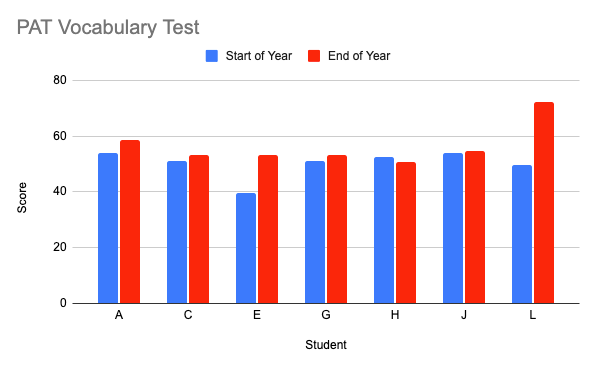
I compared the vocabulary test results for children who took both tests. Note that this test demonstrated ability to understand vocabulary through reading, a skill which we know these children are good at. Results showed that all children (except one) improved in their ability to understand a range of vocabulary they come across when reading. The one child who did not show an improvement stayed at relatively the same level.
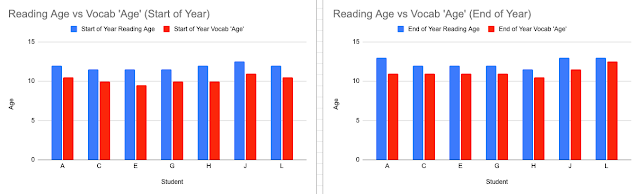
Next, I turned the PAT vocabulary test results (above) into an approximate 'age.' I wanted to see whether we have managed to close the gap between reading age and vocabulary level. Note, that the focus was to increase children's vocabulary levels in order to achieve this. You can see on the graphs that the gap for each child (difference between the blue and red column) does appear to be closing up for most children.
Unfortunately, I was unable to collect final term 4 data to show any increases in oral language of these children. However, I was able to collect a few second oral responses in term 3. These changes are explained in another blog post.
In all, I believe my focus on increasing speaking mileage with the support of speaking prompts has supported the children in the Extension class learning environment. It is something I highly recommend as a focus in all classrooms to support development of our children's oral language capabilities.
While looking into resources for term 4, I found that the National Library had these fantastic cards which have been created around the Fertile Questions model by Yoram Harpaz and Adam Lefstein.
What are fertile questions?
Fertile questions have a number of characteristics. They are open, undermining, rich, connected, charged and practical. You can read the definitions of these characteristics here.
The idea behind this is exactly what I have been aiming to achieve in my inquiry this year so I was very excited to find this awesome resource backed by research.
The National Library provide two sets of Curiosity Cards based around the history of Aotearoa. Each card includes a photograph or image with a short title. Below is the template for creating your own Curiosity cards. You can find this on the links to the pre-made Curiosity cards.
I am really looking foward to using these cards with my year 7 & 8 extension class in term 4. I am also looking forward to beginning to create my own curiosity cards going forward. This will be a skill that will take some developing but I am excited for the potential of using them in the extension classes.
When we went into lockdown, I was halfway through testing the children on another picture vocabulary test. The difference was, I was providing the children with the prompt cards so they could use them if they wanted them. The results were looking really positive. But then lockdown happened. This means I'll have to wait to find out how the other children did!
Whilst in lockdown, I have still been seeing classes through google meets. This has allowed me to continue my inquiry, even if it isn't to the same momentum it had while we were physically at school. Each time I meet with my year 5 & 6 extension children, we have been exploring a different photograph. The photographs I have chosen are ones from the New York Times: :What's going on in this picture. The children are really excited each week to talk about a new photograph and the conversation is becoming richer and richer. I have been forcing myself to take a step back, not share ideas and see how the children go with conversing around the photos. The conversation prompts are being used however usually the use of these dies off after the conversation has warmed up.
I spent some time researching other provocations that I could use with the children and I found this really cool resource called 'Once upon a picture.'
What I like about this resource is that it breaks the focus up into collections depending on what your focus is: inferring, predicting, thinking, characters etc. There is also a fantastic 'Challenge Book' which you can download.
- Those with a focus group of children who learning to read. - Those with a focus group of children who are reading to learn. - Those with an inquiry focus on maths.
I went along to the group of people who were focussed on those children who are reading to learn, as this covers my focus group of children. Our group was led by our Principal, Russell Burt. Others in the collaborative group were:
Through discussions around my inquiry, we came to identify that my focus group have an output mileage problem. That is, the children are not being given enough opportunities to practice 'output' through speaking and presenting.
Through discussions around other people's inquiries, I identified areas that could be useful to explore such as teaching understanding around lexical chunks rather than individual words as well us looking into pragmatics of oral language, being the way we interact socially with one another. More can be read about pragmatics here.
I found this collaborative inquiry session really valuable in terms of supporting one another, making links between different groups of children at different levels and sharing knowledge.
The challenge: There is a disparity between the level of oral language and vocabulary which the year 5-6 extension children use and the level of language and vocabulary they can read and recognise in written texts.
These children are all reading above their chronological age, so are good readers. As a result, I have hypothesised that using their strong reading as a medium, I will be able to support their development of oral language when participating in discussions around texts. I will do this using roles formed around the 10 language functions as explained in Teaching Pragmatic Language Awareness as an Integral Aspect of Reading and Language Arts Instruction (Monica Gordon Pershey).
The 10 Language Functions (Halliday, 1973; Smith, 1977) explain why the language is being used. They are:
I have used the text, Teaching Pragmatic Language Awareness as an Integral Aspect of Reading and Language Arts Instruction (Monica Gordon Pershey) tomake up these support cards and am in the process of making them more child-friendly using this text on thoughtco and this text on eltguide.
As mentioned in my previous blog post, I have observed that our year 5 and 6 children are really good at reading short texts that challenge them however many of them find it challenging to focus and be engaged in extended texts at their level which challenge them. There are a few questions I have around this.
- Why do these children find it difficult to engage in extended texts that challenge their thinking when they are good readers?
- How can reading extended texts (novels) excite and develop the learning of these children?
- What programmes have been used in other schools to have novel studies as part of their reading programme?
To make a start on this inquiry, I first want to gather some student voice around the children's engagement in reading extended text. I am interested in knowing such things as what genre of texts these children enjoy reading, how often they read in their own time (at home) and why they read texts (i.e for enjoyment or to learn new information).
It will be important for me to understand why I want the children to be reading novels. What will they get out of reading novels?
- One teacher writes about observing children discussing such things as character relationships, viewpoints and inferences (Differentiated Teaching). This teacher goes on to discuss research-based reasons to teach using novels:
1) Giving children experiences that go beyond their own world.
2) Vocabulary development.
3) Communication & Dialogue skills and strategies
4) Social skills development.
5) Engagement
Some books that might suit 10-11 year old children as suggested in The Teaching Bank:
- Number the Stars by Lois Lowry
- Sadako and the 1000 paper planes by Eleanor Coerr
- Esperenza Rising by Pam Munoz Ryan
- Wonder by R.J. Palacio
- Holes by Louis Sachar
- Hoot by Carl Hiaasen
- Bud, not buddy by Christopher Paul Curtis
Some books that might suit 10-11 year old children as suggested in Wheeler books:
The next step for my inquiry will be to have discussions around this inquiry focus with various people around the school. While I am doing that, I will also gather information around the children's reading habits.
Below are a number of resources which I found particularly useful around teaching critical thinking. The coral coloured boxes look at critical thinking in general, where as the blue boxes share links to articles making a connection between critical thinking in a digital/creative environment.
Task: Write a reflection in which you summarise your main learning about your teaching and next steps. This will prepare you to design an intervention next time.
Hypothesis: A focus on critical thinking and causal reasoning when responding to texts will support increased levels of critical thinking and ability to create causal links in online written interactions with others for year 5 children reading between 10 and 12 years.
1. Choose a text - image or story with no words OR story read aloud.
2. At the start of the instructional time, provide a provocation/dilemma for the concept of this text.
3. Let children discuss, encouraging use of causal reasoning.
4. Move onto guided reading session.
5. Children go off and create a video diary entry, in pairs, responding to the provocation. Each person to take a difference stance - agree or disagree.
I feel that this will be a great introduction to new texts to get the children thinking and engaged. It will also provide the children an opportunity to practice their critical thinking. The video diary task at the end will give the children a chance to draw on the new ideas from their peers and share their learning on their blog.
Texts to support me with this:
- See links above
- Once upon an if: The storythinking handbook by Peter Worley
- The Philosophy Shop: Ideas, activities and questions to get people, young and old, thinking philosophically - edited by Peter Worley
- The Numberverse by Andrew Day
- Bloomsbury: Conversations and Controversies
This text explains the use of stories to get children thinking deeply/critically. It teaches questioning. It also touches on The Concept Box.
There are different types of stories to consider. This will help me in forming a provocation or dilemma for particular texts.
- Myths/Legends: jump between fiction and non fiction. Explaining why things are as they are.
- Fables/ Parables: Teach a lesson or moral.
- Fairy tales: passed down through generations
- Anecdotes: short stories about things/events that have happened
- Humour stories: Jokes
- Tales with a twist: Not what you expect.
- 'What if' stories
The Concept Box (page 78-79, Once Upon an If by Peter Worley)
1. Read the text/story/poem OR could look at an image.
2. Comprehension Stage
a) Talk with neighbour
b) Free response to text (statement/question) - important for children to lead - sit back / observe.
3. Concept Fishing
a) Talk with neighbour - what is the text about?
b) Talk with neighbour - 1 word
c) Share 1 word (key word) - each child to share.
4. Concept Funnelling
a) Look at key words
b) Choose best word to describe the text.
c) Share both strongest word justifications and weakest word justifications.
d) Get down to list of around 5 key words
5. Exploring central concepts
a) Debate
Task: Explain how some of the data you have used to build a profile of the students’ learning will be used as baseline data at the end of the year.
Developed hypothesis (supported by research and preliminary data): A focus on critical thinking and causal reasoning when responding to texts will support increased levels of critical thinking and ability to create causal links in online written interactions with others.
My preliminary findings are made up data from:
- Reading ages (from running records)
- Reading ages (from a PAT test)
- Writing overall 'age' (from E-asttle writing)
- Writing 'age' for ideas (from E-asttle writing)
- Blog comment level: Critical thinking and Interpersonal skills
- Evidence of causal reasoning being encouraged through tasks
- Observations through running record
All of this data will be able to be compared to that at the end of the year to compare level of critical thinking. Running record data is necessary to ensure that progress occurs when using collaborative reasoning during guided reading sessions.
When looking at evidence of critical thinking/ causal reasoning, I need to decide whether I compare running record data from the same test, even if they have passed that level during the next 6 months or whether I do a comparison between different tests. I feel that a sound comparison for progress in critical thinking would only occur if I compare children's responses on the same test. That is, compare HOW they answer the questions. I have made detailed notes on how individual children responded to the comprehension questions in running record tests, which would make this possible.
At the end of the year, I would hope to see an increase in reading ages, writing 'ages', blog comment levels and evidence of critical thinking (causal reasoning) in all of the above as a result of using strategies of collaborative reasoning in guided reading sessions.
I might need to consider how I can better measure causal reasoning in running records, writing samples and on blogs. Do I look at the number of times children have used language associated with causal reasoning/ justification of their response? Do I use data gathering tools used in studies that have looked into collaborative reasoning?
This video is of Professor Anderson explaining collaborative reasoning. In the video, he mentions the modes from which data was collected and how this connected to their findings.
Task: Share three pieces of academic or professional reading and explain how they and other sources helped your form hypotheses about aspects of teaching that might contribute to current patterns of learning.
Initial hypothesis: A focus on teaching interpersonal skills and critical thinking through reading and writing, will result in an increase in levels of interpersonal skills and critical thinking when children comment on each others blogs online.
Developed hypothesis (supported by research and preliminary data): A focus on critical thinking and causal reasoning when responding to texts will support increased levels of critical thinking and ability to create causal links in online written interactions with others.
Academic/ Professional readings to support the forming of the above hypothesis: Collaborative reasoning: a dialogic approach to group discussions(Cambridge Journal of Education, 2009) By Alina Reznitskaya, Li-Jen Kuo, Ann-Marie Clark, Brian Miller, May Jadallah, Richard C. Anderson and Kim Nguyen-Jahield
Summary notes:
- Pedagogical Approach - Collaborative Reasoning
- Controversial Issues
- The introduction of this article suggests an importance for dialogue to be thoughtful, meaningful and a skill that needs to be developed as teachers.
- There should be "meaningful feedback" during dialogue (p. 30).
- Important to look at the individual student rather than group interactions when looking at dialogue.
- Some measurement/assessment tools that don't measure collaborative reasoning - vocab tests, reading comp tests. Note, this is interesting as I was going to look at reading comp test responses as a measure. It does mention that with such little research, this doesn't especially mean these above findings are definite.
- Collaborative Reasoning is important to the success of individuals in the wider world. - Monologism (one way) vs. Dialogue (two way) - important to ask ourselves, which of these are we using as teachers?
- Egalatarian
- Argumentation moves: "...taking a position on the issue, supporting it with reasons and evidence, challenging the positions of others, and responding to counterarguments" (p. 32).
- Internalised --> Externalised
- Argument Schema --> Argument stratagems / tools to use during argumentation: " ‘In the story, it said [EVIDENCE]’ " (p. 32).
- Collaborative reasoning: important that the topic is engaging and allow for rich dialogue.
1. Big Question launched. "Big questions address moral or societal dilemmas that are both complex and central to human experience." (p. 33).
2. Each student takes an initial position.
3. Speak (Reasons & Evidence); Listen (Evaluate & consider different view points)
- Collaborative reasoning pedagogical strategies: "(a) prompting students for their positions and justification of reasons; (b) explicitly drawing attention to the use of effective argument stratagems; (c) modeling reasoning processes by thinking aloud; (d) challenging students with countering ideas; (e) keeping track of proposed arguments by summing up students’ contributions; and (f) using the vocabulary of critical and reflective thinking (Waggoner et al., 1995)." (p. 35).
- More talking during collaborative reasoning compared to memorising/answering questions.
- During collaborative reasoning, children pick up each others strategies (Snowball hypothesis).
- Link between collaborative reasoning and increased argumentation skills in writing.
- In the studies looked at in this paper, the focus was not on achievement or progress in tests but in quality of dialogue. However, there is proof of transfer / applying new skills to new activities/ tasks.
It is interesting that throughout the pandemic lockdown and during the return to school in level 2, I feel that we have reverted to a more monologist approach, where we as the teachers are in control. Why is this? Is it because we are in an unfamiliar situation at the moment where we are physically distant from the children and we feel we are more in control and can 'see' there learning better in this way? Is it that we are wanting the children to feel a great sense of success which we feel they can do with a task which is more closed and mono-directional?
This article really supports my hypothesis as it stated an increased level of argumentation in written responses even when the focus was on argumentation through speech. This suggests that a focus on collaborative reasoning with this reading group could support them in demonstrating critical thinking (through argumentation) in other areas.
- Summary of Ted Talk by Brian Oshiro (Educator/ Teacher Trainer):
- Critical Thinking is really important to teach application of knowledge.
- Important that there is not one correct answer as this is more like the real world.
- Questions with a correct answer creates superficial knowledge/ belief of knowledge.
- Instead of 'what' , use 'how' and 'why' questions.
- Having evidence for a response to a question is important.
- Understanding different perspectives is really important.
- Providing solutions to a problem - make sure this is not too wide a question.
- The Role of the Teacher: "...direct their questions, listen and respond."
This speech by Brian Oshiro really highlights the importance of teaching using collaborative reasoning in the classroom. It gives some really useful tips on how this can be done. It supports my hypothesis of using collaborative reasoning/ causal reasoning/ critical thinking in the classroom.
New Zealand Curriculum
- Has a focus on equity and equality (as does collaborative reasoning, as mentioned in the above study).
- NZ Curriculum vision: "Young people who will be confident, connected, actively involved, lifelong learners." - links to above article which mentions importance for applying skills from collaborative reasoning to the wider world).
- Vision for "critical and creative thinkers" and "Informed decision makers."
- Value: "innovation, inquiry, and curiosity, by thinking critically, creatively, and reflectively"
- "discuss disagreements that arise from differences in values and negotiate solutions"
Multiple areas of the curriculum suggest the importance for critical thinking. Therefore, I feel confident that my focus on critical thinking in the classroom is justified.
Collaborate with your school’s leadership team and colleagues to identify areas where your inquiry will make a powerful contribution to wider school and cluster goals.
Since our last CoL meeting, I have had opportunities to talk with Kent from Pt England School's leadership team, colleagues in a collaborative inquiry meeting as well as meeting with Robyn Anderson from Panmure Bridge School and Sandy Lagitupu from Pt England School. Below I will summarise what I have learned and got out of each of these discussion opportunities:
In my Inquiry meeting with Kent, I posed my chosen inquiry topic and action plan. My inquiry would be based around literacy (reading and writing). With writing tracking positively, my major focus would be on reading however, I wanted the learning to link to the ability for the children to be critical in the blog comments which they write online. The hunch I posed was that a purposeful focus on critical thinking and dialogue in class will develop children’s ability to think critically in an online environment.
Kent got me to think about whether I would consider doing an inquiry into maths, particularly with a school focus on maths for the first part of this year. I feel that there are enough resources to support me in my development of maths teaching, however less resources to support the teaching of critical thinking. I am still on the fence about whether to continue pursuing my current inquiry topic, to flip across to a focus on maths OR to see if there is a way I can incorporate maths into my current inquiry.
Meeting with colleagues in our collaborative inquiry meeting:
In our school collaborative inquiry meeting, I posed my inquiry into critical thinking to my team. I still mentioned that I was on the fence regarding which inquiry was going to be more valuable.
I met with Robyn Anderson from Panmure Bridge School after we realised that our two inquiries actually seemed to match quite nicely. We shared some resources and thought about how we could support each other in our inquiries throughout the year. We decided that a good initial measure for the children in both of our classes would be a blog post written by the children around a common DLO (for the class). We decided this could create a good initial measure as the focus for the children would be on the quality of their blog post rather than of the DLO. I shared with Robyn my interpersonal skill/ critical thinking rubric which I created (see previous blog post), and I encouraged her to make changes to it if she thought necessary. We decided we would use this, or an adaption of this, to assess these blog posts.
Robyn also shared their school writing rubrics with me which have been written to support children and which create a link between the e-asttle writing rubrics and the writing of blog posts and comments. Finally, Robyn shared with me a document with suggestions from other teachers as to how they ensure children are writing quality blog comments. This will be important to consider when I develop any innovative ideas for developing children's critical thinking when writing online.
I met with Sandy Lagitupu as she undertook several years of inquiry around using Paedeia seminars with the extension groups. The purpose of these seminars is to encourage critical thinking, making causal links and getting the children talking.
We discussed whether my inquiry, which would build on this idea, would be valuable to look into for our school. We agreed that there was a definite need for a group of children who were working above their reading level to learn how to make causal links and develop their critical thinking skills. Interestingly, this focus is not needed for all of the children reading above their age. We noticed this trend across multiple years.
I discussed with Sandy that it would be important to ensure my inquiry wasn't just a replication of what Sandy and other educators have previously done. It would need to have a difference. I am hoping that the connection to children showing critical thinking online would be this difference I could inquire into.
Summary of how/where my inquiry will make a powerful contribution to wider school and cluster goals:
To summarise, I have talked with people from within our school and wider to discuss the value of my inquiry. I feel I still have more discussions before I feel confident that I will be on track to undertaking a valuable and worth-while inquiry for 2020. I need to think about how my inquiry would be different to what people have already undertaken in previous years.
For this year's inquiry to be effective, I want a really strong way of measuring any increases in ability to think critically.
1. Get all children in the class to comment on our class blog.
2. The rubric below is a development of the one from the previous blog post. Using the rubric below, mark each blog comment.
(click to enlarge)
3. I want to focus on any children who are working at level 1-2 on the critical thinking rubric above. Children at level 3 and above are already showing an ability to think critically. Those in level 1 and 2 have not yet made the jump to thinking critically.
4. Once I have found those children who are working at level 1-2 of the rubric, I will make these children my focus group. I will look at their reading and writing levels.
5. Through reading and writing, I will encourage the children to be more critical in their responses (written or spoken).
This week is digital citizenship week. With this, I have been directed towards several links which are getting people thinking about being cybersmart online.
This could be a fantastic fun activity to reinforce the cybersmart learning we are doing in class however these public kahoots are more directed at teenagers.
3. NZ Cybersmart Week
This resource reinforces reasons why we are teaching children to be cybersmart from a young age. It is applicable and necessary in the wider world so it is really important the children understand it's importance.