Monday, 28 February 2022

How can we provide opportunities for the PENN crew outside of 'normal school'

Providing real life, authentic learning experiences has long been seen as valuable for children. It provides a strong purpose for the children. PENN has always had this but has become more so as it is shared on an online platform which whānau and the wider community can view. This has become even more important over the last few years, with children learning from home. 

A quote from one teacher, describing the importance of PENN during lockdown in 2021: "A constant presence on the daily to help us keep some of the normal going."

Our first opportunity for members of the PENN crew to create a purpose beyond the walls of school will happen this week. We are going to be filming a virtual visit to our school as part of a collaboration with the Digital Council for Aotearoa. This experience will provide opportunities for several videographers as well as several presenters who will provide the voice overs, commentary, lead an interview and will 'host' the virtual visitors.

The finished product will be able to be used by the digital council as well as by us for visitors to our website.

Going forward, I will need to consider how we can provide more of these opportunities to our children, particularly since one of our major external opportunities - sporting events - is not happening much at the moment.

Some opportunities which will lend itself to this:

- Te Oro - Baby Whale Tale on display
- Blake NZ-VR experience - could we get our children to organise a 'documentary style' short film which they could then utilise?
- Some community-focussed documentary style short films to learn about the amazing things happening in our community - Kereru Kidney Centre, Te Oro, Rocket Lab, Kai Collective Project, Ruapotaka Marae, Tāmaki Regeneration.
- Meet some heroes in our community - interview of local doctors, nurses, police, supermarket workers, Marsic Bros etc.

These could be fully created by the children - from videography through to post production.

Now, I know this is ambitious especially with the fact we can't even take children out into the community at the moment, but I strongly believe this would be the next step in developing the Pt England Network News to the next level. I am sure with a team behind me, we can make this happen!

Good inquiry happens in teams

At our Kāhui Ako meeting, we discussed the importance about inquiry happening in teams to make them effective and successful. I thought it would be useful to think about who my team will be.

So far, I am thinking about inquiring into my role as leading the PENN (Pt England Network News) programme and how this programme can be used to support confidence in children's oral language capabilities. 

So...who would be in my 'team' ?

Russell's inquiry into having "present, happy, healthy, engaged tauira who are learning in the goldilocks zone" definitely fits nicely with my inquiry. There are many opportunities for children to get excited about through the PENN programme. These include presenting, being a videographer or photographer and movie editor. 

The teachers of Team 4 and 5 are very much important in my 'team' as they are the ones who teach these children on a day-to-day basis. In the environment of living in a pandemic, having these teachers on my team is important to ensure the day-to-day running of the news, even if the children or myself have to be isolating at home. It will be important to consider how we will continue to have the news running if and/or when these scenarios arise. Regular conversations with these teachers will be important to decide on these children who would benefit greatly from the opportunities of the news as well as seeing progress of these children in their confidence and oral language.

In this inquiry, it is going to be important to have an 'innovation team' as well. This could begin through my 'Team 6' colleagues as well as the enablers group. These people will be important to bring new ideas to fruition to change up the news and provide more opportunities to develop confidence and oral language.

My Kāhui Ako teachers will also be extremely valuable. Through looking at my colleague's blogs I will find those teachers whose inquiries match with mine and which could benefit from each others findings.

Wednesday, 23 February 2022

Kāhui Ako: First meeting of the year

Last Thursday we had our first Kāhui Ako meeting of the year. Russell and Chris challenged us to rethink our inquiries for the year, pondering what is realistic and important in the world we are currently living in. Russell gave a personal example with his own inquiry, "How do we reliably get a 'threefer' - three core subjects accelerating simultaneously, 3 years in a row?" Realising this was no longer a realistic expectation with so much disruption to school, he has considered changing his inquiry to, "How do I have present, happy, healthy, engaged tauira who are learning in the goldilocks zone." Russell then discussed the fine balance between social connection/ building relationships and risk mitigation/ public health goals. These two things are so important at the moment however class terribly in terms of giving them both 100%! So how do we do it?

Russell's korero got me thinking about what I can be doing for our tauira to ensure they are coming to school engaged and happy, and to continue to build their confidence - something my programme lends itself beautifully to. 

My role is divided between teaching in the Creative Space, teaching the Extension classes and teaching children through the daily production of the Pt England Network News (PENN). All of these programmes are things that already engage and excite our children. So how can I develop these programmes deeper, to better develop the confidence and key competencies of our children?

Going through lockdown last year made me realise that the children I connect with the most on a daily basis whether I am at school or at home, and therefore can have the largest impact on in this world where we have to be so flexible and resilient, is my PENN crew. During the long 2021 lockdown, I was in daily email contact with these children to ensure the news was created and online each day. This real experience in itself created a huge amount of motivation for the children involved.

Since we have returned to school, a group of keen presenters come to school early to film for the day's news. The motivation is there. So what can I do to further benefit children in our school? In particular, which children would benefit the most from participating?

Since I know I already run creative-based programmes which provide a high level of motivation for the children involved, I now need to consider how I can support children who need to develop confidence through presenting, videography and photography, and editing. 

Friday, 17 December 2021

End of Year Analysis: CoL Inquiry 2021

We are at the end of 2021 and what a year it has been! Since coming back to school, I have been unable to teach my Extension classes due to Covid-19 restrictions. As a result, I have formed a final data analysis to show what potential the implementation of my 'tool' could have had, had we had more time in the classroom this year.

I hypothesised that providing speaking prompts and increasing speaking mileage would close the gap between reading and vocabulary level when it comes to speaking and presenting. This was decided after I found that my target group were all great readers (above their chronological age) yet they did not demonstrate the same vocabulary understanding, use and knowledge when it came to speaking and presenting.

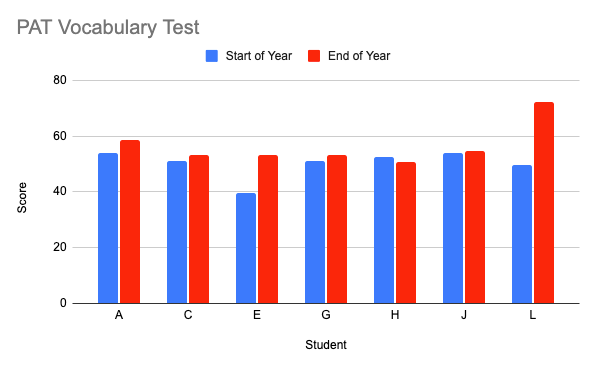
I compared the vocabulary test results for children who took both tests. Note that this test demonstrated ability to understand vocabulary through reading, a skill which we know these children are good at. Results showed that all children (except one) improved in their ability to understand a range of vocabulary they come across when reading. The one child who did not show an improvement stayed at relatively the same level.


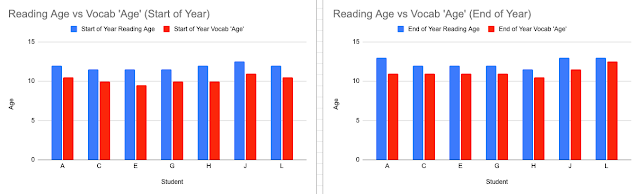
Next, I turned the PAT vocabulary test results (above) into an approximate 'age.' I wanted to see whether we have managed to close the gap between reading age and vocabulary level. Note, that the focus was to increase children's vocabulary levels in order to achieve this. You can see on the graphs that the gap for each child (difference between the blue and red column) does appear to be closing up for most children. 


 Unfortunately, I was unable to collect final term 4 data to show any increases in oral language of these children. However, I was able to collect a few second oral responses in term 3. These changes are explained in another blog post.

In all, I believe my focus on increasing speaking mileage with the support of speaking prompts has supported the children in the Extension class learning environment. It is something I highly recommend as a focus in all classrooms to support development of our children's oral language capabilities.

Thursday, 25 November 2021

Thinking ahead to 2022

The Achievement objective I am considering, is to improve the achievement of students with additional needs in the learning areas of English/key competencies using language symbols and texts.

I am in a unique position as the Creative Space and Extension teacher. I don’t have my own class but teach a programme for the year 5-8 extension children.

Prior to being in this position, I taught year 5 children. I absolutely loved that a group of children get to go out for Extension classes however, due to number limits, often wished we could give more opportunities for those children who weren’t in that group yet were still academically capable, skilled and could really benefit from additional opportunities. The Pt England Network news (PENN) is a great place for this to happen. Children have opportunities to present the news, learn how to be videographers and photographers, and learn skills around movie editing.

This year for my inquiry, I have been exploring the oral language capabilities of the year 5 and 6 children in my extension class and realised that there was a disparity between the language these children could recognise when reading and the oral language they were able to use when speaking. Many of these children had an output challenge. The children and I pin pointed the need for them to have many exposures to speaking and presenting with support and scaffolds. I have had some great success with these children in developing their oral language capabilities and confidence.

I would love to inquire around the development of oral language for the crew of news presenters. This could support reading, speaking and presenting, confidence and so much more for these children and it already is!

I want to encourage more teachers to be using video in activities for their children to share their learning. During lockdown, I was looking at a lot of student blogs and I found that in the junior classrooms, there was a lot more video being used for sharing learning than in the senior school. I would love to encourage more senior teachers to encourage video sharing by children as we go forward.

I want to inquire into the potential benefits which the use of video could have for the learning of children who are academically capable however need more oral language mileage. I want to target those children who are not in the extension group but who could benefit from this experience. Presenting on PENN  also has lots of potential for those children who are reading to learn and who need to develop confidence with their reading. 

The following inquiries could be used to support the importance of this inquiry:

MIT inquiry of the former Creative Space and Extension teacher, Sandy Lagitupu, who also inquired into the use of oral language and Paideia seminars for extension level children.

Anika Unka's flexi-connects, where there were discussions about learning between the teacher, whānau and child. I love that this is a real context for encouraging oral language for our children.

Poto Faalili brought a cultural lens to this where she explained the importance of talanoa to engage boys in her class. She emphasised the importance of commitment with this. It has to be regular. 

Amy Tofa, Clarelle Carruthers and  Robyn Anderson all talked about how limited oral language capabilities was associated with lack of confidence, self efficacy and frustration. 

A couple of years ago, Clarelle Carruthers inquired into the use of video to support Fluency. She had children listen to themselves speaking and found that they were able to pick up their errors through this process. The children could see the positives of their speaking which encouraged them to keep doing what they were doing.

This work would support Manaiakalani Pedagogy and kaupapa. The Learn-Create-Share pedagogy is absolutely present in the Pt England Network News. I would love to see more of children's personalities coming through from the children who are presenting.

I’d love to see more creativity with what and how we present the news to the school. I would love to work on an inquiry which inspires teachers to use more video and speaking opportunities for children to share their learning. 

Woolf Fisher research has strongly demonstrated that reading and writing mileage is so important for children’s learning. Through the Summer Learning Journey, we see how successful regular writing supports children’s learning. I want to see the same for oral language however it requires us to give the children lots of opportunities to talk. 

Research from Manaiakalani observations over the years has shown that we could be providing children with more varied opportunities to share their learning.  

How could I be supported in this Inquiry?

I have found the Kāhui Ako meetings extremely valuable in supporting my inquiry. Having the opportunity to talanoa and find similarities between each others inquiries is so important.

I would also like opportunities to run workshops for the PENN crew which is how I would like to spend some of my CoL release time. I think courses where I could meet with the crew as a group would be highly beneficial to support the children in forming goals and purpose for their learning through PENN.

I would like to be able to support and challenge other teachers to think about their learning experiences and whether we can include more voice and film into children’s blogging.

I think it would be really valuable to find people working across Manaiakalani schools who have a particular interest in film and video to first see what other teachers are currently doing to allow for oral language mileage but also find those teachers who are willing to incorporate more video and audio into their own classes. 

At the beginning of the year, I want to pin point those teachers who are also inquiring into oral language or use of speaking and presenting in their classrooms and then work with them to inquiry into this really important learning challenge.

Other Thoughts for my inquiry:

Ideas:

  • Focus on PENN - support for speaking and presenting/ school-wide learning opportunities through the news network. How does this support the children?

  • Year 1-2 children - minimal digital fluency/mother language development this year due to many circumstances - what might this look like next year? Could I run this programme myself as my CoL role or is this part of my creative space teacher role? Do I have time to be going into the year 1 classes myself? Maybe I could be doing this during my 2 hours of CoL release each week and working with the year 1-3 children?


Why?


  • PENN - leadership, support oral language development (speaking & presenting), how effective are the school-wide learning opportunities presented through PENN? What can I do more to develop quality learning through PENN? - Think Kea Kids News sort of thing.

  • Y1-3 children additional digital teaching/support: Teaching the mother language. 

    • Progress outcome 1 (by end of year 3): In authentic contexts and taking account of end-users, students participate in teacher-led activities to develop, manipulate, store, retrieve and share digital content in order to meet technological challenges. In doing so, they identify digital devices and their purposes and understand that humans make them. They know how to use some applications, they can identify the inputs and outputs of a system, and they understand that digital devices store content, which can be retrieved later.

    • iPads: drive, blogging, EE

    • iMacs: Students Room, Hyperstudio, Scratch (drawing tool part of scratch for y1-2 and drawing different costumes; y1-2 - Scratch Jr for simple coding; y3 begin to code on desktop Scratch). 

      • I want to avoid Scratch Jr for digital drawing as it is far too basic and restricts their drawing skills too much.


Other thoughts, after discussions with Fiona:

Show teachers links between oral language → Texts etc.

Ownership passed over more to the children.

Has to be helpful to the school.


Designing Learning With the End in Mind 

Literacy Exemplars

This is the site with examples from observations


Thursday, 18 November 2021

My Bursts in Bubbles Presentation

 Here is my Bursts in Bubbles 3 minute video to summarise my inquiry and findings this year:

Bursts in Bubbles 2021

During the Manaiakalani Kāhui Ako Bursts and in Bubbles event this afternoon, I took summary notes about the inquiries I felt I could utilise in my own current practice and incorporate with my own findings in my inquiry.


Anita Unka (Y1-2): How can I use feedback and feedforward in writing to build relationships with whānau, enabling greater shifts in student achievement for our tāmariki?

Gaps in oral language, limited vocabulary --> limited ideas when writing.
Writing flexi-connects - whānau on other end in a meet while teacher and child at school.
Through lockdown, the flexi-connects changed where the child was with their parent and Anita was on the other end of the call.

Poto Faalili (Y7&8): How will being culturally responsive in my teaching and an integrated approach to teaching and learning accelerate student achievement?

Engaging boys, particularly those that turn up to school late.
Student voice via talanoa.
Priority to see this group every morning at 8:30am. Changed to lunch with lunches. Well-being was important in this as well as talanoa about learning.

Amy Tofa (Y7&8): Will building self efficacy in students enable them to be more independent in Project Based Learning and accelerate their progress in Reading? 

Lack of self efficacy for completing project-based learning.
Lack of confidence.
Frank Paris to build self efficacy.
High anxiety impacts self efficacy.

Christine Tupou-Fonua (Y7&8): Can we make accelerated shifts in literacy through teaching identity & cultural competencies?

Coconut Model Work (see her blog)

Clarelle Carruthers (Y4): How will using a variety of high interest texts and providing open tasks impact students critical thinking?

Critical thinking and vocabulary.
Frustration by children was a big issue.
Whole class theme for reading each week to encourage more collaboration and vocabulary development.
For true critical learning to happen, the children need to be doing the work - remove the scaffolds.

Kelsey Parrant (Y5): Will a focus on vocabulary and interest specific texts have an impact on reading achievement for my learners reading below 8 years? 

Lack of understanding or strategies to understand meaning of vocabulary when reading.

Robyn Anderson (Y7&8): Will a focus on oral language in maths accelerate student confidence and capability to use spoken and written maths vocabulary and language?

Oral language and maths
Stepping in with scaffolds too early as the teacher wasn't helpful.
Robyn also developed some speaking prompts to support the children in learning to talk.
Giving children time to talk was essential.

Aimee Litchfield (Y1&2): How can I develop the use of oral language and use a wider range of vocabulary to see acceleration across all curriculum areas?

Unable to express themselves with more than one word.
Daily picture prompts.
Increase in vocabulary.
Next steps - to develop fluency.
Strongly implement learning in oral language through to writing.