Wednesday, 2 September 2020

The Concept Box (Peter Worley) - Attempting this in class

Today I trialled using the Concept Box, a teaching strategy which comes from Peter Worley's book, Once upon an if. It was a huge success! The children were engaged and I saw a vast difference in the amount of critical thinking occurring. We trialled it using the poem, The Square that Didn't Fit In, on page 172 of Once upon an if. Here are some of my observations/ notes from the learning experience. I have broken it up into the different elements of the Concept Box.

Comprehension Stage
Here are some of the comments that children made and questions they asked in this open conversation about the text:

- Couldn't the monster eat small circles? They'd fit.
- How did the monster get fooled?
- There are those crackers called shapes which come in lots of different shapes and sizes.
- Started talking about which shape they would like to be.

Lots of questions were asked by the children during this comprehension stage. I need to remind myself to sit back and observe rather than take part in the conversation.

Concept Fishing
Most children found this section of the Concept Box difficult. One child did a really good job of describing text however used a lot of detail. Here are the words they came up with to describe the text:

Different
Dumb
Confused
Personality
Confident
Life
Circle
Feeling
Purpose
Inside-out
Normal


Concept Funnelling
I got a bit confused at this point and combined this section with the final Exploring central concepts section. Next time, I will work at splitting these two sections up.  I need to remember that this section gives children a chance to share which one word they think is the best and why. Once have shared 5 words, move onto the last section.

The children gave some great explanations for and against the above words. We then filtered it down to:

Different
Normal
Personality
Purpose
expressing
feeling

 The children found it really trick to get the list down to five words. They finally decided to take 'feeling' out as they felt 'expressing' incorporated 'feeling.'

Next time, I will do a better job of splitting up Concept Funnelling and Exploring central concepts.

Thursday, 27 August 2020

Manaiakalani Create Staff Meeting

Several weeks ago, we had a Manaiakalani Create Staff Meeting. During this meeting, we each got to attend two workshops about creating digitally. Danni Stone and I ran a workshop on creating a times table quiz using scratch.

Coding is great in maths because of computational thinking - a skill that’s in both the maths and digital technologies curriculum. Creating a maths quiz in scratch is a great way to empower the students, encouraging sharing of learning and ako (teaching others).

Learning from this workshop (or these slides below) could be used by teachers to create a quiz as an independent task for the children to work on OR a task where the children create the game.

This was a great opportunity to share some knowledge, learn from others and to show some of the learning from the classroom.

Here are the slides from our workshop:


Tuesday, 25 August 2020

So what am I going to do differently?

Task: Write a reflection in which you summarise your main learning about your teaching and next steps. This will prepare you to design an intervention next time.

Hypothesis: A focus on critical thinking and causal reasoning when responding to texts will support increased levels of critical thinking and ability to create causal links in online written interactions with others for year 5 children reading between 10 and 12 years.


1. Choose a text - image or story with no words OR story read aloud.
2. At the start of the instructional time, provide a provocation/dilemma for the concept of this text.
3. Let children discuss, encouraging use of causal reasoning.
4. Move onto guided reading session.
5. Children go off and create a video diary entry, in pairs, responding to the provocation. Each person to take a difference stance - agree or disagree.

I feel that this will be a great introduction to new texts to get the children thinking and engaged. It will also provide the children an opportunity to practice their critical thinking. The video diary task at the end will give the children a chance to draw on the new ideas from their peers and share their learning on their blog.

Texts to support me with this:
- See links above
- Once upon an if: The storythinking handbook by Peter Worley
- The Philosophy Shop: Ideas, activities and questions to get people, young and old, thinking philosophically - edited by Peter Worley
- The Numberverse by Andrew Day
- Bloomsbury: Conversations and Controversies

Activity ideas:
- Bloomsbury - The If Machine

Once Upon an If by Peter Worley:

This text explains the use of stories to get children thinking deeply/critically. It teaches questioning. It also touches on The Concept Box.

There are different types of stories to consider. This will help me in forming a provocation or dilemma for particular texts.
- Myths/Legends: jump between fiction and non fiction. Explaining why things are as they are.
- Fables/ Parables: Teach a lesson or moral.
- Fairy tales: passed down through generations
- Anecdotes: short stories about things/events that have happened
- Humour stories: Jokes
- Tales with a twist: Not what you expect.
- 'What if' stories

The Concept Box (page 78-79, Once Upon an If by Peter Worley)
1. Read the text/story/poem OR could look at an image.
2. Comprehension Stage
     a) Talk with neighbour
     b) Free response to text (statement/question) - important for children to lead - sit back / observe.
3. Concept Fishing
     a) Talk with neighbour - what is the text about?
     b) Talk with neighbour - 1 word
     c) Share 1 word (key word) - each child to share.
4. Concept Funnelling
     a) Look at key words
     b) Choose best word to describe the text.
     c) Share both strongest word justifications and weakest word justifications.
     d) Get down to list of around 5 key words
5. Exploring central concepts
     a) Debate

Thursday, 20 August 2020

Season 2 of NZ's Lockdown

In a time full of seriousness and worry, there is some humour coming out. In particular, the 1pm daily update has made it onto IMDB, the well known international website reviewing movies and TV series. Amusingly, it has 2 seasons and has a rating of 9.6/10! Therefore, here I bring to you an update from inside season 2 of NZ's Covid-19 lockdown!

COVID-19: FMC's advice to clubs and backcountry users – FMC

We have made it through the first week back in lockdown up here in Auckland. The children have been amazing - the real stars of the show! We had 20 children show up to our daily google meet today and have had 31 active children posting, commenting and attending google meets. What a success!

Once again, this latest blip in the year 2020 has caused me to stop and rethink my professional inquiry for the year. After some consideration, I am determined to continue with my focus on children and their ability to think critically. The reason for this is that in many scenarios I am noticing how much our children could benefit from learning how to think deeper about their learning. Here are some examples from the last week:

During a google meet: During a conversation about food in Canada, one child ran to their kitchen and brought back a bottle of maple flavoured syrup. They confidently declared that they had some maple syrup. Here is an approximation of the conversation:

Child 1: "I have some maple syrup" [holding maple flavoured syrup up to the screen].
Child 2: "Miss West, I don't think that is real maple syrup."
Me: "Oh, why is that?"
Child 2: Because maple syrup comes from Canada.
Me: Can you think of any other reason why it might not be actual maple syrup?
[No response]
Me: What does it say on the front of the bottle?
Child 1: Maple flavoured syrup
[No elaboration]
Me: What do you think it means by maple flavoured?

From this point on, it required a lot of prompting from me for the children to be able to contribute to a critical discussion with causal reasoning. In a group of about 12 children, only 2 children contributed fully to the discussion. In this example, there were signs of one child thinking critically, however they struggled to elaborate, add causal reasoning and justify their critical thinking.

In other examples, when children were completing a task where they had to find facts about animals in Canada, many interesting facts were found however a level of causal reasoning/ critical thinking was lacking.

Examples:

"There are Polar Bears in Canada."
No elaboration. A response that could provide elaboration could be, "There are Polar Bears in Canada because Polar bears live in cold climates. Northern Canada has an extremely cold climate with snow and ice. Polar bears thrive in this climate and eat many animals that also live in this area."

"The marmot is the most endangered animal in Canada."
No elaboration. A response that could provide elaboration could be, "The marmot is the most endangered animal in Canada. This could be because of predators that eat the marmot or it could also be due to such issues as climate change or humans destroying parts of their habitat. To understand this more, we could look at whether temperatures have changed much in the area of Canada where the marmot lives or whether their habitat has been threatened by humans."

These are just examples. To get children showing this level of causal reasoning or critical thinking, I could create a causal chain template for the children to learn to use and work through when working on tasks. This causal chain template could be something to help the children when working independently. This will be important, particularly when we don't know how Covid-19 could impact us going forward. 

Wednesday, 5 August 2020

In-school Reading Professional Development

This term, we have begun some in-school reading professional development. This professional development has some overarching goals:

1. For learning to be transparent, explicit and cooperatively owned.
2. To have a shared understanding around best practise and a shared language in reading that is explicit and consistent.

There are some critical components of reading that we have to be aware of. We are using a number of resources to support us in this, including:

- Sheena Cameron and Louise Dempsey: The Reading Book

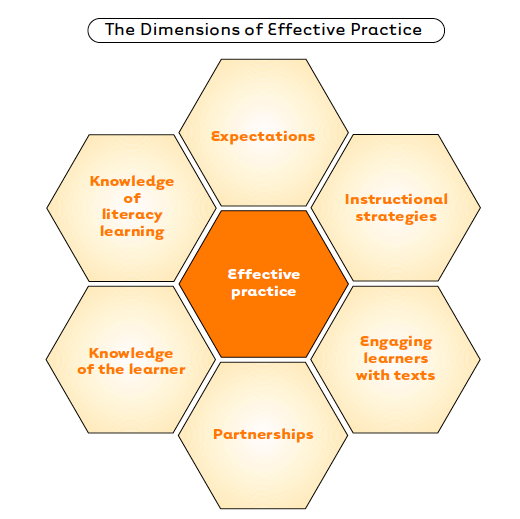
Dimensions of effective practice

This diagram shows the different dimensions of effective literacy practice. During this reading professional development, we will be focusing mainly on the instructional strategies section of this diagram.

After the first session, we were asked to go away and observe the errors that children in our target group were making.We needed to think about what they were doing, why they might be make that error and the needs of this particular child to move them away from making these errors.

Here are some of the patterns I noticed in a group of children reading at 8-8.5 years.

- 6/6 children showed signs of missing the middle of longer words. These children need strategies to attend to and correctly decode medial blends.
- 4/6 children showed signs of not attending to the ends of words. These children need strategies to support them in attending to the ends of the words.
- 5/6 children seemed to lack confidence when it came to decoding. This showed in a number of ways. Sometimes these children froze on challenging words and did not attempt to use any strategy to decode. Some children read extremely quickly and did not correct errors (either add ins or omissions). 2/6 children often added words in or omitted words and did not go back to correct themselves.

In my next blog post about in-school reading PD, I will explain strategies and prompts we are learning to support each of these above errors that are happening for these children.

Wednesday, 29 July 2020

How am I going to monitor my teaching and the children's learning?

Task: Write a reflection in which you summarise your main learning about your teaching and next steps. This will prepare you to design an intervention next time.

Hypothesis: A focus on critical thinking and causal reasoning when responding to texts will support increased levels of critical thinking and ability to create causal links in online written interactions with others for year 5 children reading between 10 and 12 years.

Based on the main learnings from observations of my teaching as well as articles by Richard Anderson that I have read, I created the following monitoring spreadsheet. Once I implement the intervention, this will allow me to efficiently keep track of children's levels of critical thinking and my teaching without taking away from the lesson. I will respond with a drop down response each week.  I have also created a tab on this same spreadsheet for my teaching, focusing on areas which I need to adapt, based on observations of my teaching.

Tuesday, 30 June 2020

Reflection: Summarise your main learning about your teaching and next steps

Task: Write a reflection in which you summarise your main learning about your teaching and next steps. This will prepare you to design an intervention next time.

Hypothesis: A focus on critical thinking and causal reasoning when responding to texts will support increased levels of critical thinking and ability to create causal links in online written interactions with others for year 5 children reading between 10 and 12 years.

Main learnings from peer observation and self assessment of my teaching practice:

Over the last few weeks, I have done both a self assessment and had a peer observation of my teaching practice. The focus of these observations was on how I encourage critical thinking and causal links in a reading group. Below are my main findings from this process:

1. I am often too quick to repeat or rephrase my questions. This doesn't give the children enough time to think and respond to what I have asked.

2. I need to be thoughtful and careful with the questions I ask so I provide a good prompt/provocation to get the children thinking but not too much to take over their ability to think critically.

3. I need to take a step back and allow the children to do more of the talking. This will be a fine balance because I still need to be providing support and teaching the children new strategies.

4. The children are quick to respond to me as the teacher but not so much to each other. The children do not tend to ask each other questions. It is very much a conversation between each of them and me. The experience needs to be more of a network where the children feel they can ask and respond to everyone in the group.

Network Totally

Next steps:

- Observe a number of teachers taking reading groups of a similar level to this group. Observe the types of questions these teachers ask and how they encourage the children to do the thinking.

- Encourage the children to respond to each other and to ask each other questions from the text.


- Encourage more causal links by the children. Teach a number of ways that this could look. They don't just have to use the word 'because.'